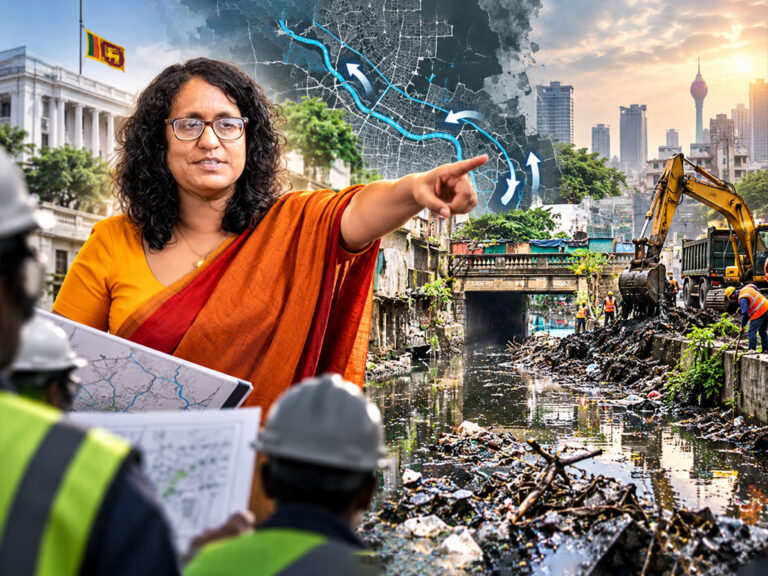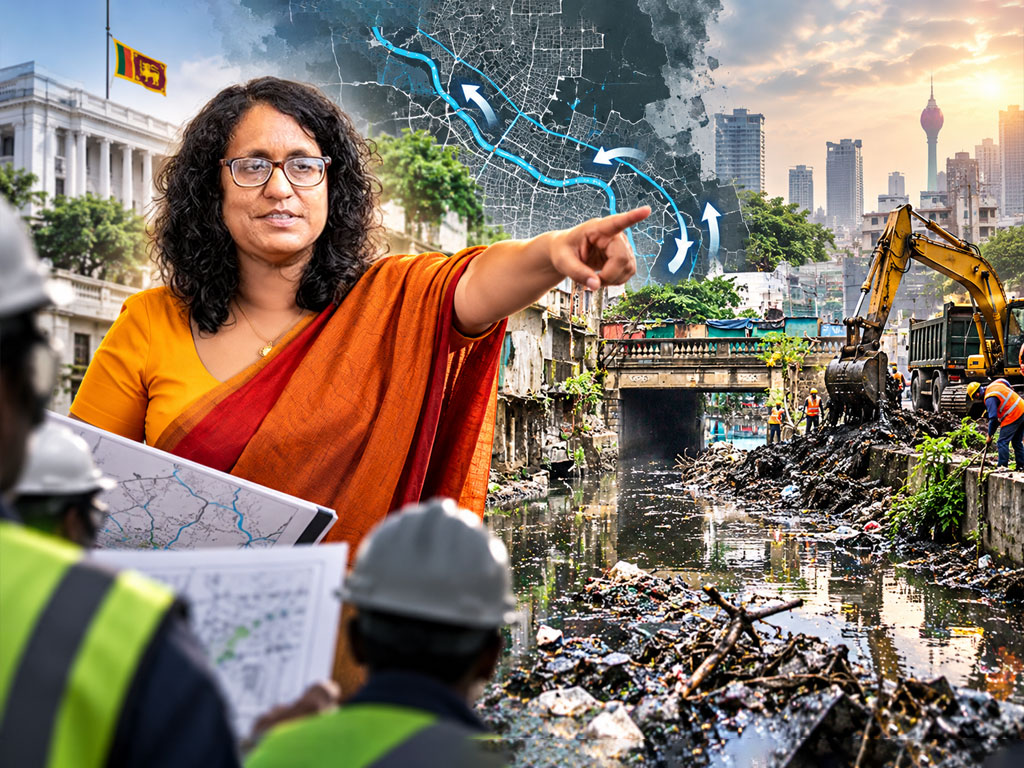
Colombo canal cleaning faces a two-week deadline from the Prime Minister, raising questions about maintenance duties, public spending and accountability.
With the Prime Minister ordering an urgent cleanup of Colombo’s drainage network, questions are mounting over why institutions already legally responsible for maintaining canals and stormwater drains require another government directive to perform their routine duties.
COLOMBO, October 15, 2026 – Prime Minister Dr. Harini Amarasuriya’s directive to cleanup Colombo’s canals and drainage systems within two weeks has brought renewed attention to a longstanding question of public accountability: who is responsible for ensuring that the capital’s waterways remain clean and functional in the first place?
The instruction, issued at the Colombo District Coordinating Committee meeting on October 13, requires the relevant authorities to complete cleaning operations within a fortnight and maintain the systems regularly thereafter.
However, while the Prime Minister’s intervention has been presented as an urgent measure ahead of anticipated heavy rainfall, the responsibility for maintaining these drains and canals is neither new nor undefined.
The Colombo Municipal Council (CMC), Sri Lanka Land Development Corporation (SLLDC), and other designated government agencies already possess established responsibilities for maintaining the city’s drainage infrastructure.
The latest directive therefore raises questions about the effectiveness of existing maintenance programmes, institutional coordination, public spending and the oversight exercised by those entrusted with protecting Colombo from preventable flooding.

Prime Minister Orders Immediate Action Ahead of Heavy Rains
At the October 13 meeting held at the District Secretariat in Narahenpita, Prime Minister Amarasuriya instructed officials to accelerate the cleaning of canals and drainage systems throughout Colombo District.
The directive comes amid concerns that increasing rainfall could overwhelm the drainage network, particularly in low-lying and densely populated areas.
Officials from Divisional Secretariats, the Department of Agrarian Development and the Provincial Irrigation Department reportedly highlighted several obstacles affecting their operations.
These included shortages of technical personnel and difficulties in preparing project plans and cost estimates.
The Prime Minister also emphasised that cleaning should not stop after the two-week exercise but should continue as part of regular maintenance.
That final instruction raises a particularly relevant question.
If continuous maintenance is already an assigned responsibility of the authorities concerned, why must the country’s Prime Minister personally instruct them to undertake it?
The reported directive sets an approximate deadline of October 27, 2026.
Colombo Municipal Council Has an Established Duty to Maintain Drains
The Colombo Municipal Council’s own published description of its engineering services provides a clear indication of where responsibility lies for municipal drainage.
According to the CMC website, its Drainage Division operates through six district offices tasked with operating and maintaining stormwater lines and sewerage infrastructure within Colombo city limits.
The responsibilities of its district drainage engineers specifically include periodic cleaning of gullies and stormwater lines, preventive maintenance and minor drainage construction.
These are established municipal functions, not extraordinary activities undertaken only after instructions from national political leaders.
The distinction matters because Colombo residents rely on these drainage systems to prevent roads, residential properties, commercial establishments and public spaces from becoming inundated during heavy rainfall.
Blocked roadside drains, accumulated sediment, rubbish and neglected stormwater channels can reduce the effectiveness of the drainage network, although flooding may also arise from inadequate capacity, extreme rainfall and other factors.
The CMC’s responsibility within its municipal limits therefore raises legitimate questions about how frequently drains are inspected, cleaned and maintained.
The Mayor of Colombo, as the elected head of the municipal council, has an important political and oversight responsibility to ensure that municipal services are functioning effectively.
Operational responsibilities, however, are exercised through the Municipal Commissioner, engineering departments and the relevant municipal officers.
Consequently, accountability must extend beyond any single elected official to include the administrative machinery responsible for planning, executing and supervising drainage maintenance.
It would nevertheless be inaccurate to suggest that the CMC is responsible for every canal in Colombo District, which extends beyond the municipal boundaries.
Sri Lanka Land Development Corporation Is Responsible for Major Canal Maintenance
While the CMC manages municipal drainage infrastructure, the Sri Lanka Land Development Corporation has a separate and substantial responsibility for maintaining Colombo’s canal network.
The corporation’s official Drainage and Reclamation Division identifies maintenance of approximately 44 kilometres of major canals and 54 kilometres of minor canals as one of its principal functions.
Its separate annual maintenance webpage lists 44 kilometres of main canals and 52 kilometres of secondary canals, indicating a small inconsistency in the published network figures.
The SLLDC’s statutory functions include the management, improvement, maintenance and control of canals, together with measures to prevent canal pollution.
These responsibilities are rooted in legislation governing the corporation rather than being dependent on instructions issued during district coordination meetings.
Where drainage systems are directly under the SLLDC’s jurisdiction, the corporation is responsible for carrying out the relevant maintenance activities.
This includes work necessary to maintain the effectiveness of canals that carry stormwater through Colombo and surrounding areas.
It also highlights the importance of clearly identifying which authority controls each particular waterway.
Without such information, responsibility can become blurred between municipal authorities, central government institutions and other agencies.
For residents whose neighbourhoods experience recurring flooding, however, the distinction between institutions offers little practical relief unless the agencies coordinate their work effectively.
Government Admitted in July 2025 That Several Canals Were Not Being Maintained
Perhaps the most significant aspect of the present controversy is that the Government had already acknowledged shortcomings in canal maintenance more than a year before the Prime Minister’s latest intervention.
On July 7, 2025, the Cabinet of Ministers approved a project under the Clean Sri Lanka programme to improve the maintenance of reservoirs and waterways in the Western Province.
The official Cabinet decision specifically acknowledged that numerous canals in Colombo North and densely populated areas of the city were not being maintained by any government agency.
The Government consequently approved a project to clean neglected secondary canals and increase the frequency of maintenance along the city’s main waterways.
The Sri Lanka Land Development Corporation was designated to implement the programme.
Its objectives included reducing flooding, improving public health, maintaining cleaner waterways and improving environmental conditions.
This earlier Cabinet decision is particularly relevant to the Prime Minister’s latest directive.
If the Government formally recognised the problem in July 2025 and approved a programme to address it, what progress was achieved during the subsequent 15 months?
Were the previously neglected canals brought under a regular maintenance system?
Were the necessary resources and funds provided?
And if the programme was implemented, what specific cleaning requirements remain outstanding in October 2026?
The Cabinet decision confirms that a maintenance problem existed and that the Government approved an intervention. However, it does not, by itself, establish whether the programme was subsequently implemented successfully.
Those questions require updated information from the SLLDC and the relevant ministries.
Another Rs. 1.23 Billion Approved for Canal-Clearing Equipment in September 2026
An additional Cabinet decision, taken less than a month before the Prime Minister’s directive, adds a financial dimension to the issue.
On September 21, 2026, the Cabinet approved a proposal to purchase vehicles and machinery for the SLLDC at an estimated cost of Rs. 1.233 billion.
According to the official Cabinet record, the General Treasury agreed to provide Rs. 625 million as an equity contribution towards purchasing machinery, with the balance to be met through the corporation’s own funds.
The proposed equipment includes smaller machinery intended to clear narrow canals that contribute to urban flooding.
The decision indicates government recognition that existing operational capacity needs strengthening.
However, Cabinet approval does not necessarily mean that the equipment has already been purchased, delivered or deployed.
The status of the procurement process, the expected delivery schedule and the intended deployment areas have not been established in the documents examined.
Nevertheless, the September approval raises further questions about whether equipment limitations have contributed to the maintenance difficulties acknowledged by officials.
Taken together, the July 2025 maintenance programme, the September 2026 machinery approval and the October 2026 emergency directive reveal an issue that has repeatedly required government attention.
What remains to be determined is whether these interventions have translated into measurable improvements on the ground.
Where Does the Mayor of Colombo Stand?
The Mayor of Colombo and the Colombo Municipal Council have an important role in ensuring that municipal drainage services function as intended.
The Mayor cannot reasonably be held operationally responsible for every major canal administered by the SLLDC or every waterway within the wider Colombo District.
However, the CMC’s clearly published responsibility for maintaining its own stormwater lines and drains means the council’s performance is open to legitimate public scrutiny.
When the Prime Minister orders urgent cleaning, municipal authorities should be able to explain the condition of their existing drainage infrastructure and identify what additional work is necessary.
This includes providing information on routine cleaning schedules, inspection reports, identified obstructions, maintenance budgets and outstanding complaints.
Similarly, the SLLDC should be able to identify the canals under its control and disclose whether they have been maintained according to established schedules.
Responsibility must therefore be assessed institution by institution, rather than treating the entire drainage network as the duty of a single political officeholder.
Equally, references to decisions made at district coordinating meetings should not obscure the fact that routine maintenance is an existing administrative obligation.
Two Weeks to Clean, But Who Will Monitor the Results?
The Prime Minister’s directive places the immediate focus on completing the cleaning exercise by approximately October 27.
Yet there is a distinction between conducting an emergency cleaning campaign and maintaining a drainage system throughout the year.
Removing rubbish and accumulated vegetation may provide short-term improvements, but effective flood management also requires regular inspections, sediment removal, functioning outlets, sufficient drainage capacity and coordination between agencies.
The maintenance programme must also account for the increasing intensity of rainfall.
The Disaster Management Centre has already raised concerns about whether existing drainage infrastructure is adequate to cope with extreme rainfall, stressing the need for preventive planning and improvements where necessary.
This means that even fully cleaned drains cannot be assumed to eliminate flooding if the underlying infrastructure lacks sufficient capacity.
It also means that measuring the success of the Prime Minister’s directive should go beyond counting the number of canals cleaned.
Authorities should establish whether water can flow effectively through the network and whether cleaning operations will be repeated at appropriate intervals.
Public Accountability Must Extend Beyond Emergency Instructions
The latest directive offers an opportunity for the Government to clarify the responsibilities of the various agencies managing Colombo’s drainage infrastructure.
It also presents an opportunity to publish maintenance schedules, expenditure information and progress reports that allow the public to assess what has been achieved.
The questions are straightforward.
How much was spent on drainage and canal maintenance during 2025 and 2026? What happened to the maintenance programme approved in July 2025? Which agency is responsible for each neglected waterway? What obstacles remain unresolved? And who will be answerable if the two-week deadline is missed?
These are questions of public administration and accountability rather than matters of political interpretation alone.
The Morning Telegraph has not established that any particular official or institution deliberately neglected its duties. Nor do the publicly available documents reviewed establish the precise extent of any unfinished maintenance work.
They do, however, confirm that responsibilities already exist, that the Government previously recognised gaps in canal maintenance, and that further urgent intervention has now been ordered.
Ultimately, Colombo’s canals and drains should not have to wait for an approaching period of heavy rainfall or an instruction from the Prime Minister before receiving the routine attention they require.
The real measure of success will not simply be whether the canals are cleaned within the next two weeks.
It will be whether the responsible institutions can demonstrate that regular maintenance is taking place afterwards, without the need for another emergency directive.
For Colombo’s residents, the question is no longer merely who will clean the drains by October 27. It is why an essential public service requires repeated high-level intervention when the responsibility for carrying it out already exists.