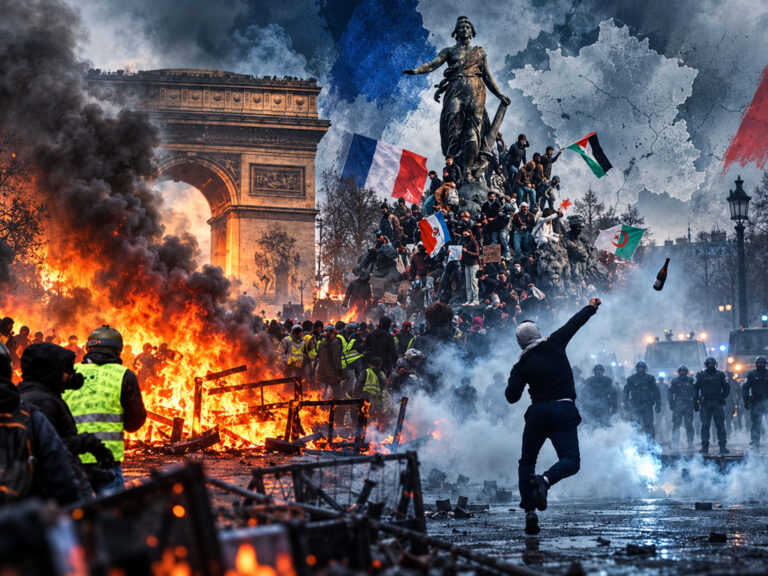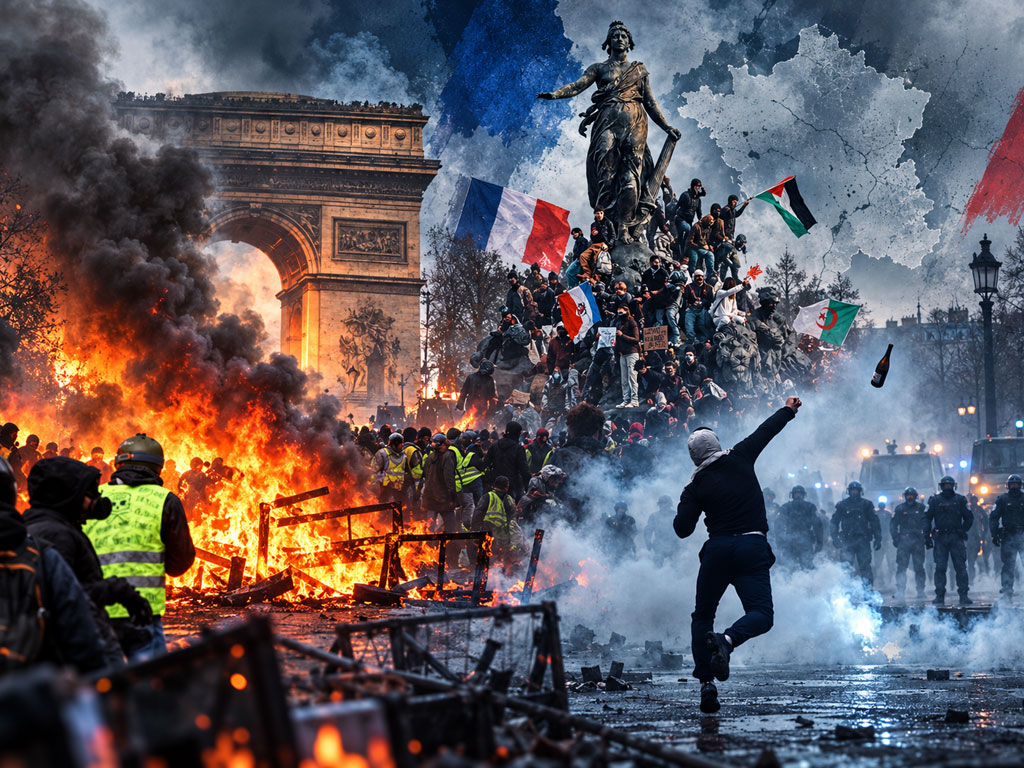
PARIS — What began as a student-led campaign demanding better classrooms, more teachers and increased education funding has developed into one of France’s most serious episodes of civil unrest in recent years, with widespread demonstrations accompanied by arson, looting, attacks on public buildings and thousands of arrests.
The violence of October 17 and 18 exposed the widening distance between those seeking improvements to public services and groups prepared to exploit mass demonstrations for confrontation, destruction or criminal activity.
Government buildings, shops, vehicles and public infrastructure were attacked across several French cities, including Paris, Lyon, Marseille, Bordeaux and Limoges.
French authorities have reported more than 2,400 arrests during the wider unrest, while substantial damage to businesses and municipal property has prompted emergency security measures and investigations into the police response.
Yet the original grievances have not disappeared. Students continue to demand improvements in education, while workers and other demonstrators are protesting over living costs, public expenditure and economic inequality.

How the Student Protests Began
The demonstrations emerged from a series of protests organised by French secondary-school students concerned about deteriorating conditions in education.
Their complaints included ageing school buildings, damaged classrooms, insufficient teaching staff, overcrowded facilities and inadequate resources.
Among their demands were:
- Repairs to classrooms, roofs, windows and other school infrastructure.
- More teachers and reduced classroom overcrowding.
- Increased government investment in public education.
- Improved educational facilities and support services.
- More accessible financial assistance for students continuing their education.
France has a substantial publicly funded education system, with tuition-free public schooling and relatively low tuition charges at many public universities.
School meals are also subsidised, although families may pay different amounts depending on local arrangements and household circumstances.
Nevertheless, the existence of a publicly funded system does not mean that individual institutions are adequately maintained or staffed.
Students and their supporters argue that additional resources are necessary to address inequalities and deteriorating conditions.
The protests also reflect a broader debate about national spending priorities, including whether education and other public services should receive greater financial support relative to defence expenditure and tax concessions.
These questions are legitimate matters for democratic debate, irrespective of the violence that later accompanied the demonstrations.
From Peaceful Marches to Street Violence
The October 17 demonstrations attracted substantial participation across France.
Estimates cited by news agencies ranged from approximately 550,000 to 800,000 demonstrators attending more than 100 marches and gatherings.
Most participants demonstrated peacefully.
However, serious disturbances occurred when groups attacked police, damaged public property, set fires and looted commercial premises.
Reports described barricades, burning vehicles and vandalised shops in several cities.
The destruction extended beyond national government property to local businesses, public transport infrastructure and community facilities.
Small retailers and other businesses suffered losses unrelated to the demands of the original student movement.
The violence illustrates a fundamental distinction: support for better education and public services does not amount to support for attacks on businesses, public buildings or individuals.
Nor can everyone attending a demonstration be held responsible for offences committed by particular participants.
Lyon and Limoges Among Cities Hit by Destruction
Lyon experienced some of the most serious damage.
On October 17, rioters attacked the tourist office pavilion at Place Bellecour, setting the municipal building on fire.
The City of Lyon subsequently condemned the destruction, describing the attack as an exceptionally serious incident involving a building associated with the city’s heritage and public life.
Local authorities reported that commercial premises, street furniture and other public spaces were also damaged.
Limoges suffered an attack on its historic municipal building, with investigators subsequently pursuing suspects connected to the fire.
The incident became one of the most prominent symbols of the violence.
Public buildings represent more than administrative property. They provide services financed through taxation and belong, in a civic sense, to the communities they serve.
Their destruction creates costs that ultimately fall upon public authorities, businesses and residents.
The attacks also affect workers, including employees of shops, restaurants and other establishments who may face temporary closures or lost income.
Who Was Responsible for the Rioting?
Determining responsibility requires separating identifiable criminal conduct from political affiliation, nationality and ethnicity.
French authorities have accused radical far-left elements and opportunistic offenders of contributing to the violence.
Interior Ministry statements and contemporary reporting also point to the difficulty of policing decentralised demonstrations involving participants with different motivations.
Some demonstrators attended to support education reform, while others protested against the rising cost of living, declining public services or wider government policies.
Labour organisations, left-wing political activists and supporters associated with the Yellow Vest movement were also among those participating in protests.
But membership of a political organisation, participation in a demonstration or support for a particular political position does not establish responsibility for rioting.
Similarly, allegations circulating online that immigrant communities collectively organised the violence have not been substantiated by the available evidence.
France’s criminal justice authorities must establish the actions of individual suspects through investigations and prosecutions.
Attributing collective responsibility to an ethnic, religious or immigrant population would obscure the identification of the actual perpetrators.
Immigration Becomes Part of the Political Debate
The unrest has reignited arguments over immigration, integration and national identity.
France has a long history of immigration, shaped partly by its former colonial relationships, labour requirements and family migration.
Communities with origins in Algeria, Morocco, Tunisia, Portugal, Italy and numerous other countries form part of contemporary French society.
According to the French national statistics agency INSEE, the country had approximately 7.97 million immigrants in 2025, representing 11.6% of its population of about 68.85 million.
Approximately 6.30 million residents were foreign nationals, accounting for 9.1% of the population.
These are different statistical categories. An immigrant may have acquired French citizenship, while a foreign national may have been born in France.
Immigration statistics do not identify the people responsible for the October riots.
The existence of unemployment, welfare dependency or criminal activity in particular neighbourhoods cannot, without specific evidence, justify generalisations about entire national or religious communities.
Nevertheless, questions concerning social integration, poverty, unemployment, housing conditions and public security remain important policy issues.
France’s challenge is to address them through reliable evidence and consistent application of the law rather than collective accusations.
Cultural Identity and Secularism Remain Contentious
France’s commitment to secularism, commonly known as laïcité, has long influenced its approach to religion in public institutions.
The 2004 law regulating conspicuous religious symbols in public primary and secondary schools was introduced within that secular framework.
Its restrictions concern conspicuous religious signs and attire, rather than amounting to a general prohibition on Christianity or the disappearance of French cultural heritage.
The legislation has nevertheless generated disagreement over religious freedom, personal identity and the relationship between the State and faith communities.
For some, secularism protects equality by preventing public institutions from favouring one religion.
Others argue that certain restrictions can disproportionately affect religious minorities or limit individual expression.
These debates are relevant to France’s wider political environment, but they should not be confused with evidence about responsibility for the October violence.
France’s cultural identity has evolved through centuries of religious, political and demographic change. Whether that evolution constitutes enrichment or erosion is a subject of political disagreement, not a conclusion established by the riots.
International Causes and Political Symbols
Some demonstrations have included political messages extending beyond education and living costs.
Protesters have raised questions about military expenditure, foreign aid and France’s involvement in international affairs.
Palestinian flags and keffiyehs have also appeared at demonstrations.
Such symbols can represent solidarity with Palestinians or opposition to particular foreign policies. Their presence does not, by itself, demonstrate support for violence or participation in criminal activity.
Swedish climate activist Greta Thunberg joined French students during demonstrations on October 13, attracting attention to the campaign beyond France.
Her participation was reported in connection with demands for improved school conditions.
The appearance of international activists or political symbols at demonstrations reflects the range of causes embraced by some protesters.
However, claims that foreign governments, including Iran or Russia, directed the October riots require verifiable evidence. No such role is established by the material reviewed for this article.
Government Faces Pressure Over Security Failures
The French Government has acknowledged weaknesses in its response to the unrest.
Prime Minister Sébastien Lecornu and senior security officials have faced criticism over intelligence failures, police deployment and the ability of violent groups to exploit demonstrations.
Authorities have introduced targeted curfews in affected areas and announced additional security measures.
A parliamentary inquiry and police investigations are expected to examine the circumstances surrounding the violence and the effectiveness of the official response.
The Government must also address concerns about the conduct of law enforcement officers.
Reports of injuries caused by police weapons, including serious injuries sustained by demonstrators, have prompted calls for independent scrutiny.
Protecting the public from arson, violence and looting does not remove the obligation to use force lawfully and proportionately.
Likewise, the constitutional right to demonstrate does not provide immunity from prosecution for assault, theft or deliberate destruction.
France’s Deeper Political and Social Challenge
The unrest has exposed several problems that cannot be resolved through arrests alone.
France faces disputes over the cost of living, investment in education, public services, economic inequality and the effectiveness of its political institutions.
Immigration and integration remain politically divisive, but those issues require evidence-based policy rather than assumptions that associate national origin with criminal behaviour.
For communities affected by the riots, the immediate priorities are rebuilding damaged premises, restoring services and ensuring public safety.
For students, the concern is whether the demands that inspired their protests will be addressed once the violence subsides.
For the Government, the challenge is to distinguish between peaceful dissent and criminal disorder while avoiding measures that unnecessarily restrict civil liberties.
The October unrest demonstrates how legitimate public grievances can become overshadowed when demonstrations are accompanied by violence.
France’s response will be judged not only by the number of people prosecuted or the effectiveness of its security operations, but also by whether the authorities address the underlying problems that brought hundreds of thousands of people onto the streets.
The central question is whether the country can restore public order without allowing the destruction to silence the original calls for reform.