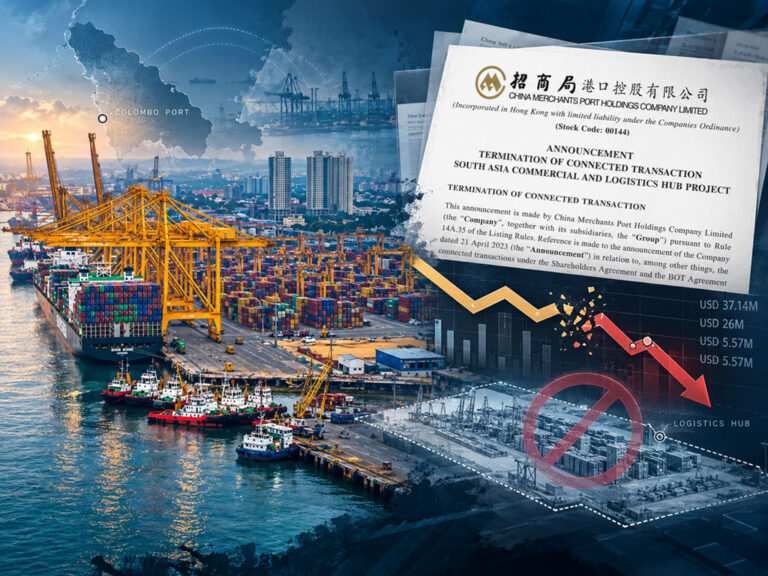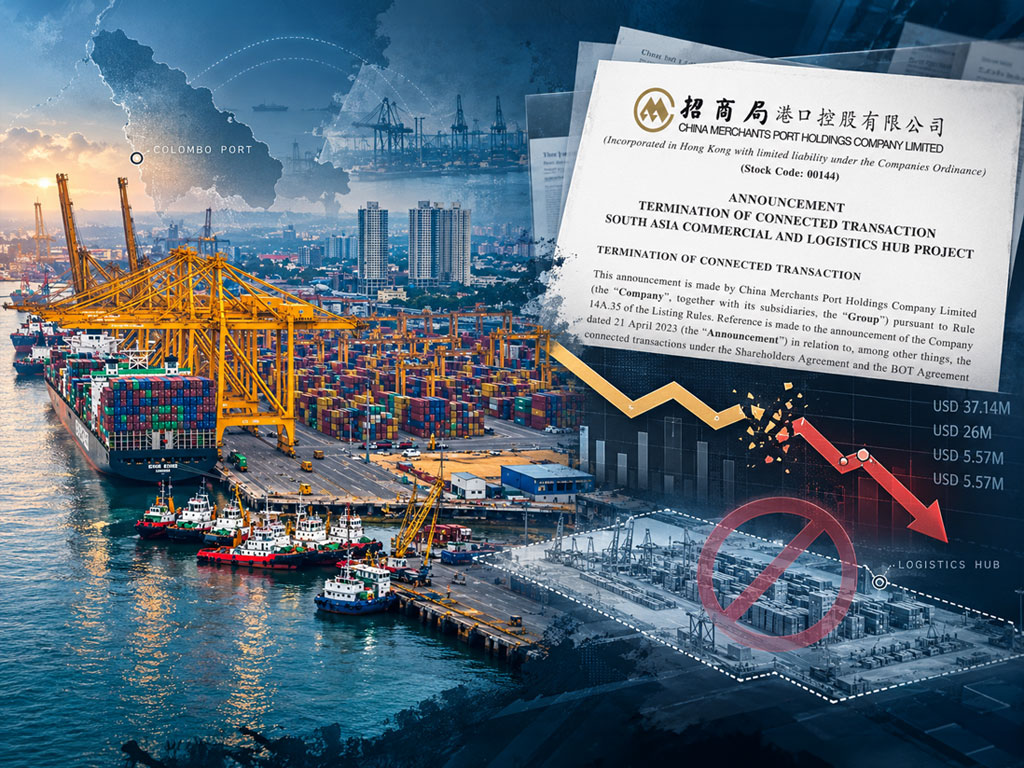
COLOMBO — A major Chinese-backed logistics development at the Port of Colombo has been abandoned after more than three years without construction progressing as originally planned, leaving the Sri Lanka Ports Authority (SLPA) facing a US$21.905 million settlement payment and seeking new investors for the strategically important project.
China Merchants Port Holdings Company Limited announced on October 15, 2026, that the partners in the South Asia Commercial and Logistics Hub (SACLH) had agreed to terminate the venture, citing changes in external circumstances, project implementation conditions, timelines and commercial considerations.
The development, announced in 2023 with a reported investment value of approximately US$392 million, was intended to establish one of South Asia’s largest commercial logistics complexes at Colombo Port.
However, the SLPA has subsequently described the proposed venture as a US$280 million development, creating a discrepancy between the original publicly reported investment estimate and the authority’s latest description.
The cancellation ends the existing joint venture rather than the broader ambition to establish a modern logistics hub at the port. The SLPA has announced that it intends to pursue a replacement project through competitive bidding under a public-private partnership model.

Who Owned the Colombo Port Logistics Project?
The original venture involved three shareholders operating through a project company established in 2023.
China Merchants Port Holdings participated through its wholly owned subsidiary, Fortune Centre Group Limited (FCGL), which controlled 70% of the company.
The Sri Lanka Ports Authority and Sri Lankan construction company Access Engineering PLC each held a 15% stake.
The project was structured around a 50-year build-operate-transfer (BOT) arrangement, under which the developers would construct and operate the proposed facility before transferring it under the terms of the agreement.
Plans envisaged a five-storey logistics complex providing approximately 150,000 square metres of floor space for commercial storage, distribution and value-added maritime services.
In December 2023, the Government granted the development Strategic Development Project status, together with investment incentives that reportedly included exemptions from corporate income tax and dividend-related taxation for 15 years.
Despite these arrangements, the project did not advance to the construction stage envisaged when the partnership was established.

Who Pays for Colombo Port’s Cancelled $392M Chinese Deal?
The cancellation of a 50-year Chinese-backed logistics agreement has left the Sri Lanka Ports Authority facing a US$21.9 million settlement. Who ultimately pays?
READ FULL STORYUS$37.14 Million Invested Before Cancellation
The October 15 disclosure to the Hong Kong Stock Exchange provides a breakdown of the capital injected by the shareholders.
According to the project’s audited financial statements as at December 31, 2025, the three investors had contributed US$37.14 million in equity capital.
The contributions were:
| Shareholder | Ownership | Equity contributed |
|---|---|---|
| Fortune Centre Group Limited | 70% | US$26 million |
| Access Engineering PLC | 15% | US$5.57 million |
| Sri Lanka Ports Authority | 15% | US$5.57 million |
| Total | 100% | US$37.14 million |
These amounts represent capital actually injected into the project company, rather than the total investment originally proposed for constructing and operating the facility.
The distinction is important because the project’s cancellation does not mean that the entire US$392 million announced in 2023 had already been invested or lost.
How the US$21.905 Million Settlement Works
The termination agreement provides for the repayment and distribution of certain project-related funds among the shareholders.
Under the settlement, the SLPA agreed to make a one-time payment of US$21.905 million to the project company within 30 days of signing the agreement.
The amount was calculated from a US$26 million settlement basis after accounting for two liabilities:
- US$3.9 million in value-added tax, which the SLPA stated had already been settled with Sri Lanka’s Inland Revenue Department.
- US$195,000 in overdue payment liabilities, which the authority was expected to settle.
After those deductions, the remaining amount was US$21.905 million.
Separately, the project company’s audited accounts showed approximately US$7.85 million in distributable cash as at December 31, 2025.
Both amounts are to be distributed among the shareholders according to their respective ownership interests.
The total amount available for distribution under these arrangements is approximately US$29.755 million.
Based on the agreed proportions, the anticipated distributions are approximately:
| Recipient | Expected distribution |
|---|---|
| Fortune Centre Group Limited | US$20.83 million |
| Access Engineering PLC | US$4.46 million |
| Sri Lanka Ports Authority | US$4.46 million |
| Total | US$29.75 million |
The figures are rounded. Crucially, the US$21.905 million is not a payment solely to the Chinese investor. It is payable to the project company before distribution among all three shareholders.
The arrangements also mean that the SLPA is both the authority making the settlement payment and a shareholder entitled to receive a portion of the distributed funds.
The Hong Kong disclosure specifies the agreed treatment of these funds but does not, by itself, establish the overall net financial cost to Sri Lanka after accounting for all previous expenditure, tax payments, recovered capital and associated obligations.
Why Did China Merchants Abandon the Project?
In its regulatory announcement, China Merchants Port Holdings identified changes in external circumstances, the implementation environment, the project timetable and the commercial interests of the parties as reasons for ending the agreement.
The company stated that termination had been assessed as being in the interests of the parties involved.
The agreement covers the early termination of the shareholders’ agreement, the BOT agreement and the site lease.
These contractual developments indicate that the original structure for implementing the project is being dismantled.
However, the company’s disclosure does not attribute the cancellation exclusively to Sri Lankan government policy, taxation, foreign investment restrictions or a dispute with any particular stakeholder.

Government Says the Project Failed to Progress
Ports, Civil Aviation and Power Minister Anura Karunathilaka offered a more specific explanation in comments attributed to him by BBC Sinhala.
According to the supplied account, the Minister said the project had been approved in 2023 but had failed to progress beyond the preliminary stages.
He maintained that the Chinese investor had not taken the steps necessary to implement the development, prompting the decision to terminate the existing agreement and create opportunities for a new project.
Karunathilaka also explained that the settlement concerned capital previously contributed by the shareholders, with relevant tax and overdue payment liabilities deducted before the remaining funds were distributed.
His position was that the cancellation would allow the Government to restart the logistics hub development under a different arrangement.
The detailed remarks attributed to the Minister should be read alongside the company’s formal disclosure, which describes a broader set of commercial and implementation considerations.
The independent verification of the complete BBC Sinhala interview remains outstanding.
SLPA Plans New Logistics Hub Under PPP Model
Following the termination announcement, the Sri Lanka Ports Authority confirmed that it intended to pursue a new logistics facility at Colombo Port through a public-private partnership.
The proposed development will be subject to the required approvals and a competitive tendering process.
According to the SLPA, the new project will seek to establish a modern logistics facility capable of accommodating a wide range of port-related and value-added commercial activities.
Its objective is to strengthen Colombo’s position in international maritime trade by expanding the range of services available beyond conventional container transshipment.
Potential activities associated with such a development include cargo consolidation, warehousing, distribution and other logistics services connected to regional supply chains.
The authority has indicated that the cancellation of the previous joint venture does not represent an abandonment of its broader port development strategy.
However, the new proposal will require fresh investor participation, workable financing arrangements and an implementation schedule capable of avoiding the delays that affected the original project.
What the Cancellation Means for Sri Lanka
The withdrawal of an established international port operator from a major proposed development is significant for Sri Lanka’s ambitions to become a regional logistics centre.
Colombo Port already occupies an important position in maritime trade, and the expansion of logistics services could help the country capture additional economic value from cargo passing through its terminals.
The cancellation introduces several immediate considerations.
First, the proposed investment has not materialised according to the original timetable, postponing the expected economic benefits of the facility.
Second, the settlement arrangements create financial obligations that require transparent accounting, particularly because the SLPA is a publicly owned institution.
Third, the new tendering process must address the factors that prevented the earlier development from progressing.
The precise economic value of the delayed project cannot be established merely from its announced investment figure, and any calculation of lost revenue, employment or commercial activity would require additional evidence.
Nevertheless, the episode demonstrates the importance of converting investment announcements into functioning infrastructure.
The immediate test for the SLPA will be whether it can attract a new development partner, complete the necessary approvals and move the proposed logistics hub towards construction.
Until then, a project once presented as a major addition to Sri Lanka’s maritime economy remains an unrealised investment opportunity, with its original partnership dissolved and its replacement still awaiting implementation.