COLOMBO, October 19, 2026 — The cancellation of a 50-year Chinese-backed logistics agreement has left the Sri Lanka Ports Authority facing a US$21.9 million settlement. But who approved the original commercial restrictions, what will taxpayers ultimately bear, and did regional geopolitical pressure influence the decision?
The cancellation of a proposed US$392 million Chinese-backed logistics complex at Colombo Port has brought renewed scrutiny to the commercial concessions granted to foreign investors, the Sri Lanka Ports Authority’s financial obligations and the possible influence of regional geopolitical interests on one of the country’s most valuable economic assets.
Under a settlement announced by China Merchants Port Holdings (CMPort) on October 15, the Sri Lanka Ports Authority (SLPA) has agreed to pay US$21.905 million within 30 days to bring the South Asia Commercial and Logistics Hub (SACLH) project to an end.
The abandoned venture would have given a Chinese-controlled consortium operating rights over a major logistics facility for 50 years, supported by generous tax concessions and contractual restrictions affecting competing services.
China Merchants cited changes in external circumstances, project implementation conditions, timelines and commercial considerations as reasons for terminating the venture.
Those explanations, however, leave unanswered questions about the original agreement, the financial consequences of its cancellation and whether wider competition between India and China played any part in the decision.

A 50-Year Agreement With Sweeping Commercial Concessions
The proposed five-storey South Asia Commercial and Logistics Hub was designed to expand Colombo Port’s warehousing and cargo-handling capabilities.
Its ownership structure gave CMPort, through its subsidiary Fortune Centre Group Limited, a controlling 70% stake. The SLPA and Access Engineering PLC each held 15%.
The project was approved as a Strategic Development Project in December 2023, providing exemptions from corporate income tax and dividend tax for 15 years.
More controversially, the agreement reportedly contained provisions restricting the SLPA from permitting competing logistics and warehousing services at rates below those established under the project company’s royalty arrangements.
Such restrictions raise an important question about the commercial freedom of Sri Lanka’s principal port.
Were these concessions necessary to attract investment, or did they place excessive limitations on the Ports Authority’s ability to encourage competition and protect its long-term interests?
The contractual terms were agreed before the present Government assumed office. Determining whether they adequately protected public interests requires examination of the original agreements, the approval process and the officials responsible.
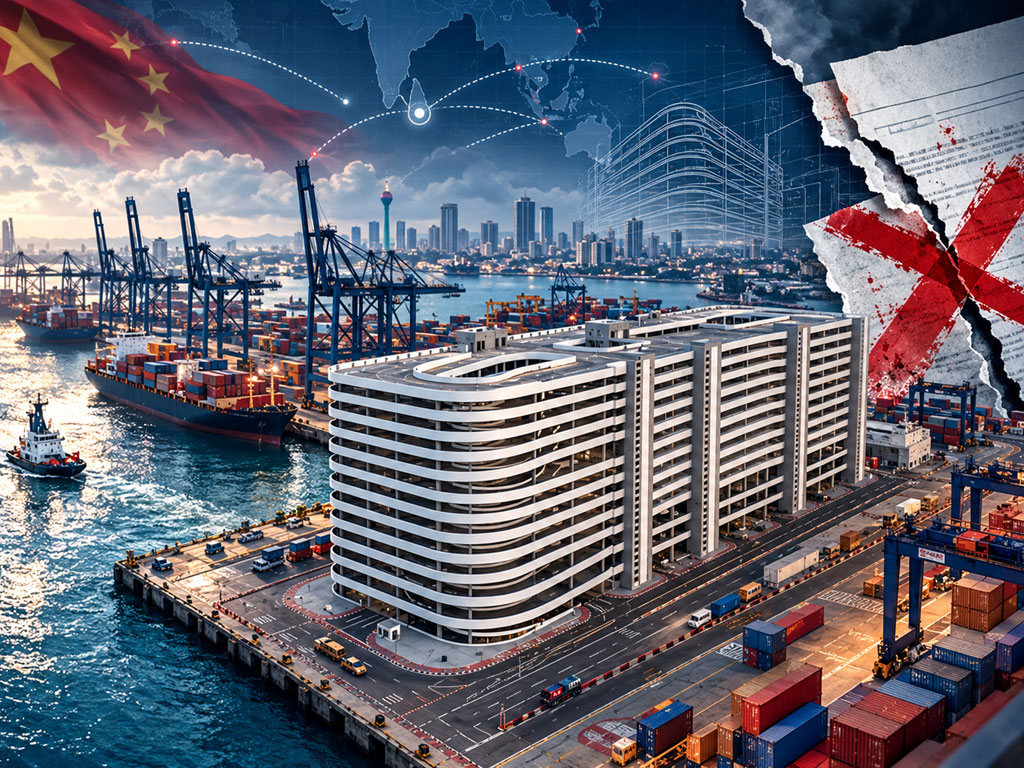
COLOMBO, October 19, 2026 — The Sri Lanka Ports Authority will pay US$21.9 million under a settlement ending a Chinese-backed logistics project, while the withdrawal has prompted debate over commercial difficulties and Sri Lanka’s strategic relations with India and China.
Read MoreWhat Did the Chinese Company Mean by External Circumstances?
In its announcement to the Hong Kong Stock Exchange, CMPort referred to changes in the project’s external environment and commercial circumstances.
The language has prompted speculation that the company’s withdrawal was influenced by India’s strategic concerns about expanding Chinese involvement in Colombo Port.
India has a substantial economic interest in Colombo’s transhipment operations, with a significant majority of the port’s transhipment traffic linked to Indian cargo.
Indian investment has also increased through the Adani Group’s involvement in the West Container Terminal.
China, meanwhile, has established a major presence through Colombo International Container Terminals and Hambantota Port.
Against that background, the prospect of a Chinese-controlled logistics operation holding commercial rights for half a century would inevitably attract attention.
Yet there is a distinction between strategic interests and evidence of direct intervention.
Neither CMPort’s announcement nor the settlement details establish that India demanded the project’s cancellation or that Sri Lankan authorities acted under pressure from New Delhi.
The suggestion that the project was terminated to satisfy Indian security concerns remains a geopolitical interpretation, not an established explanation.
Did India’s US$4 Billion Crisis Assistance Influence Colombo?
India provided Sri Lanka with approximately US$4 billion in assistance during the economic crisis of 2022, including credit facilities and other financial support.
That assistance strengthened India’s role as a major economic partner at a time when Sri Lanka faced severe shortages of foreign exchange, fuel and essential imports.
It also forms part of a broader relationship involving energy, infrastructure, trade and maritime security.
India has previously raised concerns about Chinese research vessels operating in waters close to its southern coastline, while Sri Lanka has faced difficult decisions over access for foreign research ships.
These developments demonstrate the competing strategic considerations confronting Colombo.
They do not, however, establish that India’s financial assistance was conditional on cancelling Chinese investments or that the SACLH settlement was negotiated at India’s request.
Any conclusion that Sri Lanka sacrificed the project to repay a political obligation to New Delhi would require documentary evidence, official correspondence or credible testimony establishing such a connection.
Who Ultimately Receives the US$21.9 Million?
The financial structure of the settlement is more complicated than the claim that Sri Lanka will simply hand US$21.9 million in compensation directly to a Chinese company.
According to the Hong Kong Stock Exchange announcement, the project’s three shareholders had invested approximately US$37.14 million in equity by the end of 2025.
CMPort’s subsidiary contributed US$26 million, while the SLPA and Access Engineering each invested approximately US$5.57 million.
The SLPA has agreed to pay US$21.905 million to the project company, which will distribute the money among its shareholders.
A further US$7.85 million already held by the project company will also be distributed.
The expected combined distributions are approximately US$20.83 million to the Chinese shareholder and US$4.46 million each to the SLPA and Access Engineering.
The Ports Authority has additionally settled a US$3.9 million value-added tax liability and is to settle approximately US$195,000 in outstanding payment liabilities.
These details matter because the settlement involves the recovery of shareholder funds, not simply a compensation award payable exclusively to the foreign investor.
Nevertheless, the use of public funds to terminate an unrealised project demands a full explanation of the SLPA’s net financial exposure, the money already spent and the contractual liabilities that made the settlement necessary.
What Happens to the Land and the Proposed Logistics Hub?
The cancellation ends the shareholders’ agreement, build-operate-transfer arrangement and site lease associated with the original venture.
The SLPA has since announced plans to pursue a replacement logistics development through a public-private partnership model.
That proposal suggests the authority still considers a major logistics hub commercially necessary, even though the original investment structure has been abandoned.
The Government must now explain how a new arrangement will differ from the cancelled deal, particularly in relation to competition, tax concessions, operating rights and financial obligations.
Sri Lanka’s strategic location offers substantial opportunities for port development, but that advantage can be weakened by agreements whose commercial consequences are not adequately examined before approval.
The central accountability questions are therefore straightforward.
Who approved the original 50-year arrangements? What assessment justified the restrictions on competing services? Could the financial settlement have been avoided? And what safeguards will prevent a future agreement from creating similar liabilities?
The wider India-China rivalry remains relevant to Colombo Port’s future, but it cannot be presented as the proven cause of this cancellation without supporting evidence.
For Sri Lanka, the immediate concern is less speculative: a major investment has been abandoned, public funds have been committed to a settlement, and another development proposal must now be negotiated.
Whether the replacement delivers better value will depend on the transparency of the process and the commercial terms ultimately agreed.