By Dwayne Ferreira.
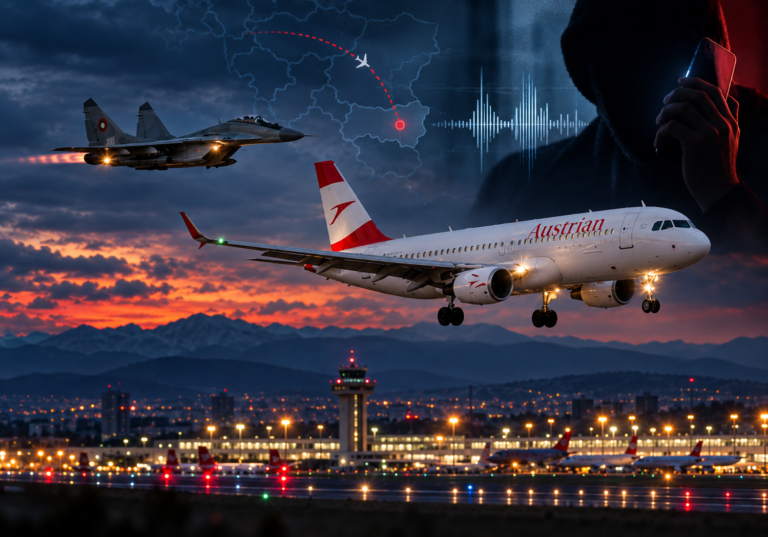
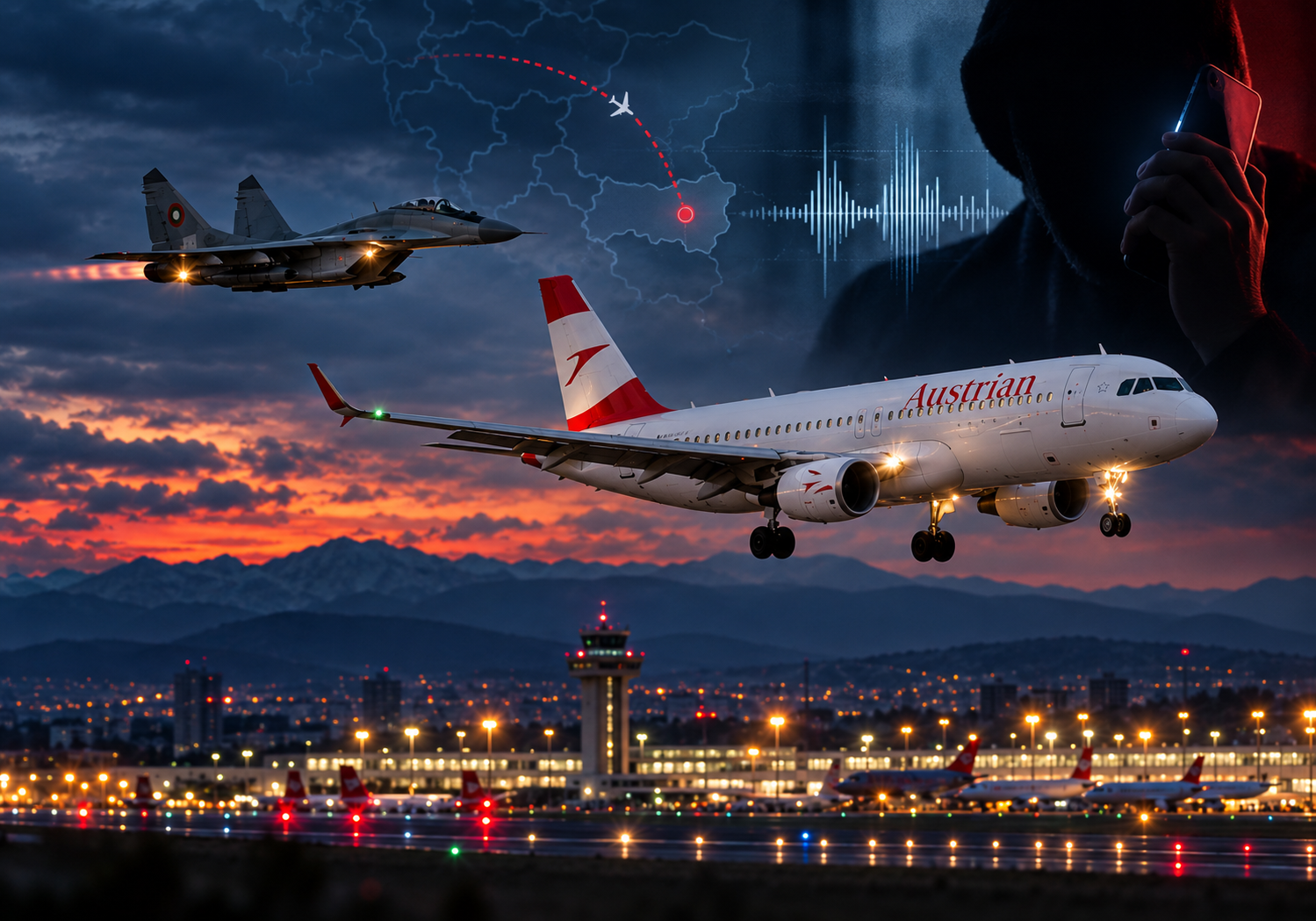
An anonymous telephone warning triggered an international aviation emergency, forcing a passenger aircraft to divert under military fighter jet escort. With no explosives discovered and all 57 occupants safely reaching Vienna, investigators are now turning their attention to the mysterious caller.
VIENNA, Austria – What began as a terrifying bomb threat aboard an Austrian Airlines passenger flight from Tel Aviv to Vienna has now developed into a potentially serious criminal investigation, as Austrian authorities attempt to establish who made the telephone call that triggered an emergency landing, the deployment of military fighter jets and a major international aviation security response.
The incident, which unfolded on Sunday evening, ended without injuries after security personnel found no explosives or other danger aboard the aircraft.
However, while the 51 passengers and six crew members eventually reached Vienna safely, the questions surrounding the individual who initiated the alert remain unanswered.

Austrian Interior Minister Gerhard Karner confirmed on Monday that the threat had been communicated by telephone to Vienna Airport, prompting authorities to launch an investigation into the circumstances surrounding the warning.
According to Reuters, Austria’s domestic intelligence and security authorities are now leading the investigation, although officials have not publicly established the identity of the person responsible.
A Single Telephone Call Triggers an International Emergency
Austrian Airlines Flight OS82, operated by an Airbus A320, was travelling from Israel’s Ben Gurion International Airport to Vienna when the security warning was received.
The aircraft was approaching Romanian airspace when its crew became aware of the reported bomb threat.
With 57 people aboard and the credibility of the warning impossible to establish immediately, the pilots diverted towards Sofia, Bulgaria, rather than continuing to their intended destination.
Bulgarian aviation authorities activated emergency security procedures, while the country’s air force scrambled MiG-29 fighter aircraft to escort the passenger jet towards Sofia Airport.
The deployment of military aircraft underlined the seriousness with which the warning was treated.
Although a fighter escort does not necessarily indicate an imminent attack, it is an extraordinary sight for passengers travelling aboard what should have been a routine commercial flight.
The aircraft subsequently landed safely in Sofia at approximately 8:42 p.m. Central European Summer Time, according to Austrian Airlines.
Extensive Searches Reveal No Bomb or Security Threat
Following the emergency landing, passengers and crew were taken off the aircraft while security personnel carried out detailed inspections.
Investigators searched the Airbus A320 and conducted security checks involving those aboard.
By Monday, Austrian Airlines confirmed that the inspection had uncovered no evidence of danger.
The airline stated:
“During the search of the affected aircraft, the passengers, and the crew, no danger was identified.”
The all-clear allowed the passengers to reboard and continue their journey to Vienna, where the aircraft arrived safely in the early hours of Monday.
For those aboard, the frightening disruption had finally ended. For investigators, however, the central mystery was only beginning.
Who Was Behind the Bomb Threat?
The most significant development emerged when Austrian Interior Minister Gerhard Karner confirmed that the warning had been communicated by telephone to Vienna Airport.
Speaking at a press conference on Monday, Karner acknowledged that authorities were investigating the threat but declined to provide additional information about the caller.
Reuters subsequently reported that Austrian domestic intelligence authorities had assumed responsibility for the investigation.
Meanwhile, Israeli media reports, including information attributed to Haaretz, suggested that the warning may have originated from an Austrian national who was not travelling aboard the aircraft.
However, this information has not been officially confirmed, and investigators have not publicly identified a suspect or established a motive.
Whether the call was intended as a malicious hoax, an attempt to disrupt aviation operations or resulted from some other circumstances remains unknown.
Could the Caller Face Criminal Charges?
If investigators establish that the warning was deliberately fabricated, the person responsible could potentially face serious legal consequences.
False bomb threats involving commercial aircraft can trigger criminal investigations because of the disruption, public alarm and potential risks created by emergency aviation procedures.
In this case, the response involved an unscheduled international diversion, military aircraft, airport emergency arrangements and security inspections.
Such operations can also generate substantial expenses, including additional aviation fuel, aircraft handling, security deployment and passenger disruption.
However, no official estimate of the financial cost of this incident has been released.
It also remains unclear whether authorities are examining potential offences under Austrian law, whether the caller’s location has been established, or whether investigators have sufficient evidence to identify a suspect.
No arrest or criminal charge connected to the warning had been confirmed in the latest reports reviewed.
Why Was the Threat Made?
One of the most troubling aspects of the case is the apparent absence of any publicly established motive.
Was the warning a deliberate attempt to disrupt a flight travelling from Israel? Was it intended to create panic among passengers? Or did the caller genuinely believe there was a security concern?
At present, these remain questions rather than established explanations.
The fact that the flight originated in Tel Aviv inevitably places the incident within a sensitive international aviation security environment.
Nevertheless, there is no verified evidence linking the warning to terrorism, political extremism or any organised group.
Authorities will need to establish the circumstances surrounding the telephone call before conclusions can be drawn about the caller’s intentions.
A Costly Emergency Even Without a Bomb
Although no explosive device was discovered, the incident demonstrates how a single unverified warning can trigger an extensive international security response.
A commercial aircraft carrying 57 people was diverted from its scheduled route.
Military fighter aircraft were deployed, airport emergency arrangements were activated, passengers were temporarily removed from the aircraft, and security teams carried out inspections before the journey could continue.
Each stage required coordination among aviation authorities, security agencies and airline personnel.
The disruption also raises wider questions about how aviation authorities assess telephone threats while ensuring that genuinely dangerous warnings are never dismissed.
Airlines have little room for error when dealing with potential explosives aboard an aircraft in flight.
Consequently, even warnings that ultimately prove unfounded can require substantial precautionary action.
Investigation Shifts From Aircraft to Mystery Caller
With the aircraft cleared and everyone safely returned to Vienna, the focus has shifted from the supposed danger aboard Flight OS82 to the circumstances surrounding the warning itself.
Investigators must now determine who contacted Vienna Airport, what information was communicated and whether the warning was deliberately false.
The possibility that a single caller triggered such an extensive security operation is likely to attract further scrutiny as Austrian authorities continue their investigation.
For Austrian Airlines, the incident ended with the safe arrival of its aircraft, passengers and crew.
For the authorities, however, the case remains unresolved.
The bomb scare may be over, but the mystery surrounding the caller and the reasons behind the warning is far from settled.
Sources:
1. Reuters – October 19, 2026. All Clear After Bomb Threat on Austrian Flight – Authorities Investigate. Confirmation of the domestic intelligence investigation, telephone warning, ministerial statements and safe arrival in Vienna. Read Reuters report via Onvista
2. Reuters – October 19, 2026. Bomb Threat Forces Austrian Tel Aviv–Vienna Flight to Land in Bulgaria. Details of the diversion, reported Austrian caller and security response. Read Reuters report via MarketScreener
3. Reuters / ThePrint – October 19, 2026. All Clear Given After Bomb Threat Diverts Austrian Airlines Flight from Israel to Bulgaria. Airline confirmation that no danger was identified and all passengers continued their journey. Read report
4. Sky News – October 19, 2026. Flight from Tel Aviv to Vienna Makes Emergency Landing After Bomb Threat. Bulgarian military escort, aircraft information and initial security response. Read Sky News report
5. Euronews – October 19, 2026. Bomb Threat Forces Austrian Airlines Plane from Tel Aviv to Divert to Bulgaria. Additional reporting on the Bulgarian Air Force deployment and emergency landing. Read Euronews report