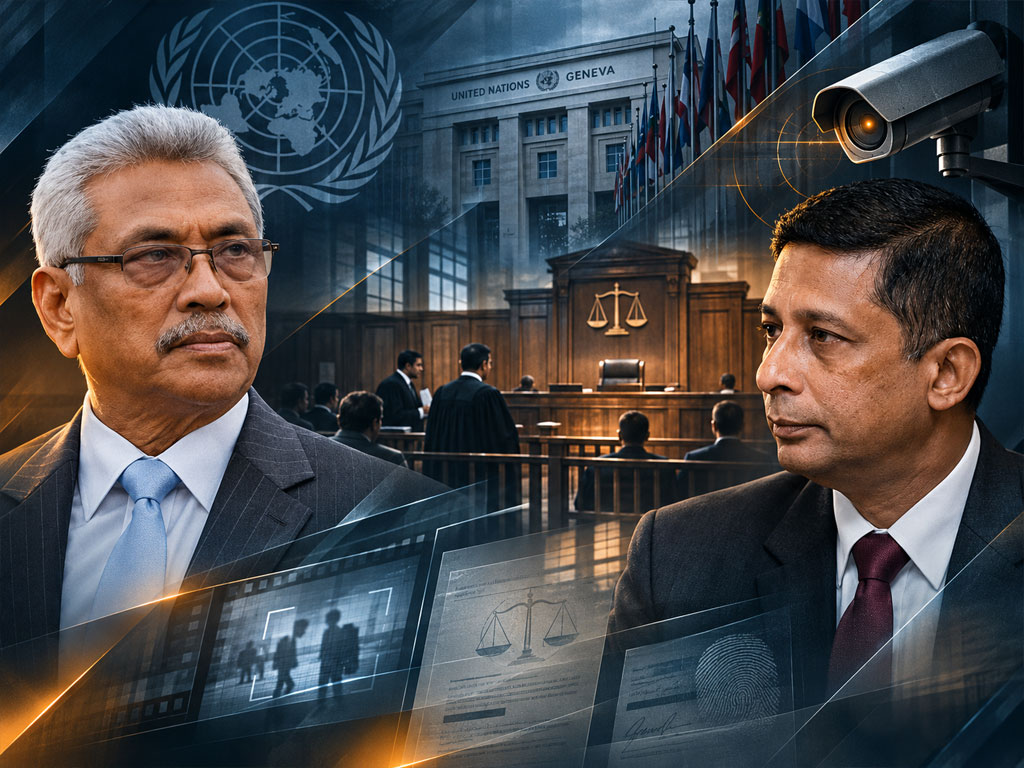
COLOMBO, November 28, 2026 — A dispute over psychiatric findings, alleged mistreatment in custody and the retention of CCTV footage has added a new dimension to the Suresh Sallay Easter attacks investigation. The Fort Magistrate’s Court has also ordered investigators to clarify former President Gotabaya Rajapaksa’s possible status as a suspect.
A disagreement between the prosecution and defence over a court-appointed psychiatric report on retired Major General Suresh Sallay has brought questions about detention procedures, medical evidence and the preservation of CCTV recordings into the continuing investigation into Sri Lanka’s 2019 Easter Sunday terrorist attacks.
During proceedings before Colombo Fort Magistrate Pasan Amarasena on November 25, Additional Solicitor General Dileepa Peiris challenged the significance of the medical findings concerning the former Director of the State Intelligence Service (SIS), while defence counsel Bhanuka Malaviarachchi argued that the expert panel had recommended further investigation into alleged mistreatment during detention.
The disagreement arose during a hearing at which the Magistrate also directed the Criminal Investigation Department (CID) to expedite inquiries into whether former President Gotabaya Rajapaksa should be named a suspect.
In a separate decision, the court refused Rajapaksa’s application to temporarily lift an overseas travel ban imposed in connection with the ongoing investigation.
The proceedings concern allegations that intelligence personnel concealed information or misled investigations relating to the Easter Sunday attacks, which killed more than 250 people and injured hundreds of others.
None of the disputed allegations against Sallay or the other individuals under investigation should be treated as findings of criminal guilt.

Gotabaya Rajapaksa’s Travel Request Rejected
Rajapaksa’s lawyers had sought permission for him to travel to Singapore for further medical examinations and treatment following cardiac surgery.
The application, reportedly filed on October 28, referred to medical documentation from Dr. C. Sivanandan concerning treatment following bypass surgery at a Singapore hospital in May 2019.
After considering the submissions, the Magistrate declined to temporarily suspend the travel restriction.
The court was informed that proceedings seeking to prevent Rajapaksa’s arrest were also pending before a higher court.
Given the seriousness of the Easter Sunday investigation and the outstanding legal proceedings, the travel request was refused.
A central question was whether the evidence gathered by investigators warranted formally naming the former President as a suspect.
Peiris told the court that, in his assessment, sufficient evidence existed to consider that course of action. He also acknowledged that decisions concerning an arrest rested with investigating officers.
The Magistrate directed the CID to expedite the relevant inquiries and report its findings.
That direction does not itself constitute a judicial finding that Rajapaksa participated in the attacks, nor does it establish criminal responsibility.
The proceedings also involved two other suspects, identified in the supplied account as intelligence officers Yasim Bawa Jegilpas and Sarath Samantha, formerly attached to the Vavuniya Army Camp.
Sallay remained in detention, while the continuing investigation was scheduled for further consideration on January 27, 2027.
Prosecution Presents Intelligence and Hotel Records
During the hearing, Peiris presented additional material that prosecutors said was relevant to examining Sallay’s alleged connections with individuals associated with the investigation.
One strand concerned Azad Maulana, who previously made public allegations about the circumstances surrounding the Easter Sunday attacks.
The prosecution referred to hotel records indicating that Sallay and Maulana had stayed at the same establishment in Ahungalla in August 2020.
According to the submissions reproduced in the source account, four rooms had been reserved for a group of ten people, including members of Sallay’s family. The account gives the reservation amount as Rs. 130,944 and refers to a booking made on July 20, 2020.
The prosecution also referred to a subsequent reservation involving Maulana.
These details were presented as part of the prosecution’s argument that the two men had a connection relevant to the investigation.
The significance of the hotel records, including whether they establish a deliberate meeting or another form of association, remains a matter for evidentiary examination.
Prosecutors also alleged that intelligence received before the attacks had been concealed.
Their submissions referred to information allegedly provided by an individual known as Thambi Anna, said to have undergone military training in India in 2018, concerning a possible serious attack.
Further questions arose over telephone numbers reportedly obtained by intelligence personnel through an entity identified as Ceylon Shipping rather than through conventional government arrangements.
The prosecution maintained that these matters warranted further investigation into the handling of intelligence before and after the bombings.
Peiris also informed the Magistrate that investigators had sought further statements from individuals convicted in the main Easter Sunday criminal proceedings.
According to the prosecution, concerns about the safety of family members had delayed those statements.
The allegations relating to intelligence concealment, hotel reservations and communications records remain subject to investigation and judicial scrutiny.
Psychiatric Report Becomes Central to Court Dispute
One of the most closely contested aspects of the hearing concerned a psychiatric assessment prepared by a five-member specialist medical panel.
The supplied account describes the document as containing 311 pages and 1,185 paragraphs, incorporating extensive material from Sallay and his wife.
Peiris referred to the report’s length and the number of statements recorded, arguing that its findings did not substantiate allegations that the former intelligence chief had been subjected to torture or had developed a psychiatric illness attributable to his detention.
The prosecution’s position was that the psychological stress described in the assessment did not establish the more serious allegations advanced by the defence.
Peiris also challenged the credibility of Sallay’s account, referring to his background as a senior intelligence officer and suggesting that he was capable of influencing the way others assessed his condition.
At one point, the Additional Solicitor General referred to an earlier remark comparing Sallay’s conduct to an Oscar-worthy performance.
As reproduced in the supplied account, he told the court:
“I said in the court term that went by that this person deserves an Oscar for his acting.”
The remark formed part of the prosecution’s criticism of the suspect’s account and should not be confused with a medical finding or a conclusion reached by the court.
Defence counsel disputed the prosecution’s interpretation.
Malaviarachchi argued that the medical panel had not reached a definitive conclusion on every allegation and that the report contained recommendations requiring further attention.
The distinction is important. A medical report that does not establish torture is not necessarily equivalent to an affirmative finding that every allegation of mistreatment is false.
Equally, a recommendation to investigate alleged misconduct does not itself prove that the misconduct occurred.
Medical Board’s Fourth Recommendation Under Scrutiny
According to the defence account presented in court, the specialist panel issued four recommendations concerning Sallay’s mental health and treatment in custody.
The first three addressed continued medical attention, the need for prompt professional intervention should anxiety-related symptoms recur, and the suitability of his detention environment.
The fourth concerned an alleged body search during detention.
Malaviarachchi submitted that Sallay had reported an incident in which officers lowered his trousers and examined him.
The defence maintained that the medical panel had not reached a final conclusion about the incident and had recommended further investigation.
Addressing the Magistrate, counsel said:
“The medical board has not reached a final decision regarding that. It has indicated that further investigation is needed.”
The defence argued that the recommendation was significant because it concerned an allegation about the conduct of officials responsible for a detainee’s treatment.
Peiris disputed the suggestion that the report established torture or related psychological harm.
During the exchange, the Magistrate questioned counsel’s description of the alleged incident and whether the language used was actually contained in the medical report.
The defence clarified that its characterisation should be distinguished from the panel’s precise findings.
The Magistrate also referred to his own visit to the CID detention facility, during which, according to the supplied account, Sallay had not raised a torture complaint.
The court’s consideration of the medical report therefore involved two separate questions: whether the available evidence established unlawful treatment and whether any outstanding recommendation justified additional inquiry.
CID CCTV Retention Period Raises Questions
The fourth recommendation led to another disputed issue: the availability of surveillance recordings from the location where Sallay was detained.
According to the defence, the medical panel had been informed that CCTV footage from the relevant CID detention area was retained for approximately 30 days.
Malaviarachchi questioned whether that retention period was adequate for a facility holding suspects in serious criminal investigations.
He told the court:
“I don’t know, Your Honour, why the CCTV footage at such a place gets erased in thirty days.”
The submission raised the question of whether recordings relevant to alleged incidents in detention could be preserved long enough to support subsequent investigations or judicial review.
A 30-day retention policy does not, by itself, establish that evidence was deliberately destroyed or that officers acted improperly.
The significance depends on when the alleged incident occurred, when the complaint was made, whether a preservation request existed and whether relevant recordings were still available when investigators sought them.
The supplied account does not establish that any officer deliberately deleted evidence to prevent examination of Sallay’s allegations.
Nevertheless, the reported retention period makes the preservation of potentially relevant footage an important procedural question.
An effective investigation would need to establish the applicable CCTV policy, the relevant dates, whether recordings were preserved and what other evidence might be available.
Defence Cites Alleged Contradictions in Officers’ Accounts
Malaviarachchi also questioned whether the medical panel had obtained statements from other detainees who might have witnessed the alleged body search.
According to the defence, the report did not indicate that those individuals had been interviewed.
Counsel further alleged that conflicting descriptions had been given by CID personnel to different institutions.
The defence referred to an officer identified as Senaratne, who reportedly made submissions before the Human Rights Commission concerning detention procedures.
It was alleged that the officer had acknowledged that examinations involving the lowering of a detainee’s trousers formed part of the procedures used.
By contrast, according to the defence, officers who subsequently appeared before the specialist medical panel denied that the particular incident involving Sallay had occurred.
These are allegations about potentially inconsistent testimony, not independently established findings that officers deliberately misled either institution.
The distinction between describing a general detention procedure and confirming that it occurred in a particular instance would also require examination.
Determining whether the accounts are genuinely contradictory would depend on their precise wording, context and the relevant documentary records.
The defence maintained that these matters strengthened the argument for implementing the medical panel’s recommendation for further investigation.
Dispute Over Computer Passwords and Investigation Delays
A separate disagreement concerned the authorities’ attempts to access an electronic device associated with Sallay.
Peiris questioned how the former intelligence chief could provide a detailed account of his long military career while claiming difficulty remembering a computer password.
The prosecution suggested that the failure to provide the required password could have obstructed investigators.
As reproduced in the supplied account, Peiris said:
“But the password is still not remembered. The art of deception. Stopping the investigation is the aim.”
Defence counsel rejected that interpretation.
According to the defence, investigators did not request the password during the first three-month detention period and raised the matter only after approximately six months, when Sallay was hospitalised.
Counsel maintained that Sallay had provided several passwords he could remember.
The defence further argued that frequent password changes were consistent with the security practices of someone who had held senior military and intelligence positions.
Consequently, it said, the inability to recall a particular password after several months should not automatically be treated as deliberate obstruction.
Neither the prosecution’s allegation of intentional non-cooperation nor the defence’s explanation can be conclusively assessed from these competing submissions alone.
Relevant questions include when access was first requested, which credentials were provided, whether investigators attempted forensic examination and whether any technical evidence supports the allegation of obstruction.
The dispute illustrates the importance of documenting investigative requests and responses, particularly when digital evidence may be material to a criminal inquiry.
Prosecution’s Courtroom Language Draws Criticism
Beyond the evidence itself, the hearing prompted criticism concerning the language used by the prosecution when discussing Sallay and the medical assessment.
The source article questions whether sarcastic references to the suspect’s conduct were appropriate when addressing a report prepared by specialists appointed through the judicial process.
State prosecutors are entitled to dispute medical evidence, challenge credibility and question whether expert conclusions are supported by the underlying material.
The defence is equally entitled to contest those arguments and seek examination of allegations concerning a client’s treatment.
The broader issue is whether strongly worded submissions remain focused on the evidence and legal questions before the court.
The supplied commentary also refers to earlier controversy surrounding the phrase “Shani’s torture chamber”, reportedly used by politicians when discussing detention facilities associated with criminal investigations.
It draws a comparison between public criticism of judicially supervised institutions and remarks made during court proceedings.
That comparison is an editorial argument rather than a legal finding that the prosecution committed contempt of court or another professional violation.
Any assessment of courtroom misconduct would require consideration of the complete proceedings, applicable professional standards and the court’s own authority over submissions made before it.
Investigation Must Address Evidence and Detention Rights
The Easter Sunday investigation remains one of Sri Lanka’s most consequential criminal inquiries, involving mass casualties, allegations concerning intelligence failures and demands for accountability that have continued for more than seven years.
Investigators have a responsibility to examine potentially relevant evidence without regard to the status or former office of those concerned.
At the same time, suspects remain entitled to lawful treatment, access to appropriate medical care and the procedural safeguards guaranteed under Sri Lankan law.
Those obligations are not competing alternatives.
An investigation can pursue accountability for victims while also examining credible allegations about how suspects have been treated in custody.
The November 25 proceedings left several matters unresolved, including the significance of the psychiatric panel’s recommendations, the circumstances surrounding the alleged body search, the availability of CCTV footage and the handling of digital evidence.
Court-directed inquiries into former President Gotabaya Rajapaksa’s possible status as a suspect also remain pending.
The case is scheduled to return before the Fort Magistrate’s Court on January 27, 2027.
For investigators, prosecutors and the defence, the next stage will require more than competing interpretations of the evidence. It will require clear documentation of what was investigated, which allegations remain unresolved and what further steps are legally justified.
The credibility of the proceedings will depend on whether those questions are answered through evidence and judicial scrutiny, while the wider investigation continues its pursuit of accountability for the victims of the 2019 attacks.