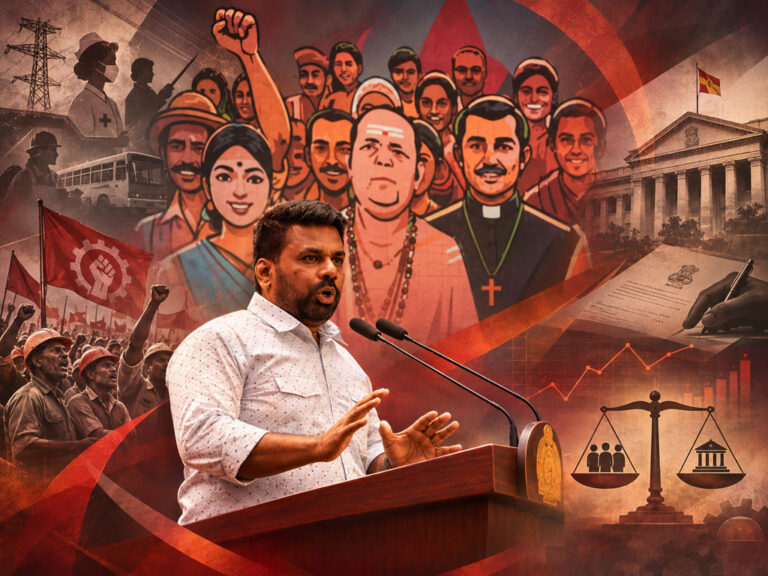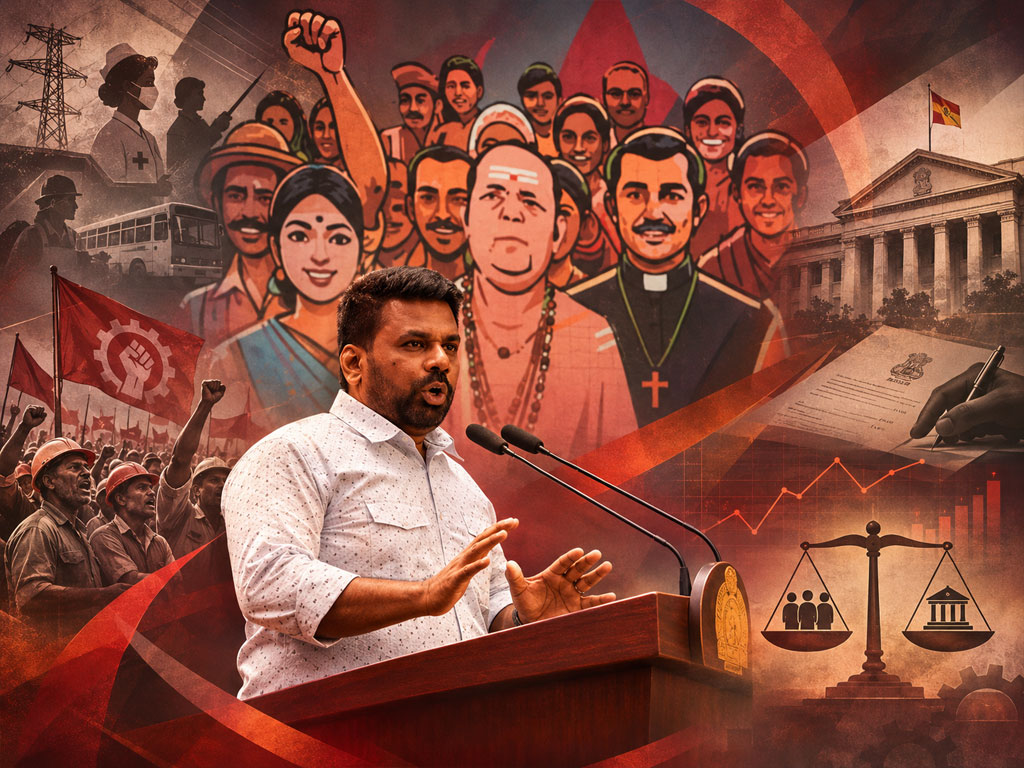
COLOMBO, November 28, 2026 — Growing trade union agitation over Budget 2027 is testing the JVP-led Government’s ability to balance its longstanding commitment to workers’ rights with the financial responsibilities of governing Sri Lanka. The dispute exposes a deeper challenge involving political credibility, economic reform and social justice.
Sri Lanka’s Janatha Vimukthi Peramuna (JVP)-led National People’s Power (NPP) Government faces a fundamental political and economic test: whether a movement built on trade union struggles, workers’ rights and promises of social justice can develop a governing philosophy capable of rebuilding a financially weakened country.
Growing tensions between the Government and public sector trade unions over Budget 2027, salary anomalies and outstanding wage demands have exposed a difficult contradiction within the ruling movement.
An organisation that spent decades supporting workers demanding higher wages, improved working conditions and protection against economic exploitation must now explain why some of those demands cannot be accommodated after assuming power.
The dispute extends well beyond public sector salaries. It goes to the heart of the Government’s economic philosophy, political credibility and responsibility to balance competing national priorities.

From Trade Union Activism to Economic Governance
For decades, the JVP developed much of its political identity through working-class mobilisation, trade union activism and opposition to economic policies it regarded as favouring powerful business interests over ordinary citizens.
Its political appeal was reinforced by commitments to eliminate corruption, reduce inequality, protect public assets and build an economy that serves the wider population.
Governing a country recovering from its worst economic crisis, however, presents challenges considerably different from organising protests against previous administrations.
Sri Lanka continues to face substantial public debt, fiscal constraints, high living costs, inadequate investment, weak productivity and significant demands for employment and social protection.
The Government cannot accommodate every wage demand without considering the consequences for public expenditure, taxation, inflationary pressures and fiscal sustainability.
Yet financial constraints cannot become a permanent justification for postponing legitimate commitments made to public employees and other sections of society.
The central challenge is to reconcile economic discipline with social justice without abandoning either principle.
Budget 2027 Exposes the Ideological Divide
Discontent over Budget 2027 has brought this tension into sharper focus, with unions representing several public sector professions expressing dissatisfaction over unresolved salary anomalies, allowances and working conditions.
The Government has maintained that additional commitments must remain within available fiscal resources while pointing to salary increases already introduced and scheduled for implementation.
Its position illustrates the difference between advocating wage improvements from the opposition benches and determining how those improvements can be financed through the national Budget.
Public sector employees are not merely an expenditure item. Teachers, healthcare professionals, administrators, transport workers and other government employees provide essential services on which millions of citizens depend.
Their remuneration, working conditions and professional security directly influence the quality and reliability of those services.
Equally, Sri Lanka cannot afford an unreformed public administration in which salary increases remain disconnected from productivity, accountability and service delivery.
A sustainable approach must address both the legitimate financial needs of public employees and the efficiency of the institutions in which they work.
Why the JVP Needs a Modern Economic Philosophy
The JVP must now consider moving beyond its traditional trade union approach towards a modern social-democratic economic framework that combines workers’ rights with economic competitiveness.
Such an approach would recognise that sustainable wage improvements require stronger economic growth, higher productivity, expanding exports, increased investment and more efficient public institutions.
It would also acknowledge that public sector salary increases alone cannot resolve Sri Lanka’s wider cost-of-living difficulties.
Private sector employees, small businesses, self-employed workers, farmers, pensioners and vulnerable households face substantial economic pressures, often without the collective bargaining power enjoyed by organised public sector unions.
A credible national economic philosophy must therefore extend beyond negotiations with individual unions.
Budget 2027 presents an opportunity for the Government to demonstrate how its electoral commitments can be translated into a coherent economic and social programme.
That requires transparent wage commitments, realistic implementation schedules, targeted assistance for low-income households and measurable reforms to improve public sector performance.
Trade Union Independence Must Be Protected
Protecting trade union independence is equally important.
The JVP cannot reasonably expect unions to abandon their established responsibilities simply because a government led by its political movement now holds office.
Collective bargaining, constructive criticism and peaceful industrial action remain legitimate components of democratic governance, regardless of which political party controls the administration.
The Government must resist treating every industrial dispute as an act of politically motivated opposition.
At the same time, trade unions must recognise that Sri Lanka cannot return to unsustainable fiscal practices that place additional pressure on public finances.
Responsible trade unionism requires defending workers’ legitimate interests while acknowledging the economic constraints confronting the country.
Neither side benefits when negotiations become a contest between political loyalty and institutional authority.
Constructive engagement should instead focus on identifying affordable solutions, correcting genuine inequalities and establishing clear standards for future wage revisions.
A New Social Contract Between Workers and Government
Sri Lanka needs a new social contract between the Government, employees, employers and taxpayers.
Such an agreement should rest on three fundamental principles:
1. Economic productivity: Improving output, institutional efficiency and the country’s capacity to generate sustainable employment and income.
2. Equitable distribution of national wealth: Ensuring that economic progress improves living standards across public and private sector employment, rural communities and vulnerable households.
3. Institutional accountability: Strengthening transparency, financial discipline and measurable performance throughout public administration.
The JVP must also demonstrate that its commitment to combating corruption extends beyond political declarations.
Recovering unlawfully acquired public assets through due legal process, addressing procurement irregularities, improving state enterprise governance and eliminating unnecessary expenditure could help create additional fiscal space for development and social protection.
Such reforms, however, require effective investigations, transparent administration and enforceable legal mechanisms rather than political promises alone.
From Opposition Politics to National Leadership
Sri Lanka needs an economy capable of creating productive employment and generating new wealth, rather than one that merely distributes limited public resources among competing interest groups.
That transformation requires stronger private investment, competitive industries, better public services and an economic environment in which employees can obtain sustainable improvements in their living standards.
The JVP-led NPP Government cannot indefinitely approach national administration with the political instincts of an opposition movement while exercising the responsibilities of government.
Its historical association with trade unions should remain a source of commitment to social justice, not an obstacle to necessary economic reform.
Equally, fiscal discipline must not become an excuse for abandoning the legitimate aspirations of the people whose support brought the Government to power.
Ultimately, the credibility of the administration will depend not on whether it satisfies every trade union demand, but on whether it can establish a transparent, equitable and financially sustainable system for resolving them.
The test facing the JVP is whether it can preserve the principles that shaped its political identity while demonstrating the economic judgement required to govern an entire nation.