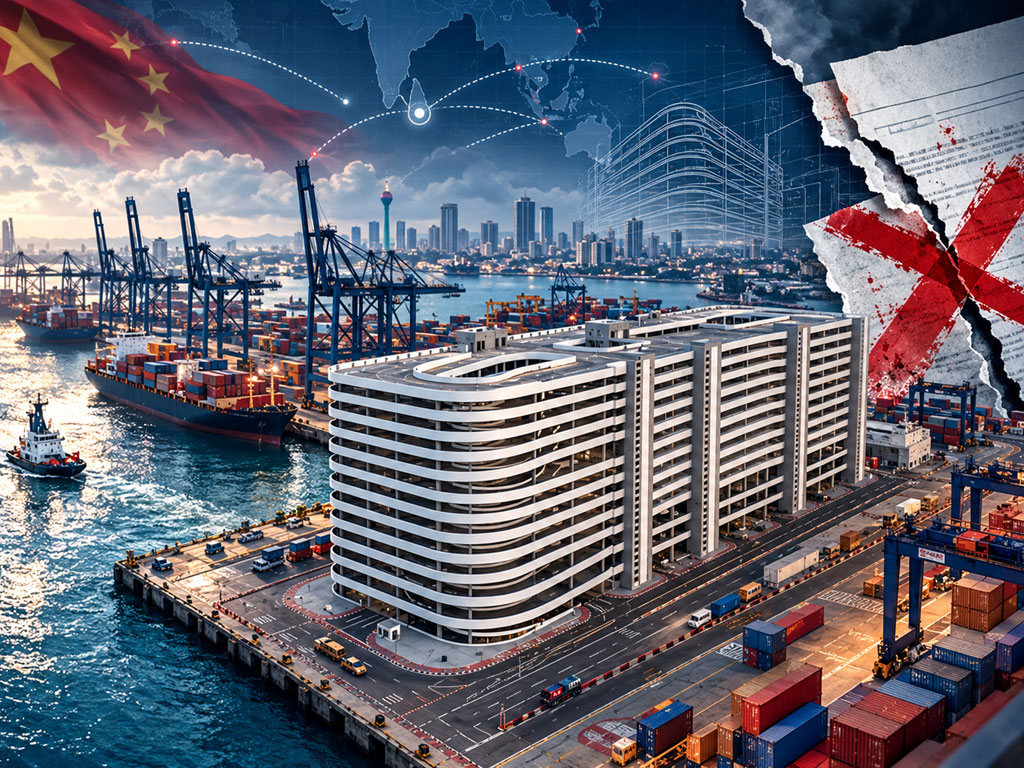
COLOMBO, October 19, 2026 — The Sri Lanka Ports Authority will pay US$21.9 million under a settlement ending a Chinese-backed logistics project, while the withdrawal has prompted debate over commercial difficulties and Sri Lanka’s strategic relations with India and China.
China Merchants Port Holdings (CMPort) and its Sri Lankan partners have agreed to terminate the proposed US$392 million South Asia Commercial and Logistics Hub (SACLH) at Colombo Port, with the Sri Lanka Ports Authority (SLPA) undertaking to make a one-time payment of US$21.905 million within 30 days under the settlement.
The decision ends plans to construct a five-storey logistics complex that had been granted substantial tax concessions and a 50-year operating arrangement at one of South Asia’s most strategically important ports.
In an October 15 announcement to the Hong Kong Stock Exchange, CMPort attributed the withdrawal to changes affecting the project’s operating environment, implementation timetable and the commercial considerations of the parties involved.
The announcement did not identify geopolitical pressure from India, or a shift in Sri Lanka’s foreign policy towards China, as reasons for the termination.
Nevertheless, the cancellation has attracted attention beyond its financial implications because Colombo Port occupies an important position in the maritime relationship between Sri Lanka, India and China.

SLPA Agrees to US$21.9 Million Settlement
Under the settlement arrangement, the SLPA has agreed to pay US$21.905 million to the project company, South Asia Commercial and Logistics Hub Limited, within 30 days.
The payment forms part of a wider arrangement to return funds invested in the project and terminate the agreements governing its development.
According to CMPort’s regulatory announcement, the project’s shareholders had contributed a combined US$37.14 million in equity by December 31, 2025.
Of that amount, CMPort’s subsidiary Fortune Centre Group Limited (FCGL) had invested US$26 million, while the SLPA and Access Engineering PLC had each contributed US$5.57 million.
The settlement also accounts for tax obligations and cash already held by the project company.
CMPort disclosed that the SLPA had settled a US$3.9 million value-added tax liability and would address a further US$195,000 in overdue payment liabilities.
The agreed US$21.905 million payment, together with approximately US$7.85 million in distributable cash held by the project company, is to be distributed among the three shareholders according to their respective interests.
These arrangements mean the payment should not simply be described as compensation paid directly and exclusively to the Chinese shareholder.
The final financial effect on the SLPA will depend on the settlement’s full accounting treatment, the amounts returned to each shareholder and the associated liabilities.
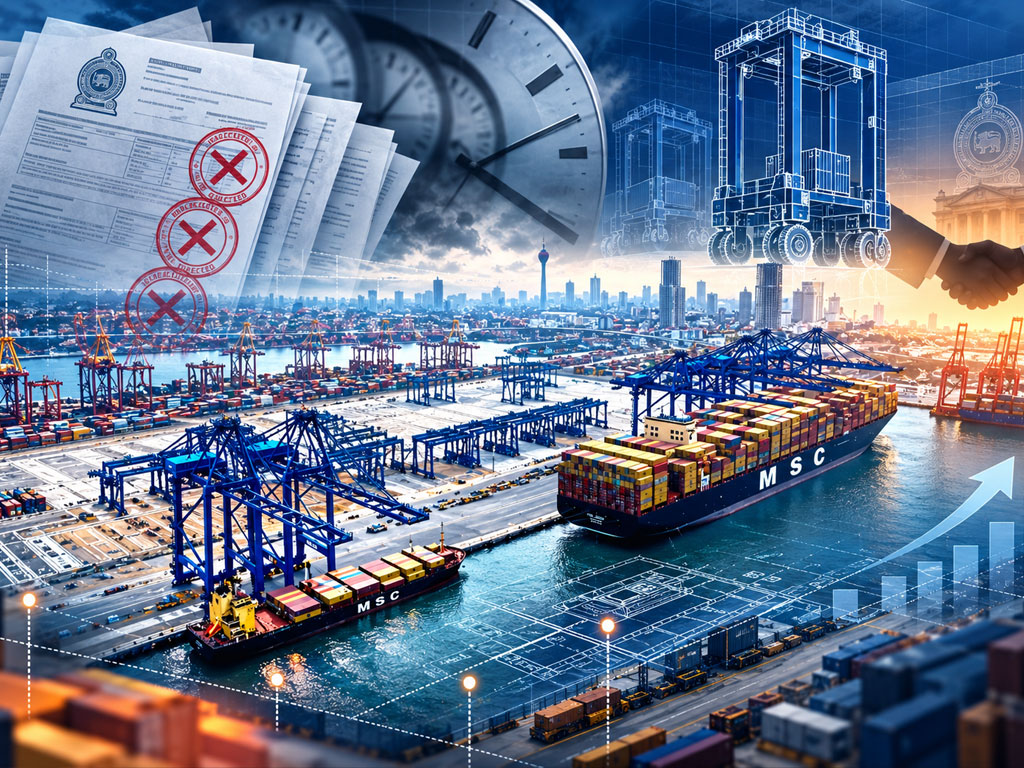
COLOMBO, October 18, 2026 — With civil construction approximately 82–85% complete, the Government is making a fifth attempt to procure 15 straddle carriers while considering private participation in operating the State-owned terminal.
Chinese Company Held 70% Stake and 50-Year Operating Rights
The abandoned venture was structured around a 50-year build-operate-transfer arrangement.
CMPort participated through FCGL, its wholly owned subsidiary incorporated in the British Virgin Islands.
The project’s ownership was divided as follows:
- China Merchants Port Holdings, through FCGL: 70%.
- Sri Lanka Ports Authority: 15%.
- Access Engineering PLC: 15%.
Sri Lanka had approved the logistics complex as a Strategic Development Project in December 2023.
That designation provided concessions including 15-year exemptions from corporate income tax and tax on dividends.
The arrangement also granted extensive operating rights for logistics and warehousing services at Colombo Port.
Reporting on the original agreement indicates that the SLPA was restricted from allowing third parties to provide comparable port-related logistics or warehousing services at rates below the royalty fees payable by the project company.
Such provisions were commercially significant because they could have affected how competing logistics services were offered within the port.
However, the precise legal effect of the exclusivity provisions following termination would depend on the settlement documents and the cancellation of the relevant contractual rights.
The project’s shareholders have agreed to end the shareholders’ agreement, the build-operate-transfer agreement and the site lease.
Project Had Already Encountered Commercial and Regulatory Obstacles
Although the formal settlement was announced in October, the project’s difficulties had emerged considerably earlier.
In May 2026, officials from Sri Lanka’s Board of Investment and the SLPA publicly confirmed that the proposed logistics complex would not proceed.
Board of Investment Director General Renuka M. Weerakone indicated that the SLPA intended to seek fresh proposals for the land allocated to the project.
Earlier reporting had also identified difficulties arising from Sri Lanka’s changes to investment concession arrangements following the 2022 economic crisis and commitments made under its International Monetary Fund programme.
The SLPA had examined possible alternative arrangements for providing the project with concessionary status.
These developments provide documented commercial and regulatory context for the cancellation.
They do not exclude the possibility that geopolitical considerations influenced the wider investment environment, but they show that the project’s difficulties cannot safely be attributed to foreign-policy pressure alone.
India-China Competition Provides a Strategic Backdrop
Colombo Port is central to regional maritime trade, particularly transhipment cargo connected to India.
More than 70% of the port’s transhipment traffic has been described in industry reporting as linked to Indian cargo, giving developments at Colombo considerable commercial significance for its larger neighbour.
India has also increased its involvement in Sri Lanka’s port infrastructure through the Adani Group’s participation in the West Container Terminal.
China, meanwhile, has maintained substantial investments in Sri Lankan port-related infrastructure, including its involvement in the Colombo International Container Terminals and Hambantota Port.
Against this background, major long-term logistics concessions involving Chinese and Indian interests can attract strategic attention.
The source commentary argues that the cancellation signals a gradual shift in Sri Lanka’s foreign policy towards India and a corresponding reduction in Chinese influence.
That interpretation is not established by the Hong Kong Stock Exchange announcement.
No evidence examined for this report demonstrates that New Delhi requested the cancellation, threatened consequences if the project proceeded or negotiated the withdrawal with Sri Lankan authorities.
The geopolitical context is relevant, but it should be distinguished from the documented reasons supplied by the parties.
India’s Crisis Assistance and Maritime Security Concerns
India’s influence in Sri Lanka’s economic and strategic affairs has been shaped partly by the financial assistance it provided during the country’s 2022 economic crisis.
New Delhi extended support amounting to approximately US$4 billion through credit facilities, currency assistance and other measures during that period.
The assistance strengthened bilateral cooperation at a time when Sri Lanka faced severe shortages of foreign exchange and essential imports.
India has also expressed security concerns regarding certain Chinese research vessel visits to Sri Lanka.
Those concerns contributed to wider discussion over the management of foreign research vessel access, and Sri Lanka subsequently introduced a temporary restriction on such visits.
The original commentary places the withdrawal from the logistics hub within this broader pattern of balancing Chinese investment and Indian security interests.
While the events illustrate the strategic pressures Sri Lanka faces, the available evidence does not establish a direct causal connection between India’s economic assistance, its maritime security concerns and the termination of the SACLH project.
Likewise, describing Sri Lanka as having formally adopted an “India First Policy” would require evidence of such a declared policy rather than an inference drawn from individual investment decisions.
What the Cancellation Means for Colombo Port
The proposed logistics hub had been promoted as a substantial addition to Colombo Port’s commercial infrastructure, with the potential to expand warehousing and related services.
Its cancellation means that the intended development will not proceed under the original investment structure.
Attention will now turn to the future use of the land, the settlement of outstanding financial obligations and the terms under which new investors may be invited to participate.
The SLPA has previously indicated that it would consider a fresh request-for-proposals process involving the project site.
The status of that process, including whether an invitation has been issued or alternative investors identified, requires further confirmation.
For Sri Lanka, the decision highlights the importance of assessing not only the investment value of major port projects but also the commercial restrictions, tax concessions, implementation risks and long-term contractual commitments accompanying them.
The cancellation may carry geopolitical implications in a region where ports have considerable strategic significance. Yet its documented history also reveals regulatory complications and commercial setbacks that predated the formal withdrawal.
The clearest immediate consequences are financial and contractual: a US$392 million development has been abandoned, a settlement must be implemented, and the future of the allocated port land remains to be determined.
Whether the decision also reflects a broader realignment in Sri Lanka’s relations with China and India cannot be established from this transaction alone.