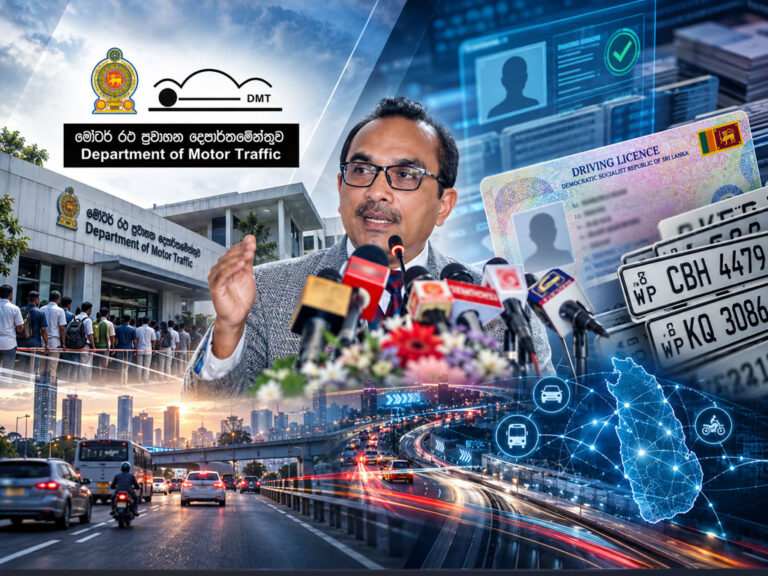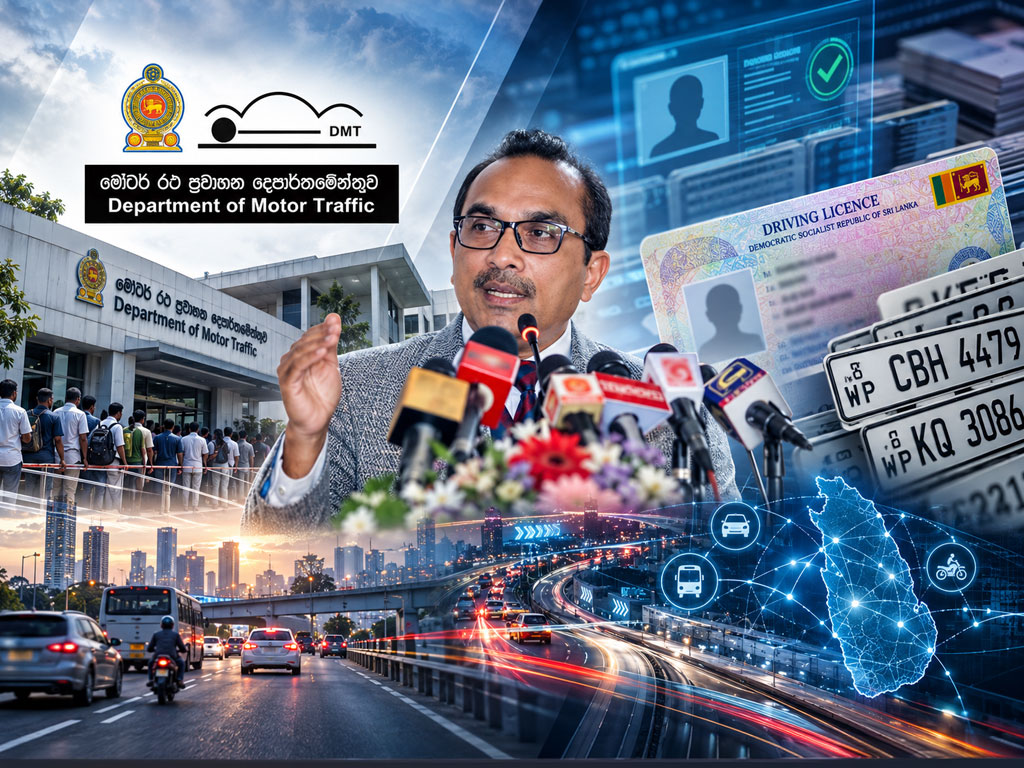
COLOMBO, October 19, 2026 — Sri Lanka is preparing to enforce a digital traffic demerit-points system while the Department of Motor Traffic struggles with 673,000 unprinted driving licence cards and a reported backlog of 958,651 vehicle number plates, exposing the gap between technological ambitions and basic public services.
Sri Lanka’s plans to introduce a digital demerit-points system for traffic offenders are moving forward even as the Department of Motor Traffic (DMT) struggles to clear hundreds of thousands of unprinted driving licences and vehicle registration number plates, exposing a fundamental weakness in the country’s transport administration.
Figures presented to the Ministerial Consultative Committee on Transport, Highways and Urban Development indicate that approximately 673,000 driving licence cards remain unissued, while a reported 958,651 vehicle number plates have accumulated in an earlier registration backlog.
The figures underscore the scale of an administrative problem that has persisted despite repeated promises to modernise the Department.
Transport, Highways and Urban Development Minister Bimal Rathnayake has defended the proposed demerit-points system as a necessary measure to improve road discipline and reduce accidents.
The reform offers a potentially useful mechanism for identifying repeat traffic offenders. Its successful implementation, however, will depend on the reliability of the same administrative and technological infrastructure that has struggled to deliver essential documents to motorists.

How the 30-Point Demerit System Will Work
The proposed system is designed to discourage repeated traffic violations by attaching penalty points to offences committed by licensed drivers.
A six-month pilot programme is under way and is scheduled to continue until March 31, 2027.
During the trial, motorists are to receive SMS notifications informing them of the points associated with traffic violations after they settle the relevant fines.
The Government has described the pilot as an awareness-building exercise intended to familiarise drivers with the system before full implementation.
The proposed enforcement arrangements include three principal measures:
- Licence suspension: Drivers who accumulate 30 demerit points would face automatic suspension of their driving licences for one year. Suspended licences would have to be surrendered to the nearest police station.
- Rehabilitation and training: Drivers who successfully complete prescribed rehabilitation programmes and training sessions could have their suspension reduced from one year to three months.
- SMS notification during the pilot: Motorists would be notified of accumulated penalty points through text messages during the trial, rather than immediately facing the proposed full enforcement consequences.
The new system would therefore introduce a record of repeated violations, rather than treating every offence as an isolated incident.
Such an approach could improve road safety if it is supported by accurate records, reliable identification procedures and consistent enforcement.
The concern is whether the DMT’s existing operational difficulties will undermine those objectives.
Sri Lanka Driving Licence Backlog Reaches 673,000
The Department’s difficulties are most clearly illustrated by the large number of driving licence cards awaiting printing.
Commissioner General of Motor Traffic, retired Air Vice Marshal Thushara Indunil Fernando, informed the parliamentary committee that approximately 673,000 licences remained pending because of shortages involving blank cards and printing equipment.
The Department has also encountered uncertainty over future supplies.
According to Fernando, an existing stock of one million cards could be exhausted by January 2027, while the first consignment under a new contract for two million cards is expected only towards the end of March.
To bridge the anticipated supply gap, officials have proposed seeking Cabinet approval to purchase a further 500,000 cards from the existing supplier.
The Commissioner General indicated that the backlog could be cleared by the middle of 2027.
For motorists awaiting their permanent documents, however, that timetable means further months of uncertainty.
Temporary documents may allow eligible motorists to continue driving, but they do not eliminate the inconvenience and practical difficulties caused by prolonged delays in issuing official cards.
The backlog is particularly troubling because printing and delivering driving licences is one of the Department’s most basic responsibilities.
Introducing additional digital enforcement mechanisms while this function remains disrupted places further pressure on an institution already struggling to meet existing obligations.
Nearly One Million Vehicle Number Plates Reported Pending
Driving licences are only one part of the problem.
The parliamentary committee was also informed that 958,651 vehicle registration number plates remained pending from applications accumulated between January 1, 2025, and March 9, 2026.
Fernando reportedly indicated that this backlog could be cleared within seven to eight months if the existing contractor was assigned the necessary production work.
The figure reflects a substantial administrative failure affecting vehicle owners who have completed registration procedures but have not received their permanent plates.
Other recent reporting has cited approximately 450,000 plates as pending. The apparent difference between these figures requires clarification, particularly whether they cover different registration periods, outstanding production orders or categories of applications.
Vehicle number plates are not merely administrative accessories. They are an essential means of identifying vehicles during traffic enforcement, accident investigations and criminal inquiries.
Extended delays create additional complications for drivers, law enforcement personnel and authorities responsible for maintaining accurate vehicle records.
The question is why a statutory registration process has been permitted to accumulate such a large backlog without an effective supply and production arrangement.
Can Digital Penalties Work Without Physical Licence Cards?
One of the central concerns raised by the proposed demerit system is how it will operate in a country where hundreds of thousands of drivers are awaiting permanent licence cards.
Under the planned enforcement procedure, a driver whose licence is suspended would be required to surrender it to the nearest police station.
Yet many motorists are still using temporary documentation while awaiting their permanent cards.
This creates a practical question about how physical surrender requirements will be administered when a driver has never received the card.
It does not necessarily mean digital enforcement will be impossible.
If licence records, identification details and suspension notices are maintained accurately in a central database, authorities could theoretically enforce suspensions without relying exclusively on possession of a physical card.
The effectiveness of that arrangement would depend on clear legal provisions, reliable database access, accurate links between drivers and their records, and appropriate procedures for police verification.
Authorities must also ensure that motorists receive accurate notifications and have a means of challenging incorrect records.
Without those safeguards, an otherwise useful reform risks creating confusion rather than improving compliance.
Procurement Delays and Dependence on Existing Suppliers
The Commissioner’s proposed response to the shortage has also raised questions about procurement planning.
Officials are considering an additional purchase of 500,000 driving licence cards from the existing supplier to cover the period before the new contract begins delivering.
In the case of vehicle number plates, the Department has indicated that assigning production work to the existing contractor could help clear the backlog within seven to eight months.
These measures may provide short-term relief, but they also demonstrate the Government’s continuing reliance on established suppliers.
The original commentary questions whether returning to existing contractors is the best solution when prolonged supply difficulties have already disrupted essential services.
That concern warrants scrutiny, although the available information does not establish that individual suppliers caused the entire backlog or breached contractual obligations.
Responsibility may involve procurement timetables, contract administration, printing capacity, shortages of materials or a combination of operational failures.
A proper assessment requires examination of contract terms, delivery commitments, performance records, procurement decisions and the Department’s internal planning.
The more important issue is whether emergency purchasing arrangements will solve the underlying problem or merely postpone another disruption.
Personalised Number Plates: Revenue Opportunity or Enforcement Risk?
The committee has also considered introducing personalised vehicle registration number plates as a potential source of additional government revenue.
Such arrangements could generate income by allowing motorists to select distinctive registration combinations under an approved scheme.
However, financial returns should not be the only consideration.
Any personalised number plate system would need to maintain uniform technical standards and preserve the ability of authorities to identify vehicles reliably.
Two areas require particular attention:
- Technical compatibility: Personalised plates must remain readable by police surveillance cameras and automatic number plate recognition (ANPR) systems. Their appearance should not undermine the accuracy of automated vehicle identification.
- Legal and security safeguards: Registration rules must ensure that personalised combinations cannot create confusion, duplicate existing identifiers or obstruct investigations involving traffic offences, accidents or criminal activity.
The Department would also need to establish transparent allocation procedures and clear rules governing the ownership, transfer and cancellation of personalised registration numbers.
Introducing another service before resolving existing plate shortages could place further strain on an already overburdened system.
Digital Reform Must Begin With Administrative Reliability
The Ministerial Consultative Committee’s discussions, which included Deputy Ministers Dr. Prasanna Gunasena and Eranga Gunasekara, reflect a broader attempt to modernise Sri Lanka’s transport sector.
The proposed demerit-points system, electronic notifications and personalised registration services may each have a place in improving road safety and administrative efficiency.
Their introduction should nevertheless be matched by improvements in the Department’s underlying operations.
Motorists should not have to wait months for a licence card or registration plate after completing the legally required procedures.
Minister Rathnayake has directed officials to take urgent action to clear the outstanding applications and improve the issuance process.
That response should now be supported by realistic production deadlines, transparent procurement arrangements and regular public reporting on progress.
A separate parliamentary oversight inquiry into the delays provides an opportunity to establish why the backlogs developed and identify the operational weaknesses that allowed them to persist.
The success of transport modernisation will not be measured solely by the sophistication of a new digital penalty system.
It will also depend on whether the Department of Motor Traffic can perform its existing responsibilities accurately, efficiently and on time.
For the hundreds of thousands of motorists awaiting their documents, that remains the more immediate test of reform.