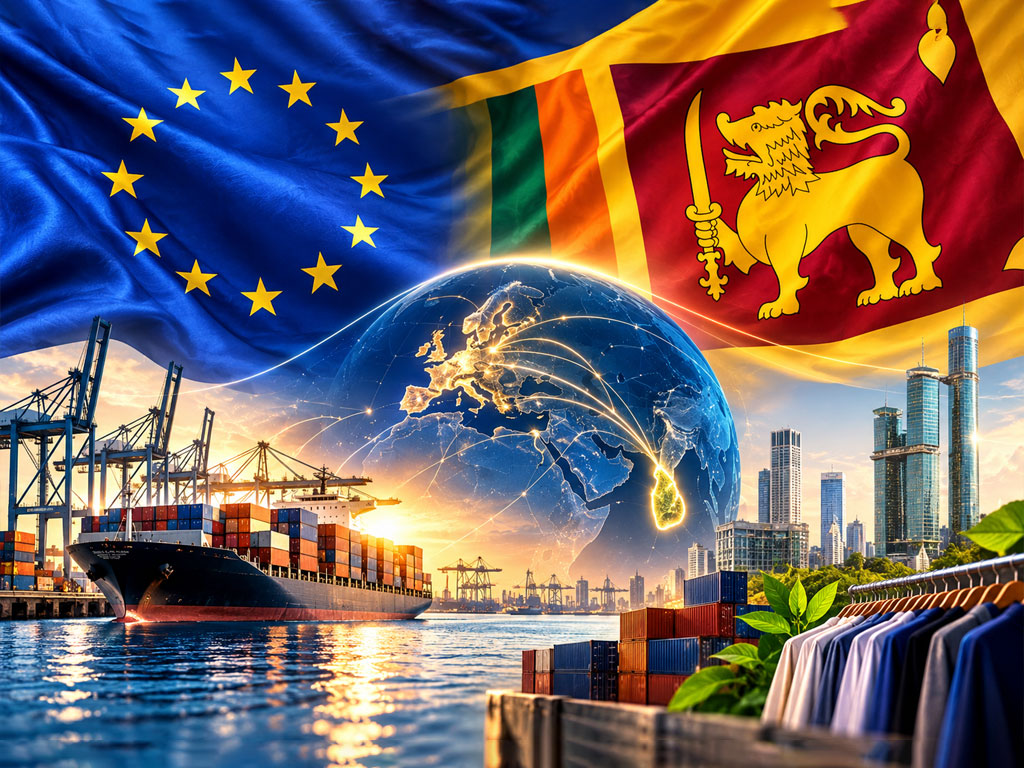
COLOMBO — The European Union’s revised GSP+ scheme introduces additional human rights, labour, environmental and governance obligations, giving Sri Lanka two years to prepare a fresh application while retaining preferential market access.
Sri Lanka will continue receiving preferential access to the European Union market until December 31, 2028, under transitional arrangements that give the Government additional time to comply with stricter conditions governing the bloc’s Generalised Scheme of Preferences Plus (GSP+).
The revised framework, established under EU Regulation 2026/1395, comes into effect on January 1, 2027, and expands the international conventions associated with the scheme from 27 to 32.
For Sri Lankan exporters, particularly apparel manufacturers, the transitional arrangement provides continuity in a major overseas market while placing greater responsibility on the Government to demonstrate progress in human rights, labour protection, environmental standards and good governance.
Countries currently benefiting from GSP+ must submit fresh applications before the transitional period ends if they wish to retain the concessions under the revised framework from 2029.
Beneficiaries that submit applications in accordance with the new requirements can continue receiving preferences while the European Commission completes its assessment.
The change therefore provides temporary certainty for exporters but does not guarantee Sri Lanka’s continued eligibility beyond the transition.

Five Additional Conventions Under Revised GSP+ Framework
The European Union’s revised trade preferences scheme introduces five additional international conventions, expanding the total number of relevant instruments to 32.
The new requirements address disability rights, child protection, workplace oversight, consultation on international labour standards and transnational organised crime.
The five additions are:
1. Rights of Persons with Disabilities: The United Nations Convention on the Rights of Persons with Disabilities strengthens commitments concerning equal opportunities, accessibility, non-discrimination and legal protection for people with disabilities.
2. Protection of Children in Armed Conflict: The Optional Protocol to the Convention on the Rights of the Child on the involvement of children in armed conflict establishes safeguards against the recruitment and use of children in hostilities.
3. Workplace Labour Inspections: International Labour Organization Convention No. 81 addresses labour inspection in industry and commerce, promoting effective oversight of workplace conditions and compliance with labour protections.
4. Tripartite Labour Consultation: ILO Convention No. 144 concerns consultation among governments, employers and workers on international labour standards.
5. Combating Transnational Organised Crime: The United Nations Convention against Transnational Organized Crime strengthens international cooperation against organised criminal activity, including associated trafficking and cross-border criminal networks.
In addition, the Paris Agreement on climate change replaces the Kyoto Protocol among the environmental instruments covered by the revised framework.
The Paris Agreement is therefore a replacement within the updated list, rather than a sixth additional convention.
EU Trade Preferences Depend on More Than Export Prices
GSP+ provides preferential tariff treatment for eligible products originating from qualifying developing economies.
For Sri Lanka, the scheme is especially important to apparel exporters, whose competitiveness in European markets can be influenced by import duties.
The arrangement also benefits other qualifying product categories, subject to the rules governing product eligibility and origin.
Unlike ordinary commercial agreements based primarily on tariff arrangements, GSP+ links enhanced market access to commitments concerning internationally recognised standards.
Beneficiary countries must ratify and effectively implement the relevant conventions, rather than merely demonstrate that the documents have been formally signed.
The revised system strengthens the European Union’s emphasis on human rights, labour protections, environmental sustainability and responsible governance.
Consequently, maintaining preferential market access will depend partly on Sri Lanka’s ability to demonstrate that its domestic laws, institutions and enforcement practices are consistent with the requirements of the scheme.
For exporters, the wider implications extend beyond individual factories.
National labour inspection systems, human rights protections, environmental policy and institutional accountability can affect a country’s eligibility for benefits available to entire industries.
New Mechanism Allows Faster Withdrawal of Preferences
The revised EU regulation also introduces an urgent withdrawal procedure for exceptionally serious circumstances involving violations of relevant international standards.
The mechanism is intended to allow the European Union to respond more quickly when the gravity of alleged violations makes ordinary procedures inadequate.
Under the revised approach, certain urgent procedures can be completed within a substantially shorter timeframe than the standard withdrawal process.
The changes also expand the grounds on which trade preferences may be withdrawn, including serious and systematic violations of obligations concerning environmental protection, climate commitments and good governance.
Withdrawal is not automatic whenever an individual violation occurs.
The European Commission must follow the applicable legal procedures and assess the circumstances before action is taken.
Nevertheless, the strengthened mechanism increases the importance of effective national monitoring and timely responses to concerns raised by international organisations, civil society and other stakeholders.
Sri Lanka Must Prepare a Fresh Application Before 2029
Existing GSP+ beneficiaries, including Sri Lanka, have been given a transitional period ending on December 31, 2028, to prepare applications under the new rules.
The European Commission requires applicants to demonstrate compliance with the revised eligibility conditions, including the relevant international conventions.
The updated framework also requires applicants to submit a plan of action addressing the effective implementation of their commitments.
This places particular importance on identifying legislative gaps, improving institutional capacity and demonstrating practical enforcement.
Sri Lanka cannot secure long-term eligibility merely by relying on its existing status as a GSP+ beneficiary.
The Government will need to document the reforms undertaken and provide credible evidence of implementation.
On September 22, Deputy Finance Minister Anil Jayantha Fernando told Parliament that claims of an immediate suspension of Sri Lanka’s GSP+ benefits were incorrect.
He also said Cabinet had appointed a committee to examine preferential market access and another committee to prepare the country’s new application.
These preparations will be important because delays in legislative reform or administrative coordination could create difficulties as the transitional deadline approaches.
Government, Exporters and Trade Unions Face a Shared Task
Compliance with the revised framework extends beyond government ministries responsible for international trade.
Parliament will have a role in examining whether domestic legislation meets Sri Lanka’s international obligations.
Labour authorities must ensure that inspection systems operate effectively, while employers will need to maintain appropriate workplace standards.
Trade unions and civil society organisations can contribute by identifying enforcement weaknesses and providing information on conditions experienced by workers and affected communities.
Export manufacturers also have an interest in supporting transparent compliance systems because the loss of GSP+ eligibility could affect their competitive position in the European market.
A coordinated national monitoring arrangement involving public institutions, employers, workers and independent stakeholders could help identify problems before they threaten the country’s trade preferences.
Sri Lanka must now use the transitional period to move from formal commitments towards demonstrable implementation.
The immediate benefit is continued preferential access to the European market through 2028.
The longer-term test will be whether the Government can submit a credible application supported by effective legal, administrative and institutional reforms, allowing Sri Lankan exporters to maintain their competitiveness in one of the country’s most important markets.