COLOMBO — High-level talks in Baku have outlined plans to expand football facilities, strengthen national teams and establish a high-performance centre, with proposed FIFA funding potentially reaching US$25 million.
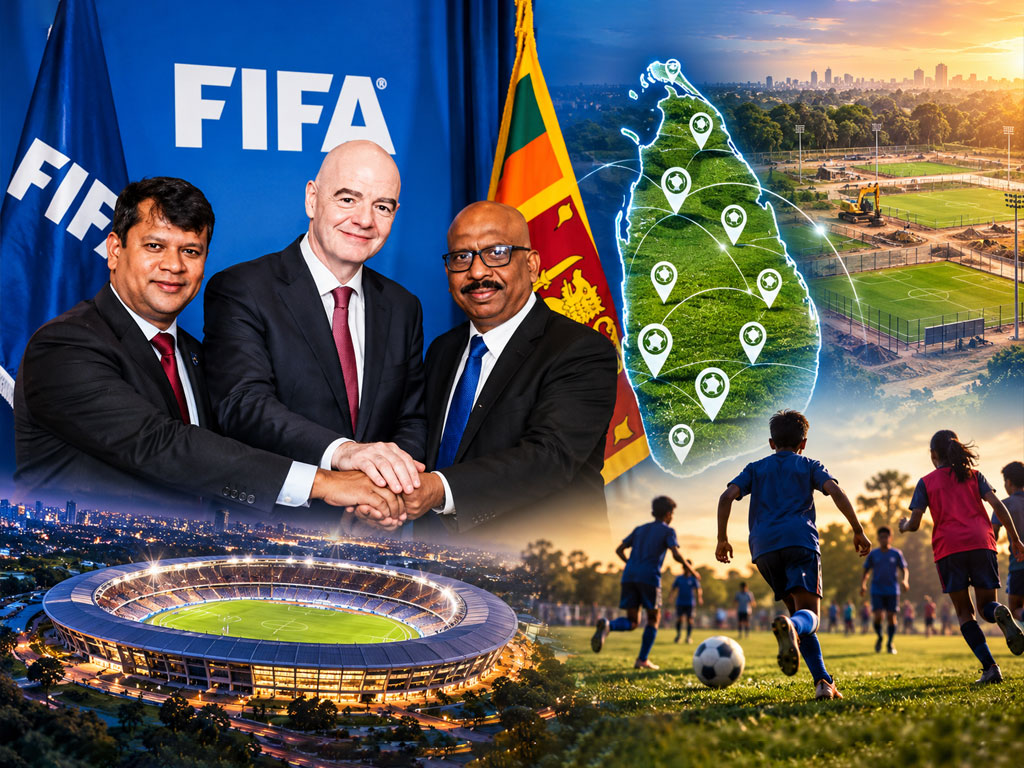
FIFA President Gianni Infantino has expressed support for an ambitious programme to develop football in Sri Lanka following discussions with Sports Minister Sunil Kumara Gamage and Football Federation of Sri Lanka (FFSL) President Jaswar Umar in Baku, Azerbaijan.
The meeting focused on expanding football infrastructure, improving training standards and creating opportunities for young players, as Sri Lankan authorities pursue a four-year strategy aimed at making football the country’s leading sport.
Sri Lanka’s delegation also included National Sports Council Chairman Priyantha Ekanayake and High Performance Centre lead Prasanna Jayalath.
Infantino welcomed the progress made in Sri Lankan football over the past two years and expressed FIFA’s willingness to strengthen cooperation with the Government and the FFSL.
The discussions follow renewed efforts to improve the national team’s performance, rebuild domestic competitions and secure international assistance for long-term development.

FIFA Funding Could Reach US$25 Million
A central component of Sri Lanka’s football development strategy is the prospect of accessing up to US$25 million in FIFA funding over the next four-year cycle.
FIFA has outlined plans to increase development allocations for member associations under its proposed FIFA Forward 4.0 programme.
However, the proposed funding arrangements remain subject to further approvals, eligibility requirements and procedures governing the submission and assessment of projects.
The amount should therefore be understood as a prospective allocation rather than an unconditional grant already disbursed to Sri Lanka.
FFSL President Jaswar Umar has indicated that the federation is preparing development proposals for submission to FIFA.
The proposed assistance is expected to support three principal areas:
- Raising the performance standards of Sri Lanka’s national football team and youth squads through improved facilities, training and player-development programmes.
- Expanding women’s football across the country by strengthening participation, competition structures and development opportunities.
- Introducing advanced international training programmes for Sri Lankan coaches and referees to improve technical standards and officiating.
The investment could provide a substantial financial foundation for the country’s football ambitions, provided that the relevant projects receive approval and are implemented effectively.
Plans for 40 Football Grounds by 2031
Infrastructure development featured prominently in the Baku discussions.
Sri Lankan authorities have proposed establishing football facilities across all districts, with the first phase of construction targeted to begin in 2027.
The objective is to make suitable playing grounds more accessible to young athletes, schools and clubs outside established football centres.
Under a related FFSL development proposal, approximately 40 football grounds would be established through affiliated member leagues by the end of 2031.
The programme is intended to reduce disparities in access to playing facilities while strengthening grassroots competitions and creating clearer pathways into provincial and national teams.
Discussions also addressed the possibility of developing a fully equipped international-standard football stadium.
Such a facility could support major domestic competitions, national team preparations and international fixtures.
The proposals remain at the planning stage, and details concerning locations, construction budgets, land allocation and implementation schedules have not been finalised publicly.
National High-Performance Centre Proposed
The development programme also includes plans for a National High-Performance Centre intended to improve the technical and physical capabilities of Sri Lankan footballers.
The proposed centre would operate through cooperation between the Ministry of Sports and the FFSL, with technical expertise and guidance sought from FIFA.
Its intended role includes supporting elite player development, modern coaching methods and structured preparation for national and youth teams.
A dedicated high-performance facility could also improve coordination between grassroots talent identification and advanced training.
The source proposal anticipates that the centre’s facilities and technical expertise could contribute to the wider development of Sri Lankan sport.
However, its location, operational structure, financing and construction timetable have yet to be confirmed through publicly available project documentation.
FIFA Recognises Progress in Sri Lankan Football
The renewed cooperation follows encouraging developments in Sri Lanka’s football administration and competitive performances.
Jaswar Umar has highlighted improvements in the national team’s international standing, the revival of domestic competitions and renewed institutional cooperation as indicators of progress.
The Asian Football Confederation has also acknowledged Sri Lanka’s recent advances and continued to support infrastructure development.
Infantino’s discussions with the Sri Lankan delegation reflected FIFA’s interest in expanding opportunities for aspiring players and strengthening the country’s football development framework.
The FIFA President emphasised the importance of cooperation between international football authorities, the Government and the national federation.
His remarks also highlighted youth football as a means of improving technical skills and providing young players with international competitive experience.
Government, FIFA and FFSL Seek Long-Term Partnership
The proposed programme depends on cooperation between three principal institutions: the Sri Lankan Government, FIFA and the Football Federation of Sri Lanka.
Government involvement would be particularly important in facilitating infrastructure projects, coordinating land and planning requirements, and supporting access to football facilities.
FIFA’s role would involve development funding, technical assistance and project oversight, subject to its established approval procedures.
The FFSL would be responsible for developing programmes, identifying priorities and coordinating implementation through its affiliated leagues and football institutions.
The four-year ambition to make football Sri Lanka’s leading sport is a development target rather than an established outcome.
Achieving it would require sustained participation, competitive domestic leagues, effective coaching, better facilities and measurable improvements in national team performances.
The proposed funding and infrastructure programme represents an opportunity to address longstanding weaknesses, but its success will depend on approved project plans, transparent financial management and the ability to translate international support into lasting improvements for players.
The next important steps will be the approval of FIFA’s funding arrangements, the submission of Sri Lanka’s development proposals and the confirmation of construction schedules for the planned football facilities.