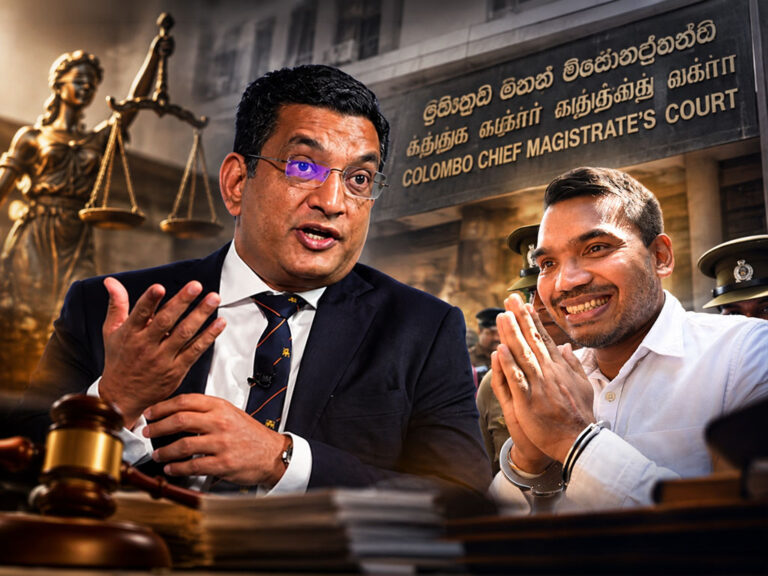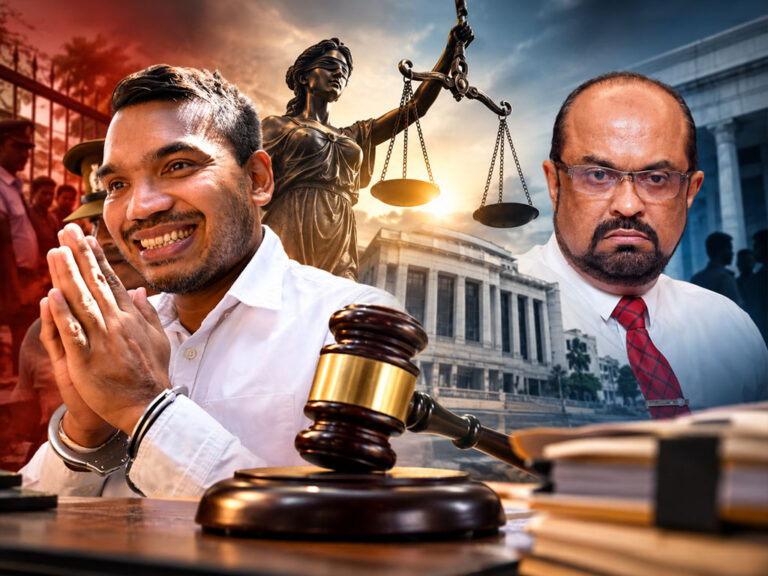
COLOMBO — The contrasting bail proceedings involving Namal Rajapaksa and former Minister Kumara Jayakody highlight the need for consistency, transparency and impartiality in the prosecution of corruption-related cases.
The contrasting approaches to bail in corruption-related proceedings involving opposition parliamentarian Namal Rajapaksa and former Energy Minister Kumara Jayakody have raised a question central to Sri Lanka’s criminal justice system: whether prosecutorial decisions are being applied consistently, regardless of a defendant’s political affiliation or position.
Article 12(1) of the Constitution guarantees equality before the law and equal protection of the law. That principle requires public authorities to exercise their powers without arbitrary discrimination or improper political influence.
Yet equal treatment does not necessarily mean identical decisions in every criminal proceeding.
Bail determinations depend on the offences alleged, the applicable legislation, the stage of proceedings, the evidence placed before the court and the risks identified by prosecutors.
The cases involving Rajapaksa and Jayakody provide an opportunity to examine how those distinctions operate in practice and whether the public receives sufficient explanation when prosecutors adopt different positions.

Sri Lanka’s Bail Act Establishes Release as the General Rule
The Bail Act, No. 30 of 1997, establishes the principle that granting bail should ordinarily be the rule, while refusing bail should be the exception.
The framework recognises that a person accused of an offence has not been convicted and should not automatically be deprived of liberty while the criminal proceedings remain unresolved.
Article 13(5) of the Constitution further protects the presumption of innocence until guilt is established according to law.
Section 14 of the Bail Act identifies circumstances in which a court may refuse bail or cancel an existing bail order.
These include:
- A reasonable belief that the suspect or accused may fail to appear for an inquiry or trial.
- A risk of interference with witnesses, tampering with evidence or otherwise obstructing justice.
- A likelihood that the person may commit another offence while on bail.
- Circumstances in which the gravity of the alleged offence and public reaction may give rise to public disquiet.
The existence of an allegation involving public money does not, by itself, automatically establish every ground for refusing bail.
Equally, the fact that an investigation has been completed does not necessarily eliminate all concerns about witness interference, non-appearance or the administration of justice.
Courts must assess the circumstances of each application, while taking account of any special statutory provisions governing the particular offence.
The prosecutor’s role is important because submissions concerning the investigation, witnesses and other relevant risks can influence how a bail application is considered.
Nevertheless, the final decision ordinarily rests with the court exercising jurisdiction under the applicable law.
Namal Rajapaksa’s Bail Applications Faced Strong Opposition
The proceedings involving Sri Lanka Podujana Peramuna (SLPP) parliamentarian Namal Rajapaksa illustrate a comparatively restrictive approach to bail in several corruption-related matters.
Rajapaksa was arrested on September 4, 2026, following questioning by the Commission to Investigate Allegations of Bribery or Corruption (CIABOC) over allegations concerning a Rs. 100 million payment associated with SriLankan Airlines’ Airbus aircraft procurement.
He has denied wrongdoing.
Subsequent hearings involved arguments over the progress of investigations, the legal grounds for continued detention and the courts’ authority to grant bail.
On September 29, the Colombo Chief Magistrate’s Court rejected an application for bail in the Airbus bribery proceedings and extended Rajapaksa’s remand.
The prosecution also pursued proceedings concerning alleged financial irregularities associated with the Krrish property development transaction.
Rajapaksa’s lawyers argued that the completion of investigations should be considered when deciding whether further remand was justified.
The distinction between the separate cases is important.
On September 30, the Colombo Fort Magistrate’s Court granted Rajapaksa bail in an Airbus-related money-laundering investigation, subject to cash bail, substantial surety conditions and a foreign-travel prohibition.
That decision did not secure his release because separate remand orders remained in effect.
The Attorney General subsequently filed an indictment containing 24 charges before a Permanent High Court Trial-at-Bar in connection with the Airbus transaction.
During the October 27 proceedings, the prosecution argued that the filing of the indictment had altered the jurisdictional position and that the Magistrate’s Court could no longer determine bail in the matter.
Rajapaksa remained in custody pending proceedings before the High Court.
These developments show that the prosecution and courts addressed several distinct legal questions, including alleged bribery, money laundering, remand and jurisdiction.
They should not be treated as one undifferentiated bail decision.
Kumara Jayakody Released on Two Rs. 1 Million Bonds
A different procedural outcome occurred in the corruption proceedings involving former Energy Minister Kumara Jayakody, who was indicted before the Colombo High Court over alleged irregularities in a procurement process at the Lanka Fertilizer Company.
The Bribery Commission alleges that Jayakody, while serving as a procurement manager, facilitated an undue advantage to a private company in connection with work at the company’s Hunupitiya warehouse complex.
The prosecution alleges that the transaction caused a State financial loss of Rs. 8,859,708.
Jayakody was charged under Section 70 of the applicable bribery legislation.
When the matter was taken up before Colombo High Court Judge Rashantha Godawela on March 27, 2026, Jayakody appeared in response to a court summons.
After the indictments were served, President’s Counsel Nalinda Indatissa, appearing for the defence, requested bail.
The court ordered Jayakody’s release on two personal bail bonds of Rs. 1 million each and directed that his fingerprints be recorded.
The case subsequently progressed to the examination of prosecution evidence.
Reports of the March 27 hearing do not record the kind of prolonged argument against bail described in several of Rajapaksa’s remand proceedings.
However, the absence of a reported objection cannot conclusively establish that prosecutors abandoned relevant concerns or deliberately treated Jayakody more favourably.
A full assessment would require the official proceedings, the submissions made by counsel and the legal basis for the court’s decision.
Different Outcomes Do Not Automatically Prove Political Bias
The contrast between the two politicians’ experiences may appear substantial.
Rajapaksa faced repeated remand orders and challenges to obtaining bail in certain proceedings. Jayakody was released on personal bonds after appearing in court in response to a summons.
Nevertheless, significant differences must be considered before drawing conclusions about unequal treatment.
Rajapaksa’s proceedings involved allegations associated with substantial financial transfers, alleged bribery and money laundering, as well as separate cases before different courts.
Jayakody’s case concerned an alleged procurement-related offence in which he had already been summoned before the High Court to receive indictments.
The procedural stages were therefore not identical.
Furthermore, special statutory provisions may govern particular offences and restrict the powers available to some courts.
A direct comparison must examine whether the same legal provisions applied, whether the prosecution identified equivalent risks and whether the accused were in comparable procedural circumstances.
Without that analysis, the different bail outcomes cannot establish that one defendant received preferential treatment because of political affiliation.
They can, however, justify closer scrutiny of how prosecutorial discretion is exercised.
Prosecutorial Discretion Must Follow Consistent Legal Standards
The Attorney General’s Department and CIABOC perform important prosecutorial functions in matters involving alleged corruption, bribery and financial misconduct.
Their responsibilities include assessing available evidence, presenting relevant facts and making submissions concerning bail.
Prosecutors are not required to oppose bail in every financial crime case.
Nor should they seek remand custody merely because the allegation is politically sensitive or involves a substantial sum of money.
The appropriate question is whether there are legally sustainable grounds for opposing release in the circumstances of the particular case.
This requires a consistent approach to matters such as witness interference, the destruction of evidence, the risk of absconding and the possibility of further offences.
Where prosecutors seek stringent bail conditions in one proceeding but do not raise similar objections in another, the difference should be capable of explanation through the law and the facts.
Such explanations do not require disclosure of confidential evidence or privileged prosecutorial deliberations.
They do, however, support accountability by demonstrating that submissions are based on identifiable legal considerations rather than personal, political or institutional preferences.
Public Confidence Depends on Impartiality and Transparency
Public confidence in criminal justice depends not only on the independence of judges but also on the conduct of those responsible for bringing cases before the courts.
Perceptions of unequal treatment can arise when prominent individuals experience substantially different outcomes without a clear public understanding of the legal reasons.
That perception can be particularly damaging in corruption cases involving public officials, where confidence in investigative and prosecutorial independence is essential.
The proper response is not to assume that every difference proves political interference.
Instead, comparable proceedings should be assessed against transparent legal principles.
The central questions include whether similar risks were identified, whether equivalent statutory provisions applied and whether the prosecution’s submissions reflected the available evidence.
Judicial decisions must also be understood within their individual procedural contexts.
Neither Rajapaksa nor Jayakody has been convicted in the proceedings discussed here. Both remain entitled to the presumption of innocence and the opportunity to contest the allegations against them.
The constitutional principle of equality before the law does not demand that every accused person receive identical bail conditions.
It demands that decisions be made through lawful, rational and impartial criteria.
The credibility of Sri Lanka’s anti-corruption efforts will depend in part on whether prosecutorial authorities can demonstrate that those criteria are applied consistently, irrespective of whether a defendant belongs to the Government or the Opposition.
SOURCE:- HARI DESHAYA