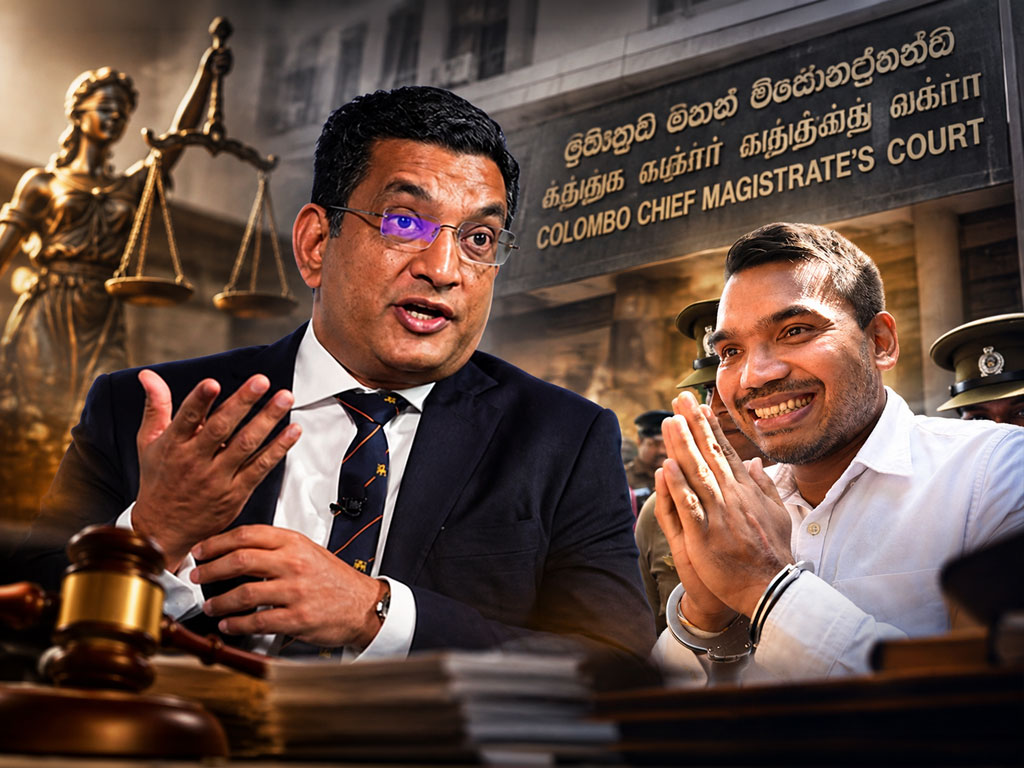
COLOMBO — Ali Sabry alleges political discrimination and appeals for bail on humanitarian grounds, while the Bribery Commission argues that the seriousness of the allegations and concerns over witness protection justify continued detention.
The Colombo Chief Magistrate’s Court has fixed November 3 to deliver its decision on a bail application filed on behalf of parliamentarian Namal Rajapaksa in the Krrish bribery investigation, following contentious exchanges between defence counsel and prosecutors over alleged political interference, witness protection and the medical conditions of his parents.
The proceedings before Chief Magistrate Asanga S. Bodaragama on October 27 and 28 brought sharply differing arguments from President’s Counsel Ali Sabry, appearing for Rajapaksa, and Commission to Investigate Allegations of Bribery or Corruption (CIABOC) Assistant Director Thanuja Bandara.
Sabry argued that his client was being denied the ordinary protections available to other suspects because of his political identity. The prosecution rejected that characterisation, maintaining that the nature of the alleged offences and concerns surrounding witnesses warranted continued remand.
The hearing also produced a disagreement over remarks attributed to Sabry concerning those who exercise power today potentially becoming its victims in the future.
Rajapaksa remains in remand custody in connection with separate investigations involving the Krrish property transaction and the SriLankan Airlines Airbus procurement. The present bail application concerns the Krrish proceedings.

Defence Invokes Constitutional Rights and Political Discrimination
Sabry placed considerable emphasis on constitutional protections, arguing that Rajapaksa should receive neither preferential treatment nor discriminatory treatment because of his political affiliation.
He relied on Article 13(5), which protects the presumption of innocence, and Article 12, which guarantees equality before the law and protection against specified forms of discrimination.
In the translated account supplied from the proceedings, counsel stated:
“We don’t want special treatment; treat us normally without discrimination. The judge is not a spectator. Use your power without being subject to anyone’s wishes.”
Sabry also criticised what he described as public statements by political leaders concerning the timing and outcomes of criminal proceedings.
Referring to remarks allegedly made by the President about forthcoming judgments and a list of 50 individuals, he questioned whether political authorities were attempting to influence perceptions of the judicial process.
The defence portrayed these circumstances as grounds for concern about the independence of legal proceedings.
Those submissions constitute allegations made by counsel. They do not establish that the President directed prosecutors or that the judiciary acted under political pressure.
Dispute Over Remarks About Oppressors and Victims
One of the most contentious exchanges concerned an earlier statement attributed to Sabry about those who act as oppressors potentially becoming the oppressed.
Bandara questioned whether the remarks could be understood as an indirect warning to investigators, prosecutors or witnesses.
Addressing the Magistrate, she argued that the comments had to be considered in the context of concerns already raised about witness intimidation.
According to the translated account, Bandara said:
“The witnesses in this case who were afraid to give statements initially, later came forward without fear and gave evidence after Namal Rajapaksa and Janaki were remanded.”
She maintained that any attempt to influence witnesses would undermine the integrity of the investigation.
The prosecution’s interpretation was disputed by Sabry, who rejected the suggestion that his remarks were intended as a threat.
“This wheel turns, that is what I meant,” he said, according to the supplied translation.
Sabry maintained that his comments concerned the changing circumstances of those exercising authority and should not be interpreted as intimidation directed at witnesses or investigators.
The exchange highlighted a central disagreement in the bail proceedings: whether the defence’s criticism of the prosecution represented legitimate legal advocacy or raised genuine concerns about potential interference.
No judicial finding establishing that Sabry threatened witnesses has been identified in the reporting reviewed.
Parents’ Medical Conditions Cited as Exceptional Circumstances
The defence also advanced humanitarian grounds for Rajapaksa’s release.
Sabry told the court that his client’s father, former President Mahinda Rajapaksa, aged 81, had been receiving medical treatment and required care.
He further submitted that former First Lady Shiranthi Rajapaksa, aged 74, was suffering from a serious cardiac condition and had been scheduled to undergo open-heart surgery at 4 p.m. on October 27.
According to counsel, Shiranthi had previously been responsible for caring for her husband, but her own medical condition had made those arrangements difficult.
Sabry argued that Rajapaksa, as the family’s eldest son, had responsibilities towards both parents and should be permitted to assist them during their illnesses.
The defence maintained that these circumstances should qualify as exceptional grounds for bail.
Sabry also compared the maximum sentence associated with the bribery allegation to penalties imposed for other serious offences, questioning why pretrial release could not be considered in the present proceedings.
The medical circumstances had been raised in earlier applications, but the defence submitted that their seriousness warranted renewed consideration.
Bribery Commission Rejects Humanitarian Grounds for Bail
Bandara opposed the application, arguing that the allegations under investigation involved serious corruption-related offences and could not be assessed solely on the basis of the accused person’s family circumstances.
She submitted that alternative arrangements were available for caring for Rajapaksa’s parents.
The prosecution maintained that the seriousness of the allegations and the need to protect the investigation remained important considerations.
Bandara also referred to the wider public interest in the investigation of bribery and corruption offences, arguing that such allegations affect public confidence in government and the administration of justice.
According to the supplied account, she emphasised that the law must be applied without favour, regardless of the identity or political standing of those under investigation.
The prosecution further submitted that the suspects, charges and circumstances involved in separate proceedings could not automatically be treated as interchangeable when determining bail.
Sabry responded that although the cases differed, Rajapaksa’s family responsibilities and his parents’ medical conditions remained the same.
The Magistrate was therefore asked to consider the humanitarian circumstances alongside the prosecution’s objections.
Court Examines New Grounds Presented by Defence
During the proceedings, Chief Magistrate Bodaragama observed that certain exceptional circumstances advanced by the defence had not been presented in the same manner at the previous hearing.
The court required the relevant material to be considered through the proper process, including allowing the prosecution to examine supporting documents.
Following the October 28 submissions, the Magistrate fixed November 3 for his order on the bail application.
The decision will concern whether the circumstances presented justify release under the applicable law, taking into account the prosecution’s objections and any relevant statutory restrictions.
The hearing did not determine Rajapaksa’s guilt or innocence in the underlying Krrish investigation.
His lawyers remain entitled to challenge the allegations, while prosecutors must establish their case through admissible evidence.
Political Revenge Allegations Remain Unproven
The proceedings illustrate two competing interpretations of Rajapaksa’s continued detention.
The defence maintains that constitutional guarantees, the presumption of innocence and the medical circumstances of his parents justify reconsideration of bail. Sabry has also alleged that political considerations are influencing how his client is treated.
CIABOC, by contrast, argues that the seriousness of the alleged offences and concerns over witnesses require the court to exercise caution.
Neither argument establishes the ultimate legal outcome.
Political affiliation cannot lawfully justify arbitrary discrimination against a suspect. Equally, holding political office does not entitle an accused person to preferential release from custody.
The court must assess the evidence, applicable statutory provisions and relevant circumstances independently.
That distinction is particularly important in politically sensitive corruption investigations, where accusations of selective prosecution and concerns about obstruction can both affect public confidence.
The judiciary’s responsibility is to determine the application according to law, without accepting political allegations or prosecutorial objections merely because they have been forcefully presented.
The next decision rests with Colombo Chief Magistrate Asanga S. Bodaragama, who is scheduled to deliver his bail order on November 3.