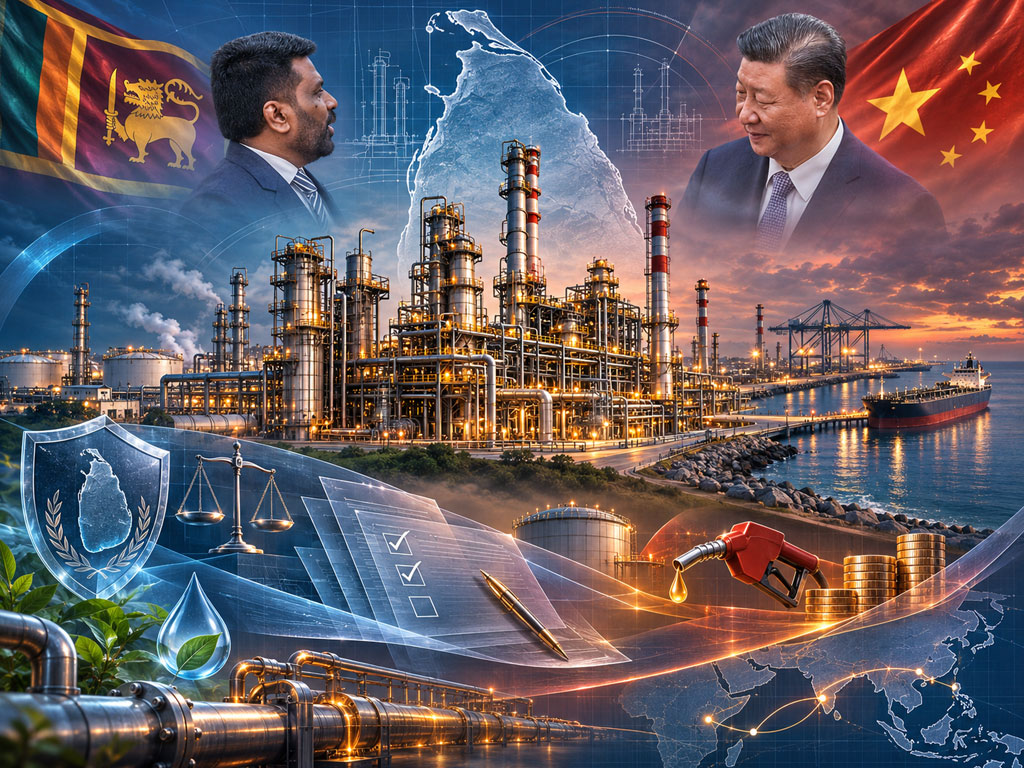
A reported recommendation to terminate the existing refinery award has intensified questions over tax concessions, domestic fuel sales, environmental safeguards and Sri Lanka’s ability to negotiate major foreign investments on equitable terms.
Sri Lanka’s proposed Sinopec oil refinery in Hambantota, widely promoted as one of the largest foreign direct investments in the country’s history, has reached a decisive stage following reports that a Cabinet-appointed negotiating committee recommended withdrawing the existing project award and inviting fresh proposals.
Estimated at approximately US$3.7 billion, with some accounts placing the broader investment value as high as US$4.5 billion, the project was intended to establish an export-oriented petroleum refinery near Hambantota Port.
Its future has become the subject of an increasingly heated debate, with some commentators interpreting the reported recommendation as evidence of a geopolitical shift away from China and towards India.
That interpretation, however, risks overlooking a more immediate question: whether the proposed commercial terms would deliver sufficient long-term benefits to Sri Lanka to justify the concessions requested by the investor.
The distinction matters. Rejecting unfavourable contractual conditions is not necessarily equivalent to rejecting foreign investment, nor does disagreement with a Chinese company automatically establish an anti-China policy.
Equally, the scale of a proposed investment cannot, by itself, demonstrate that an agreement serves the national interest.

The Committee’s Recommendation and the Government’s Responsibility
Sinopec received initial approval for the export-oriented Hambantota refinery project following a Cabinet decision dated 27 November 2023.
The proposal subsequently gained renewed prominence when Sri Lanka and China signed an agreement to advance the investment during President Anura Kumara Dissanayake’s visit to Beijing in January 2025.
The planned refinery would process approximately 200,000 barrels of crude oil per day, substantially exceeding the capacity of Sri Lanka’s existing Sapugaskanda refinery.
Negotiations nevertheless became complicated by disagreements over domestic-market access, taxation, land requirements and other commercial arrangements.
According to recent reports, the Cabinet-Appointed Negotiating Committee (CANC), together with the Project Committee, recommended two principal courses of action:
1. Withdraw the existing project award: Discontinue the approval granted to China Petroleum & Chemical Corporation for the proposed export-oriented refinery under the existing arrangements.
2. Invite fresh investment proposals: Begin a new, open and competitive Request for Proposals (RFP) process to identify an investor willing to develop the project under acceptable commercial and regulatory conditions.
The recommendation has been associated in published accounts with committee chairman B. K. Prabhath Chandrakeerthi and members Professor K. T. M. Udayanga Hemapala and A. K. D. D. Arandara.
However, the committee’s recommendation must be distinguished from a final decision by the Cabinet of Ministers. The Government’s formal position, including any decision to terminate the award or initiate a new procurement process, requires official confirmation.
Domestic Fuel Sales: The Dispute Over the 40% Proposal
One of the most contentious issues has been the proportion of refined petroleum products Sinopec would be permitted to sell within Sri Lanka.
The original project framework envisaged an export-oriented refinery, with approximately 80% of output intended for overseas markets and 20% available for domestic sales.
Subsequent negotiations reportedly examined increasing Sinopec’s access to the local market to as much as 40%.
At the proposed refining capacity of 200,000 barrels per day, that percentage represents approximately 80,000 barrels of refinery throughput, although the actual volume of saleable products would depend on the refinery’s output mix and operating conditions.
The implications extend beyond Sinopec’s commercial interests.
A substantial increase in domestic refined-fuel supply could alter competition between Sinopec, the Ceylon Petroleum Corporation (CPC) and other market participants. The potential consequences for the state-owned supplier would depend on pricing arrangements, distribution access, product demand and the competitiveness of existing operations.
It would therefore be premature to conclude that the proposed quota would inevitably destroy the CPC’s financial viability. Nevertheless, the Government has a legitimate responsibility to assess the consequences for national fuel supply, competition and public finances.
There is also an important development in the negotiating history. In January 2026, Energy Ministry Secretary Professor Udayanga Hemapala reportedly said Sinopec had agreed to proceed within the 20% domestic-sales limit.
Later accounts continued to identify market access among the disputed issues.
The precise status of this condition should therefore be established from the latest negotiating documents before any final judgment is reached.
Tax Concessions: What Would Sri Lanka Receive in Return?
The proposed refinery has also raised substantial questions about the duration and extent of tax relief requested by Sinopec.
Published reports have referred to requests for corporate income tax holidays lasting either 25 or 35 years, alongside exemptions involving withholding taxes and other fiscal obligations.
The discrepancy over the proposed duration must be resolved through examination of the relevant negotiating documents.
Regardless of the precise figure, extensive tax concessions warrant careful scrutiny.
Sri Lanka continues to face pressure to strengthen public revenue while households and domestic businesses bear a considerable tax burden. Against that background, a major foreign investment receiving exceptional tax treatment must demonstrate clear economic benefits.
Those benefits could include employment, infrastructure development, export earnings, technology transfer, supplier opportunities and additional commercial activity.
However, the Government must also assess revenue forgone through tax exemptions, potential environmental liabilities and the possibility that significant profits may be repatriated overseas.
A tax holiday does not necessarily mean an investor will contribute nothing to the economy or pay no taxes whatsoever. Different taxes, fees, payroll obligations and indirect economic effects must be considered separately.
The appropriate test is whether Sri Lanka’s total economic return would justify the proposed incentives when compared with alternative investments and procurement arrangements.
Environmental Protection and Hambantota’s Water Requirements
Environmental safeguards form another important part of the debate.
A refinery capable of processing 200,000 barrels of crude oil daily would require substantial water supplies, wastewater treatment, emissions controls and other environmental infrastructure.
Concerns raised in published accounts of the committee’s deliberations include the adequacy of environmental-impact documentation and arrangements for a desalination plant.
These matters are particularly significant in Hambantota, where local water availability and competing demands from communities, agriculture and industry require careful management.
Any refinery project must meet applicable environmental requirements before construction and operation.
The investor’s responsibilities for water sourcing, desalination, treatment facilities, waste management and environmental monitoring should be defined clearly in the final agreement.
It would be inappropriate to conclude, without the relevant regulatory records, that the investor committed a specific legal violation. Nevertheless, no agreement should leave the allocation of major environmental costs or operational liabilities uncertain.
Land, Foreign Exchange and State-Level Privileges
Reports concerning the negotiations have also identified requests for additional land, special foreign-exchange arrangements and commercial privileges comparable to those available to the CPC.
The source article refers to demands for an additional 100 to 200 acres beyond the land originally envisaged.
Such requests require detailed examination because their consequences cannot be assessed independently of the project’s design, financing and operating model.
Additional land may be necessary for storage facilities, transport connections, utilities or future expansion. Equally, it may impose costs on the state or affect alternative uses of public land.
Any request for exceptional foreign-exchange treatment must be assessed against Sri Lanka’s regulatory framework and its wider macroeconomic commitments.
The same applies to reported proposals involving the sale of surplus electricity to the national grid.
The central issue is not whether a foreign investor should be permitted to negotiate favourable terms. It is whether those terms are transparent, lawful, commercially justified and consistent with the country’s long-term interests.
Is the Sinopec Dispute Really About China and India?
The Hambantota refinery has inevitably attracted geopolitical attention.
China and India have substantial economic and strategic interests in Sri Lanka, including its ports, energy infrastructure and position along major international shipping routes.
Sinopec’s investment would represent an important expansion of China’s commercial presence in the island’s petroleum sector.
Yet the existence of regional competition does not establish that every disagreement over a Chinese investment results from Indian pressure.
Claims that the reported recommendation was made to favour India require direct evidence. The same standard applies to suggestions that critics or supporters of the agreement are being financed by foreign interests.
Political arguments should not be presented as established facts without supporting documentation.
Sri Lanka should evaluate the proposed investment primarily through its economic, environmental and legal merits.
The Government must be capable of rejecting unacceptable contractual terms without having that decision automatically interpreted as hostility towards the investor’s country of origin.
The Same Standards Must Apply to Indian and Other Investors
A principled position on national economic sovereignty cannot be selective.
If Sri Lanka determines that a particular agreement with Sinopec is unacceptable, it must apply equivalent scrutiny to proposals submitted by Indian, Middle Eastern, Western or other Chinese investors.
Any future refinery tender should be governed by consistent eligibility requirements, transparent evaluation criteria and clearly defined contractual obligations.
That principle must extend to major companies operating across the region, including Indian energy businesses such as Lanka IOC and the Adani Group, should they participate in relevant future investment proposals.
No investor should receive preferential treatment simply because of the country from which its capital originates.
Conversely, a company should not be excluded solely because of geopolitical perceptions unrelated to its qualifications or the merits of its proposal.
An appropriately structured competitive tender would allow Sri Lanka to compare financing, technical capability, environmental compliance, fiscal returns and long-term energy-security implications.
Sapugaskanda: Strengthening Sri Lanka’s Domestic Refining Capacity
The uncertainty surrounding Hambantota has renewed attention on the modernisation and expansion of the state-owned Sapugaskanda refinery.
Sapugaskanda remains a central component of Sri Lanka’s domestic petroleum infrastructure, although its limited capacity and ageing facilities constrain the volume and range of products it can supply.
A modernisation programme could potentially provide several benefits:
– Greater domestic refining capacity: Increasing the processing of imported crude oil could reduce reliance on some categories of imported refined petroleum products, subject to economic viability.
– Improved foreign-exchange efficiency: Domestic refining may retain more value within the economy where refining costs, crude procurement and product yields are competitive.
– Industrial by-products: Expanded refining capacity could improve domestic availability of bitumen, furnace oil, naphtha and other products used in construction, manufacturing and electricity generation.
– Potential Treasury returns: A commercially successful state-owned refinery could contribute dividends and other revenue to the Government, provided it operates efficiently and earns sustainable profits.
– Stronger supply resilience: Additional domestic production capacity could provide greater flexibility during disruptions to international fuel supply chains.
These potential advantages do not eliminate the need for careful financial assessment.
Refining margins fluctuate, crude oil imports require foreign exchange, and refinery modernisation demands substantial capital investment.
State ownership alone does not guarantee profitability.
Accordingly, proposals to expand Sapugaskanda should be evaluated using the same rigorous standards applied to any proposed foreign-financed refinery.
A Strategic Choice, Not a Rejection of Investment
Sri Lanka requires foreign investment to strengthen industrial capacity, create employment and support long-term economic growth.
The Hambantota refinery proposal offered the prospect of substantial capital inflows and the development of an export-oriented petroleum-processing industry.
Abandoning such an opportunity without examining commercially workable alternatives could carry significant costs.
At the same time, the promise of a multibillion-dollar investment should not oblige the Government to accept concessions whose long-term consequences have not been adequately assessed.
The most constructive course would be to establish precisely why negotiations reached an impasse, publish an appropriate account of the disputed terms and explain the economic reasoning behind any final Cabinet decision.
If a new international tender is authorised, it should preserve genuine competition while protecting public revenue, environmental standards and national energy security.
Ultimately, Sri Lanka’s objective should not be to favour China over India, or India over China. It should be to secure an investment framework under which the country receives a fair and sustainable return from the use of its resources, markets and strategic infrastructure.
That is the standard against which the Government’s eventual decision on the Sinopec Hambantota refinery should be judged.