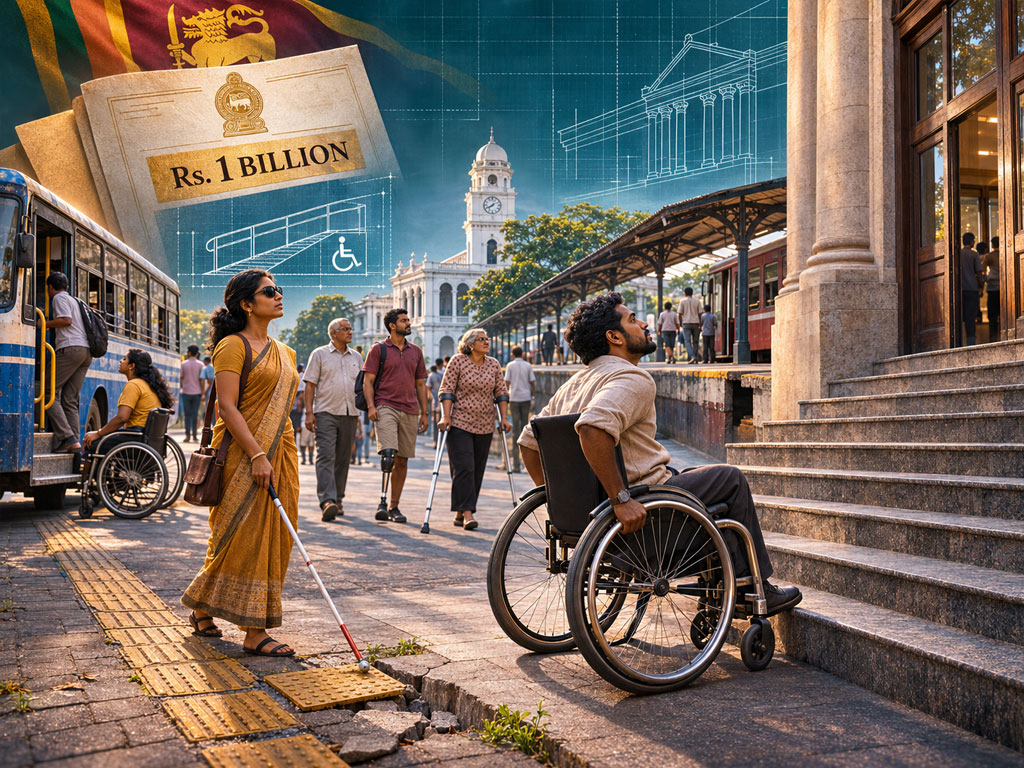
Sri Lanka has promised Rs. 1 billion to make public spaces accessible to people with disabilities. But for citizens still confronted by impassable pavements, inaccessible government offices and public transport they cannot use, the real question is painfully simple: will the money finally remove the barriers, or merely produce another impressive announcement?
Rights Written Into Policy, Barriers Built Into Everyday Life
For decades, Sri Lankans with disabilities have faced a troubling contradiction. Their rights may be recognised in laws, policies and official pronouncements, yet something as ordinary as entering a government building, boarding a bus or travelling safely along a pavement can remain an extraordinary challenge.
The concerns raised by disability advocates, including Chameera Pubudu Kumara of the Federation of Visually Impaired People, highlight a persistent failure to translate public commitments into practical accessibility.
This is not simply an infrastructure problem. It raises fundamental questions about dignity, equal citizenship and the government’s responsibility to ensure that public services are genuinely available to everyone.

What the Official Numbers Actually Reveal
Sri Lanka’s 2024 Census of Population and Housing identified 727,293 people aged five and above with at least one significant disability across six functional domains.
The Department of Census and Statistics recorded:
- 447,969 people with significant difficulty walking or climbing steps.
- 192,578 people with significant difficulty seeing.
- 189,292 people with significant difficulty performing self-care activities.
- 167,826 people with significant difficulty remembering or concentrating.
- 130,097 people with significant difficulty hearing.
- 112,798 people with significant difficulty communicating.
These categories overlap because a person may experience difficulties in more than one area.
Broader estimates of disability have previously been considerably higher, including figures around 1.6 million to 1.7 million. Different definitions and measurement thresholds help explain the variation.
The existence of census data, however, does not mean the government possesses a sufficiently detailed, continuously updated picture of accessibility needs in every community.
Statistics alone cannot tell officials whether a wheelchair user can enter a particular hospital, whether a railway platform is accessible or whether a person with a visual impairment can safely navigate a busy junction.
That requires practical assessments, reliable local information and regular monitoring.
Will Rs. 1 Billion Make a Measurable Difference?
The government’s 2026 Budget proposed allocating Rs. 1,000 million to improve accessibility and sanitation facilities at public locations, including Divisional Secretariats, railway stations, bus stands, courts and police stations.
The allocation is welcome in principle. Accessible public infrastructure requires investment, and years of neglect cannot be corrected without financial commitments.
Nevertheless, announcing a substantial allocation is not the same as delivering improvements that people can use.
Accessibility must be measured by outcomes, not the number of projects announced or the amount of money allocated.
A ramp that is too steep, a pavement obstructed by utility poles or an accessible toilet that remains locked serves little purpose, regardless of how much its construction costs.
Likewise, a renovated railway station cannot reasonably be described as accessible if passengers with disabilities still cannot board the trains.
The critical question is whether public funds will produce facilities that meet appropriate standards and remain functional after construction.
Three Questions the Government Must Answer
Before celebrating another allocation, the public deserves clear answers:
- Which locations will benefit? Authorities should publish a detailed list of the public buildings and transport facilities selected for improvements, explaining how priorities were determined.
- Who will verify the work? Independent accessibility assessments, involving people with different disabilities, should establish whether completed projects are genuinely usable.
- What happens when facilities fail? Authorities must identify who is responsible for maintaining ramps, lifts, accessible toilets, pedestrian crossings and other improvements after the initial expenditure.
Without transparent answers, even well-intentioned spending risks becoming another exercise in announcing progress rather than achieving it.
Accessibility Is a Right, Not a Government Favour
People with disabilities should not have to depend on sympathy, political promises or the goodwill of individual officials to exercise ordinary rights.
They are entitled to access public institutions, education, transport, employment opportunities and essential services on an equal basis with other citizens.
The government’s responsibility extends beyond constructing isolated facilities. Accessibility should be considered when planning roads, purchasing buses, designing government buildings and maintaining existing infrastructure.
Importantly, people with disabilities must participate in decisions affecting them. Their firsthand experience can reveal practical shortcomings that conventional engineering inspections might overlook.
A genuinely inclusive approach would also establish clear implementation deadlines, publish expenditure and progress reports, and make responsible institutions answerable for failures.
The Real Test Begins After the Budget Announcement
Sri Lanka does not lack evidence that accessibility matters. Its census provides important information, disability advocates have repeatedly identified everyday barriers, and the government has now proposed substantial public funding.
What remains to be demonstrated is whether those commitments will produce lasting change.
The success of the Rs. 1 billion initiative should ultimately be judged by a person who can finally enter a public office independently, a commuter who can safely use public transport, or a student who no longer encounters unnecessary obstacles on the way to school.
Until those experiences become commonplace, accessibility will remain a promise that looks far more convincing on paper than it does on the streets.
Sri Lankans with disabilities deserve more than another allocation. They deserve public spaces that allow them to participate fully and independently in the life of their country.