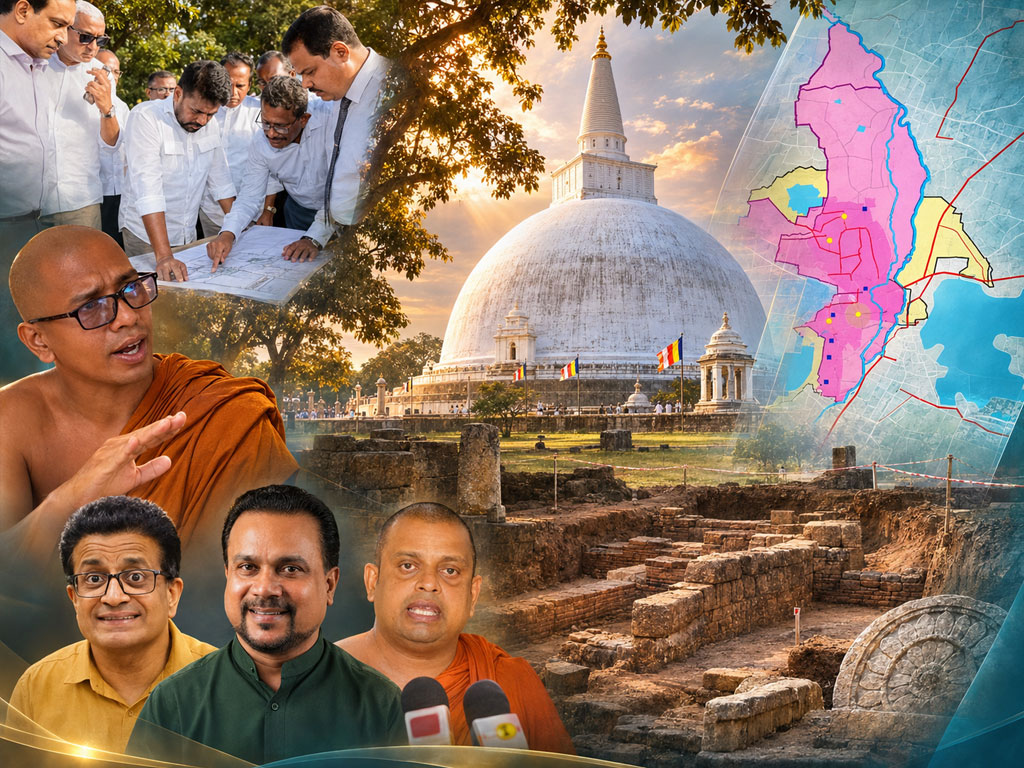
Warnings about endangered stupas, underground construction and new religious buildings have dominated the controversy surrounding Anuradhapura’s development plan. Yet behind the heated political rhetoric lies another difficult question: how can Sri Lanka protect its ancient archaeological landscape while fairly addressing the rights of families occupying land earmarked for conservation?
A Sacred City Caught in a Political Storm
The proposed Anuradhapura Sacred City Development Plan has become the focus of a contentious national debate, with warnings that some of Sri Lanka’s most revered Buddhist monuments could face damage and that the religious identity of the ancient city may be threatened.
However, beyond the allegations and political exchanges lies a separate controversy involving archaeological conservation, land occupation and the possible relocation of residents from historically significant areas.
The dispute intensified following an October 26 media briefing in Colombo by Pivithuru Hela Urumaya leader and former parliamentarian Udaya Gammanpila.
He raised concerns that proposed underground construction and tunnels could threaten the foundations of major stupas, including the Ruwanwelisaya.
Gammanpila also questioned whether the development plan’s zoning provisions could permit additional religious buildings, including kovils, as well as liquor outlets and spas within designated service areas.
His objections centred on the protection of Anuradhapura’s Buddhist identity and the potential consequences of development within an exceptionally sensitive archaeological and religious landscape.

Planning Authorities Reject the Allegations
The National Physical Planning Department (NPPD) has disputed interpretations suggesting that the plan authorises new religious constructions or restricts the movement of devotees.
Its Director General, Ruchira Withana, has explained that the development proposals form part of a continuing planning process intended to protect the sacred city’s historical and religious importance.
Authorities have also addressed concerns about protective fencing near the Ruwanwelisaya, explaining that the structure is situated approximately 500 metres from the stupa and is intended to prevent animals from entering protected areas.
The department maintains that the project does not propose new kovils or other religious structures within the sacred area.
Meanwhile, a complaint has been lodged with the Criminal Investigation Department against Gammanpila over his statements.
The complaint, associated with Anuradhapura activist Upali Ratnayake, alleges that the remarks could mislead the public and generate religious tensions.
The filing of a complaint does not establish that Gammanpila committed an offence. Nor does the department’s rejection of his interpretation remove the need for independent scrutiny of the development proposals.
A project involving monuments of such profound religious and historical importance must withstand detailed examination, regardless of which political group supports or opposes it.
The Archaeological Question Behind the Controversy
One of the less-discussed aspects of Anuradhapura’s development is the continuing need to investigate, document and conserve archaeological remains beyond its best-known places of worship.
The ancient city’s significance extends far beyond the principal stupas and temples visited by pilgrims.
Its historical landscape includes residential areas, monastic complexes, ancient structures, fortifications and the remains of administrative centres.
Archaeologically important areas in western Anuradhapura, including locations around Sanghamitta Mawatha and Anula Mawatha, have attracted interest because of surviving structural remains.
The original account of the controversy describes proposed investigations involving padhana ghara structures, possible palace remains and parts of the ancient inner city.
It also refers to earlier explorations in which vegetation was cleared to reveal building foundations and other archaeological features.
Such work can contribute substantially to understanding the city’s development. Nevertheless, claims that particular remains have been conclusively identified as royal palaces dating to 600 BC require supporting archaeological reports before they can be treated as established findings.
Likewise, the existence of historic kovil remains must be understood through archaeological evidence rather than contemporary religious disputes.
Anuradhapura’s past is too important to be interpreted through political speculation.
Is Land Occupation a Major Factor?
The controversy becomes more complicated when attention turns to residential occupation within areas identified for conservation and development.
The government’s own account of discussions held in August 2026 acknowledged the proposed resettlement of 331 families living in the Inner City area at Lolugaswewa.
President Anura Kumara Dissanayake instructed officials to examine alternative arrangements, including land, housing or financial compensation.
That acknowledgement confirms that displacement and resettlement are genuine considerations within the development programme.
It does not, however, establish that every affected household occupies land unlawfully.
The original criticism of the project alleges that some residents have built houses on historically significant land and that certain properties may have obtained permits through political intervention.
It further suggests that individuals seeking to protect their occupation of such land may have an interest in encouraging opposition to archaeological investigations.
Those allegations deserve examination, particularly where construction may have damaged protected archaeological remains or where land permits were issued improperly.
But the motives of individual protesters, residents or religious figures cannot responsibly be presented as proven without evidence.
Some residents may have legitimate concerns about losing homes, livelihoods or property they have occupied for many years.
Others may have legal documentation whose validity requires examination.
A credible investigation must distinguish between unlawful encroachment, disputed permits and households with legitimate rights.
Conservation Cannot Become an Excuse for Injustice
Protecting archaeological land is a legitimate responsibility of the State. So is ensuring that people affected by public development projects are treated lawfully and fairly.
Neither obligation cancels the other.
If unauthorised construction has occurred on protected archaeological land, officials should establish when it happened, who approved it, whether political influence was involved and what legal remedies are available.
Where relocation is necessary, the authorities must clearly explain the process, assess individual circumstances and provide any compensation or resettlement assistance required by law.
The government’s approach must also prevent future encroachment through consistent enforcement rather than occasional action prompted by political controversy.
At the same time, archaeological investigations should proceed under qualified professional supervision, with findings made accessible to the public.
Religious leaders, historians, archaeologists and affected residents should have meaningful opportunities to examine and discuss the plans.
Anuradhapura Is Already a World Heritage Site
There is another important factual distinction in this debate.
The Sacred City of Anuradhapura was inscribed on UNESCO’s World Heritage List in 1982.
The challenge today is therefore not to secure its initial recognition as a World Heritage Site, but to preserve the qualities that justified that recognition.
Poorly planned construction, damage to archaeological remains and inadequate management could undermine the site’s heritage value.
Equally, conservation measures that disregard the living religious character of Anuradhapura or the rights of affected communities could create unnecessary conflict.
The government’s development proposals include improvements to transport, sanitation, access roads and facilities for pilgrims.
Officials have also discussed expanding the planned sacred area from approximately 28 to 38 square kilometres.
These objectives deserve serious consideration, but their implementation must be transparent and sensitive to the city’s exceptional importance.
Publish the Evidence, Protect the Heritage
The controversy should not be reduced to a choice between protecting Buddhism and supporting development.
Anuradhapura requires both religious protection and responsible archaeological conservation.
The public deserves access to the gazetted plan, detailed maps, archaeological assessments, environmental studies and proposed construction specifications.
Equally important are transparent records identifying affected properties, the legal basis for any relocation and the procedures for resolving disputes.
If claims about dangerous underground construction are credible, they should be investigated through independent technical assessments.
If allegations of politically assisted land occupation are supported by evidence, the responsible authorities should investigate those dealings without discrimination.
Neither fearmongering nor official reassurances alone can resolve a dispute of this magnitude.
Anuradhapura belongs to Sri Lanka’s shared historical inheritance. Its protection must not depend on political allegiance, religious suspicion or the private interests of those who may benefit from disputed land arrangements.
The best defence of the Sacred City is a development process in which archaeological evidence is respected, affected people receive fair treatment and every major decision can withstand public scrutiny.