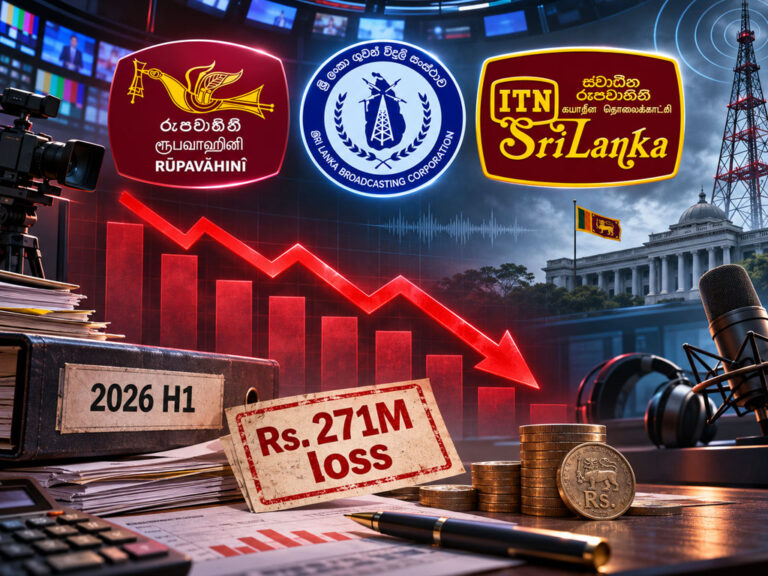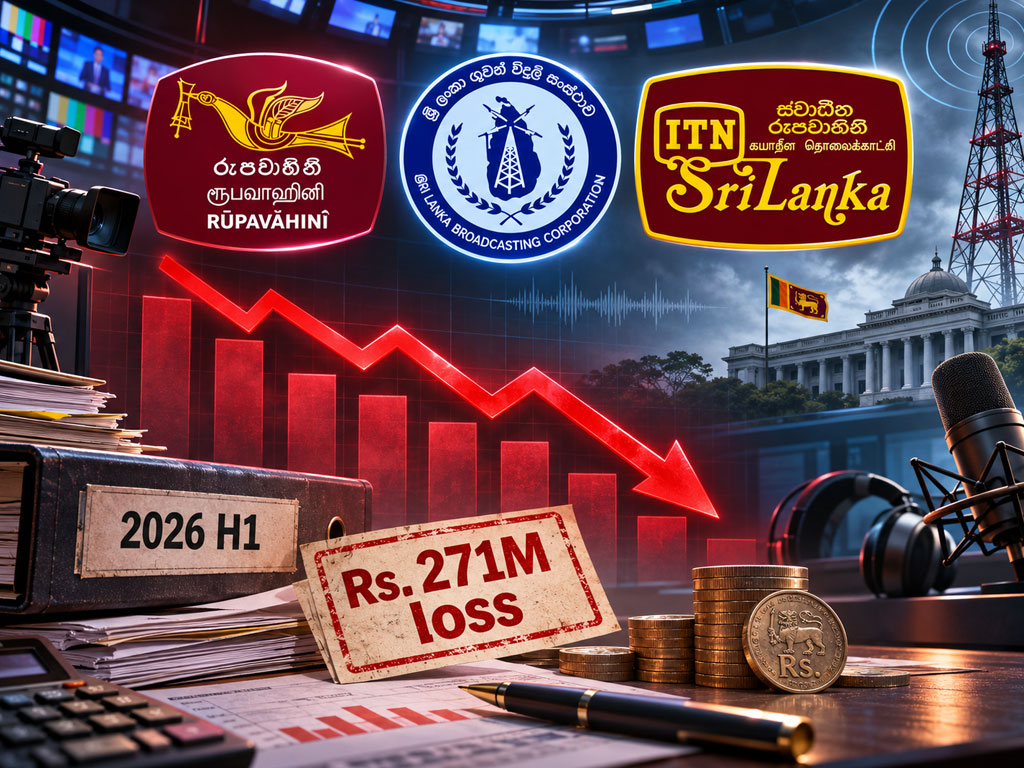
COLOMBO, November 12, 2026 – Sri Lanka’s three leading state broadcasters lost a combined Rs. 271 million in just six months, even as major state enterprises reported growing profits. With Rupavahini approaching its entire 2025 loss in half the time and ITN slipping back into the red, the figures expose a pressing challenge for the government: how to restore financial stability without sacrificing the independence and public-service responsibilities of state media.
Sri Lanka’s three principal state-owned broadcasting institutions recorded combined losses before tax of Rs. 271 million during the first six months of 2026, according to the Ministry of Finance’s latest fiscal performance figures, exposing persistent financial weaknesses within the country’s public broadcasting sector.
The Sri Lanka Rupavahini Corporation (SLRC), Independent Television Network (ITN) and Sri Lanka Broadcasting Corporation (SLBC) all reported losses between January and June, even as major state-owned enterprises collectively achieved higher profits.
The figures, published in the Ministry’s Mid-Year Fiscal Position Report 2026, highlight the financial pressures confronting institutions established to provide broadcasting services to the public.
Their combined losses amounted to Rs. 420 million in 2024 and Rs. 332 million in 2025. Another Rs. 271 million was recorded during the first half of 2026 alone.
While the latest figures do not establish the precise causes of the losses, they underline the need for closer examination of operating expenses, revenue performance, management decisions and the financial sustainability of state broadcasting.

Rupavahini Accounts for the Largest Loss
Rupavahini reported the largest deficit among the three institutions, recording a loss before tax of Rs. 166 million during the first six months of 2026.
The broadcaster had previously reported losses of Rs. 247 million in 2024 and Rs. 191 million in 2025.
Its latest six-month deficit is already equivalent to approximately 87% of the loss recorded throughout 2025.
That comparison is particularly significant because the Corporation has incurred almost an entire previous year’s loss within half the reporting period.
ITN’s performance presents a different concern.
After recording a modest profit of Rs. 3 million in 2024, the network improved its position to a Rs. 62 million profit in 2025.
However, that recovery was reversed during the first six months of 2026, when ITN reported a loss of Rs. 37 million.
SLBC, meanwhile, continued its sequence of losses.
The national radio broadcaster recorded deficits of Rs. 176 million in 2024 and Rs. 203 million in 2025, followed by another Rs. 68 million loss during January to June 2026.
Together, the three institutions recorded losses of Rs. 271 million during the six-month period.
The figures demonstrate differing financial trajectories, but none of the broadcasters reported a profit during the first half of the year.
State Enterprises Report Higher Profits
The broadcasters’ financial performance contrasts with the results reported by Sri Lanka’s major state-owned enterprises.
According to the Ministry of Finance, 51 leading state enterprises recorded combined profits of Rs. 259.3 billion during the first six months of 2026, compared with Rs. 227.8 billion during the corresponding period in 2025.
The increase of Rs. 31.5 billion represents growth of approximately 13.8%.
State-owned banks and several major commercial institutions were among the strongest contributors.
These results demonstrate that public ownership does not automatically result in financial losses.
Nevertheless, broadcasting institutions operate under different commercial conditions and public-service obligations from banks, ports and other revenue-generating enterprises.
Their performance therefore requires examination against appropriate financial targets, public-service responsibilities and operating costs.
The wider profitability of state enterprises does not, by itself, explain why Rupavahini, ITN and SLBC remain under financial pressure.
Why Are State Broadcasters Losing Money?
Several structural and commercial factors may be contributing to the financial difficulties of state broadcasting.
Audience Trust and Advertising Revenue
One concern is the perception that state media institutions have historically served as communication platforms for successive governments rather than operating as fully independent public broadcasters.
Such perceptions can affect public confidence and, potentially, the commercial attractiveness of their programming.
Advertising revenue is particularly important for broadcasters that compete with private television stations, radio networks and digital platforms.
A decline in viewership or advertising demand could weaken income and make it increasingly difficult to cover operating costs.
However, the available financial summary does not establish that audience distrust or declining advertising revenue directly caused the losses recorded in 2026.
Advertising income, audience measurements and programme-level revenue would need to be examined before such conclusions could be reached.
Operational and Staffing Costs
Personnel expenses, administrative overheads and programme production costs represent another area requiring scrutiny.
Where staffing structures and operating expenditure exceed an institution’s sustainable revenue, financial pressures can persist even when management attempts to improve income.
Comparisons with private broadcasters may provide useful benchmarks, although the differing public-service responsibilities of state institutions must also be considered.
A detailed operational audit would help establish whether staffing levels, allowances, procurement expenses and production costs are proportionate to the services delivered.
Without that evidence, excessive staffing cannot be treated as an established explanation for the latest losses.
Competition from Private and Digital Media
The broadcasting industry has undergone substantial change as audiences increasingly consume news, entertainment and information through social media, streaming services and digital platforms.
Traditional broadcasters face pressure to adapt their programming, distribution methods and commercial strategies to changing audience behaviour.
State institutions must respond to those developments while maintaining their responsibilities to provide information, educational programming and other services of public value.
Failure to modernise could affect their long-term competitiveness.
Yet any assessment of the broadcasters’ digital performance should consider actual audience data, advertising trends and the effectiveness of existing online services.
Financial Recovery Without Political Interference
The government’s challenge is to restore the financial stability of public broadcasters without compromising their editorial independence.
Financial reform cannot be limited to reducing expenditure. It must also examine governance, revenue generation, the quality of public-service programming and the ability of these institutions to compete in a changing media environment.
Three measures deserve consideration:
- A comprehensive operational audit: Conduct independent examinations of management expenditure, staffing arrangements, recruitment practices, programme production costs and outstanding advertising payments owed by public and private organisations.
- Institution-specific financial recovery targets: Establish realistic financial improvement plans for Rupavahini, ITN and SLBC, with regular reporting of performance to Parliament and the public. These targets should account for legitimate public-service obligations rather than measuring success solely through commercial profit.
- Digital modernisation and revenue development: Strengthen digital content production, online distribution, audience engagement and advertising strategies to improve competitiveness and develop sustainable sources of income.
Greater transparency in financial reporting would also allow the public to assess whether reforms are producing measurable improvements.
State broadcasting institutions provide services that cannot always be judged by commercial profit alone, particularly where educational, cultural and public-interest programming is concerned.
Nevertheless, their public-service role does not remove the responsibility to manage resources effectively.
The Rs. 271 million loss recorded during the first half of 2026 represents more than a financial setback. It places responsibility on the government and the management of each institution to explain the underlying causes and demonstrate how further deterioration will be prevented.
The next test will be whether detailed financial reviews and institution-specific recovery plans can reverse the losses while protecting the editorial independence and public-service value of Sri Lanka’s state broadcasters.