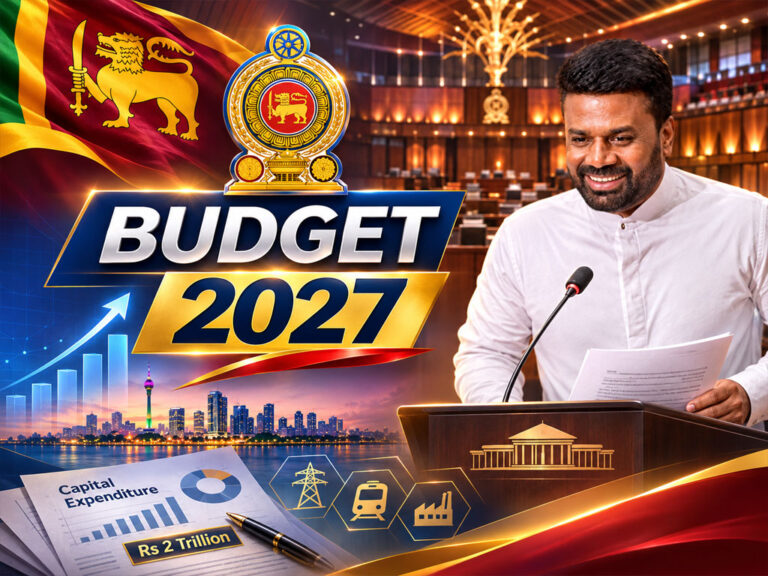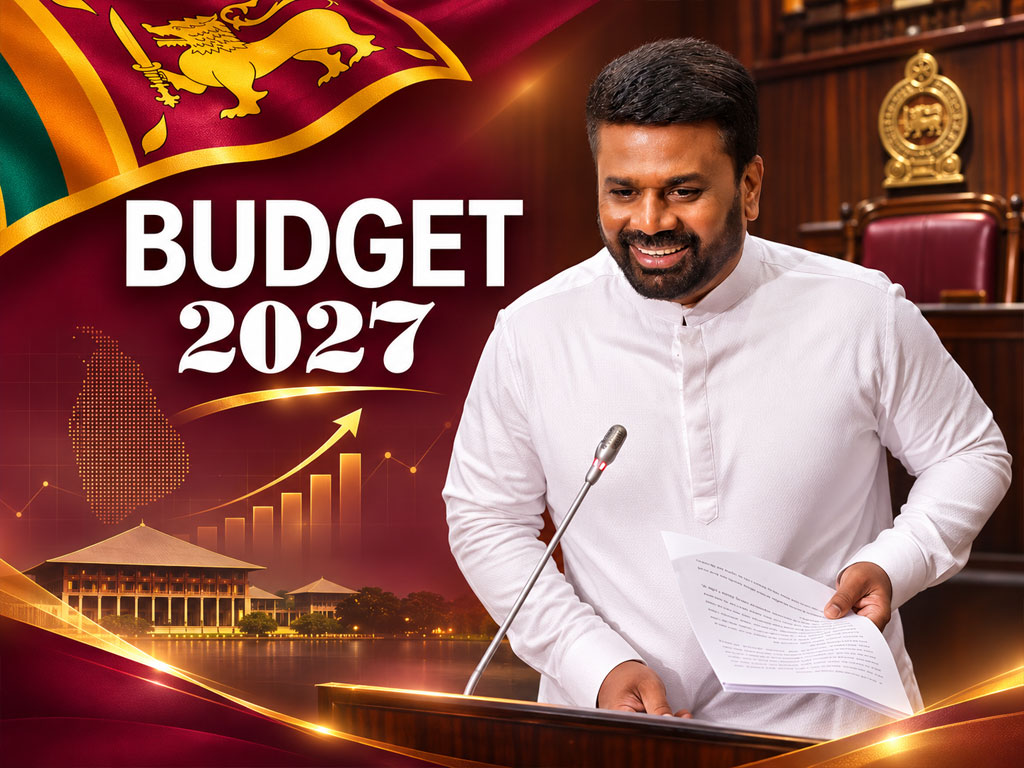
COLOMBO, November 12, 2026 – President Anura Kumara Dissanayake has unveiled a sweeping economic programme for 2027, promising major investments in renewable energy, railway electrification, digital technology, education and healthcare, alongside increased support for vulnerable families. From Rs. 2 trillion in capital expenditure to new solar battery subsidies and billions for infrastructure, the Budget sets out an ambitious development agenda whose success will depend on financing, implementation and accountability.
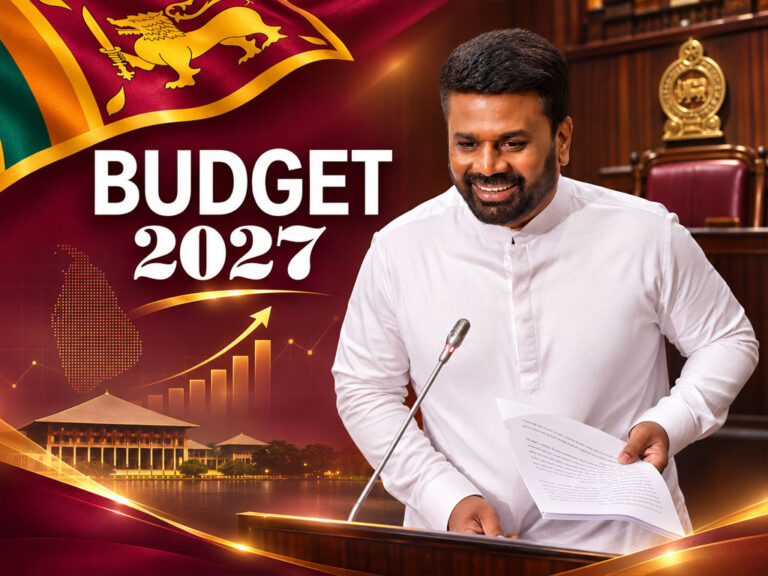
President Anura Kumara Dissanayake presented the government’s 2027 Budget proposals to Parliament on Thursday, outlining a wide-ranging programme of public investment, regulatory reform and social protection intended to accelerate Sri Lanka’s economic transformation.
The proposals include Rs. 2 trillion in capital expenditure, major investments in renewable energy and transport infrastructure, new measures to support exporters and businesses, and expanded financial assistance for vulnerable communities.
Dissanayake, who also serves as Minister of Finance, Planning and Economic Development, presented the National People’s Power government’s third Budget after the Cabinet approved the proposals earlier in the day.
The 2027 Appropriation Bill was first presented to Parliament on October 7. The Second Reading debate will begin on November 13 and continue until November 20, followed by committee-stage proceedings through December 14.
Special security arrangements were implemented around the parliamentary complex for the Budget presentation.

Economic Stability, Debt and the Government’s Growth Strategy
In his Budget address, the President outlined the government’s intention to protect the economic stability achieved over the previous two years while introducing reforms designed to support long-term growth.
He said Sri Lanka must avoid repeating the economic collapse of 2022 and ensure that future generations do not inherit similar financial instability.
The government reported that Rs. 144 billion had been spent on relief measures associated with the impact of the Middle East conflict on energy prices.
Dissanayake also highlighted several economic indicators which, according to the figures presented in his speech, demonstrate improvements in Sri Lanka’s fiscal and external position.
These included:
- A current account surplus of US$1.719 billion in 2025.
- An expectation that workers’ remittances will exceed US$9 billion in 2026.
- A reported reduction in the public debt ratio to approximately 95% by the end of 2025.
- A decline in interest payments as a proportion of government revenue, from 79.1% in 2022 to 45.9% in 2025 and 39.6% by September 2026.
- A reported turnaround in the combined financial performance of 52 state enterprises, from a pre-tax loss of Rs. 744.6 billion in 2022 to a profit of Rs. 44.4 billion in 2025.
- A further reported pre-tax profit of Rs. 367 billion among state institutions by the end of August 2026.
The President also referred to improvements in international rankings, including Sri Lanka’s position in Transparency International’s Corruption Perceptions Index and the Global Peace Index.
He said the country had advanced 14 places in each ranking, reaching 107th and 67th respectively. These figures, together with the government’s claims concerning sovereign ratings and income classification, require comparison with the underlying international publications.
Addressing the financial burden imposed by SriLankan Airlines, Dissanayake referred to cumulative losses of Rs. 528 billion over the period identified in his speech as 2018 to 2025.
The government has appointed a Cabinet committee to examine possible solutions.
Higher global fuel prices remain a significant challenge. According to the Budget presentation, Sri Lanka spent US$4.042 billion on fuel imports in 2025, while expenditure had reportedly reached US$4.487 billion by September 2026.
Foreign reserves were reported to have exceeded US$7 billion in October 2026, despite the reopening of vehicle imports and continuing pressure from energy requirements.
Inflation was also identified as a concern, with the President citing an increase in annual inflation from 2.1% in December 2025 to 8.3% in October 2026.
Against this economic backdrop, the government announced seven strategic objectives for the 2027 Budget, focusing on sustainable economic growth, investment, stronger public institutions and financial resilience.
Investment, Trade and Regulatory Reform
The government proposed a series of legislative and institutional reforms intended to improve the investment environment, facilitate international trade and reduce administrative delays.
The proposed measures include:
- Submitting the Investment Protection Bill for clearance by the Attorney General.
- Drafting a new National Statistics Act.
- Amending the Customs Ordinance in early 2027.
- Introducing proposed manufacturing-related tax relief legislation.
- Amending legislation governing monetary and financial business activities.
- Establishing special investment zones outside Colombo with targeted concessions.
- Creating a Treasury-owned investment promotion company with international expertise.
- Introducing further regulation of casinos and gambling through the relevant statutory framework.
- Expanding trade agreements with foreign countries, including renewed attention to a possible free trade agreement with China.
The President proposed the establishment of a company wholly owned by the Treasury to support investment promotion, with foreign specialists to be recruited under special remuneration arrangements.
To simplify international trade, the government intends to develop a National Single Window for exporters and importers.
The programme is expected to begin with selected export businesses during the first half of 2027, followed by importers and re-export activities during the latter half of the year.
An allocation of Rs. 1,990 million was proposed for further development of the system.
Separately, Rs. 100 million has been earmarked for establishing a National Single Investment Window, for which consultancy procurement has been initiated.
Under the Sri Lanka–European Union Sustainable Trade and Economic Integration Project, Rs. 3,430 million is expected to be invested between 2027 and 2030 to promote exports.
The government also proposed Rs. 1 billion to expand Sri Lanka Customs’ container-scanning facilities and strengthen inspection capacity.
Additional measures would modernise procedures for imports used in export manufacturing, particularly to encourage small and medium-sized enterprises to enter international markets.
Renewable Energy and Electricity Infrastructure
Energy-sector reform forms a substantial component of the Budget.
The government plans to increase renewable energy’s contribution to electricity generation to 69% by 2029, supported by proposed investment of Rs. 26.5 billion to expand sector capacity.
The programme includes new grid-stability infrastructure, battery storage facilities and additional transmission capacity.
Among the announced proposals are two synchronous condensers, described in the Budget notes as 75 MW each, at Habarana and Mannar, as well as a 300 MW installation at the Padukka 220 kV grid substation targeted for completion by 2029.
The government also intends to develop battery storage capacity amounting to 1,245 MW by 2029.
Technical specifications for these installations will need confirmation in the detailed energy project documents.
Household Solar Battery Subsidies
Households installing rooftop solar systems with battery storage facilities are expected to qualify for a new subsidy.
The proposed assistance is Rs. 25,000 for each kilowatt of qualifying battery capacity, with support capped at Rs. 250,000 for systems of up to 10 kW.
An allocation of Rs. 3.5 billion has been proposed for the scheme.
The government also intends to remove the 10% Port and Airport Development Levy on batteries imported for solar energy storage.
At the Norochcholai coal-fired power plant, a 30 MW battery storage system has been proposed to support operational stability.
The President explained that the plant’s total installed capacity of 900 MW includes approximately 90 MW required for its own operations, leaving around 810 MW for the external electricity system under the operating assumptions described.
The government has allocated Rs. 500 million for preliminary work on a proposed 400 kV northern transmission network linking Kilinochchi and Habarana, with completion targeted for 2030.
Private-sector investment will also be invited for additional 220 kV and 400 kV transmission infrastructure.
A US$12 million Asian Development Bank grant is expected to support smart-meter installations for 300,000 electricity consumers using more than 180 units, along with eligible LECO consumers using more than 120 units.
Four electricity distribution control centres are planned for Kuliyapitiya, Peradeniya, Battaramulla and Dehiwala to improve data-driven distribution management and outage response.
Petroleum Exploration and Fuel Storage
The Budget includes proposals to expand domestic fuel storage capacity and attract investment in petroleum exploration.
Bids for oil and natural gas exploration and production in four blocks in the Mannar Basin are scheduled to be opened on February 2, 2027.
At the Kolonnawa petroleum complex, the government outlined investments of Rs. 3,746 million for six tanks and Rs. 1,446 million for another two tanks.
Three additional tanks are proposed for Muthurajawela at a cost of Rs. 3,786 million.
According to the Budget presentation, the projects are intended to increase storage capacity by 126,000 cubic metres, supporting a national storage requirement equivalent to approximately 45 days.
The government also referred to plans for strengthening petroleum-related infrastructure and improving supply security.
Digital Economy Receives Rs. 28.5 Billion
The government has proposed Rs. 28.5 billion for digital-sector transformation in 2027, describing it as the largest annual allocation for the sector in Sri Lanka’s history.
The programme is intended to expand digital public services, strengthen cybersecurity, improve connectivity and promote technology-based enterprise.
The Treasury-owned GovTech institution has begun implementing a roadmap for digital government services.
Following amendments to the Personal Data Protection Act and activation of the Data Protection Authority, the government plans to introduce legislation establishing a Digital Economy Authority and Digital Economy Council during the first quarter of 2027.
A proposed Cyber Security Act has been submitted for Attorney General’s clearance, while a Cyber Security Authority is expected to be established next year.
Digital procurement guidelines are also planned for the first half of 2027.
An Artificial Intelligence Centre of Excellence is to be established at Wijerama Mawatha, bringing together government institutions and the academic community to strengthen national AI expertise.
The Lanka Government Cloud is expected to expand from LGC 2.0 to LGC 3.0, alongside plans to develop sovereign AI infrastructure.
Further proposals include:
- A Presidential Digital Awards programme to encourage government digitalisation.
- Expanded GovPay services and QR-based cashless payments.
- Broadband vouchers for 750,000 selected schoolchildren.
- Rs. 10 billion for funds supporting technology-based private enterprises.
- Expansion of communications infrastructure, with 573 towers already reported under the village connectivity programme.
- Five-year relief on the specified tax affecting new communications towers, alongside proposed grants and electricity connection support.
The government aims to complete the village communications programme by 2028.
Education and Higher Education
The 2027 Budget proposes reforms to school education, teacher training and university infrastructure.
New educational reforms for Grades 2 and 6 are scheduled for implementation during 2027.
From April next year, allowances for students attending teacher training colleges are proposed to increase from Rs. 10,500 to Rs. 20,000.
Daily allowances for pirivena education will also rise under the proposals, from Rs. 15 to Rs. 50 for student monks and from Rs. 5 to Rs. 25 for lay students.
Annual allowances for voluntary Sunday school teachers are expected to increase from Rs. 7,500 to Rs. 12,000.
The government said school uniforms supplied through Chinese government assistance would continue to be distributed.
Digital Learning and School Infrastructure
According to the President, reliable internet connections have been provided to 6,225 schools, including 3,009 connections completed during the current year.
The government intends to connect the remaining 750 secondary schools as soon as possible before extending the programme to primary schools.
A five-year initiative covering interactive digital learning, teacher development and technical skills is estimated to cost Rs. 96.5 billion.
An additional Rs. 3 billion has been proposed for initial implementation, supplementing the Rs. 4 billion allocated during the current year.
Overall, Rs. 35 billion has been proposed for education-related infrastructure and development in 2027, including teacher training, school buildings, laboratories, institutional modernisation and digital facilities.
University Development
The Budget also includes:
- Rs. 450 million in 2027 towards medical faculty and clinical infrastructure at the universities of Peradeniya and Wayamba, within a broader Rs. 8 billion programme.
- Rs. 2.25 billion for academic and infrastructure development at universities.
- Rs. 6.25 billion for student welfare activities, including Rs. 717 million for specified development initiatives such as wastewater treatment.
- A proposed Rs. 2.05 billion residential quarters project for academic and non-academic staff at the University of Vavuniya.
- Repairs to higher education institutions affected by Cyclone Ditwah, including an estimated Rs. 6.15 billion requirement for damage at the University of Peradeniya.
An allocation of Rs. 700 million was identified for 2027 repair work across affected higher education institutions.
Research, Innovation and Commercialisation
The government intends to strengthen the connection between research activity and national economic development.
Its research and innovation agenda includes better coordination of public and private research, support for local scientists, development of national research policies and greater commercial use of technologies developed in laboratories and universities.
A central objective is to convert research findings into products and services capable of supporting industry, exports and economic growth.
The proposals also call for stronger research capabilities and support for internationally competitive scientific work.
Highways, Railways, Ports and Airports
Transport infrastructure receives extensive attention in the Budget.
An allocation of Rs. 251 billion has been identified for roads, highways and railways.
The Budget notes also refer to Rs. 146 billion in new proposals and Rs. 90 billion associated with Cyclone Ditwah recovery, with an overall planned expenditure figure of Rs. 487 billion. The precise relationship between these amounts requires reconciliation with the detailed expenditure tables.
Expressway Development
Major proposed allocations include:
- Rs. 30 billion for the Kurunegala–Galewela section of the Kurunegala–Dambulla expressway.
- Rs. 27 billion for the Kahathuduwa–Ingiriya section of the Ruwanpura Expressway.
- Rs. 53.45 billion for the Kadawatha–Mirigama section of the Central Expressway, targeted for completion by September 2028.
- Rs. 4.5 billion for the Pothuhera–Rambukkana section, targeted for completion by May 2027.
- Rs. 23.05 billion for the Rambukkana–Galagedara section, targeted for completion by July 2029.
Additional allocations were proposed for connecting roads associated with the Kurunegala–Dambulla, Pothuhera–Galagedara and Kadawatha–Mirigama expressway projects.
Railway Electrification
The government announced a major railway electrification programme with a stated long-term investment requirement exceeding Rs. 1.2 trillion.
The first phase includes:
- Rs. 45 billion for the Maradana–Homagama section of the Kelani Valley Line.
- Rs. 16.4 billion for the Maradana–Ragama section of the Main Line.
- Rs. 17.7 billion for the Maradana–Panadura section of the Coastal Line.
The total proposed initial allocation is approximately Rs. 80 billion, including Rs. 900 million for related expenses such as land acquisition.
Port Development
The government intends to expand Colombo Port’s total container-handling capacity to more than 30 million twenty-foot equivalent units by 2040.
Its strategy is to strengthen Colombo’s position as a regional transshipment and maritime services hub.
The Budget also proposes expanding marine fuel bunkering capacity to more than 50,000 metric tonnes through private participation under Build-Operate-Transfer arrangements, with support from the Ceylon Petroleum Corporation.
International and Domestic Airports
At Bandaranaike International Airport, work has begun on an investment programme valued at Rs. 15 billion to increase the capacity of the existing terminal from six million to nine million passengers annually.
Construction of the delayed second terminal is expected to proceed with support from the Japan International Cooperation Agency.
For domestic aviation, Rs. 100 million has been proposed to improve facilities at Sigiriya Airport.
Airport and Aviation Services is also expected to undertake improvements at China Bay Airport in 2027.
Rs. 174 Billion in Concessionary SME Lending
Micro, small and medium-sized enterprises are expected to benefit from expanded concessionary lending arrangements.
The government proposes Rs. 67.687 billion in allocations for interest subsidies and refinancing support, with the aim of facilitating approximately Rs. 174 billion in concessionary loans.
The programmes include:
- Refinancing and interest subsidy arrangements for struggling MSMEs.
- Financial assistance schemes supported by the Asian Development Bank.
- Working capital loans for small and medium-scale rice mill owners.
- Assistance for women-headed households.
- Rural enterprise empowerment.
- Concessionary finance for larger fisheries enterprises.
- Loan facilities for home-based tourism accommodation.
The Development Finance Department’s website and the 1819 hotline have been identified as information channels for prospective borrowers.
Agriculture and Livestock Development
The Budget proposes Rs. 400 million to introduce a collective cultivation approach known as the Yaya production model.
The programme is intended to encourage farmers to coordinate cultivation rather than rely solely on individual production.
An Integrated Plant Nutrient Management programme is also proposed over four years, including support for the combined use of organic and chemical fertilisers.
An initial Rs. 47 million has been proposed for 2027.
Paddy farmers are expected to continue receiving a fertiliser subsidy of Rs. 30,000 per hectare, supported by a proposed allocation of Rs. 44 billion.
Livestock and Dairy Production
The government intends to develop specialised breeding facilities under the National Livestock Development Board.
An allocation of Rs. 1.8 billion has been proposed for nucleus breeding herds covering dairy cattle and buffaloes at Nikaweratiya, pigs at Horakelle and sheep at Siringapatha.
Plans also include a poultry export-oriented economic zone covering the Western and North Western provinces.
A further Rs. 3 billion has been proposed to complete the new Milco milk-processing facility at Badalgama.
An additional Rs. 300 million, supplementing Rs. 200 million already allocated, would support goat farming in Puttalam, Mannar and Batticaloa.
Social Welfare and Assistance for Vulnerable Groups
The government has proposed Rs. 230 billion for social security allowances in 2027, including continued Aswesuma assistance for households classified as poor and extremely poor.
Monthly financial support for kidney patients and persons with disabilities is expected to increase from Rs. 10,000 to Rs. 12,500.
A further Rs. 25 billion has been proposed for an island-wide integrated rural development programme under the Janashakthi National Campaign.
The Budget also includes Rs. 200 million for day-care centres and transport facilities serving children with disabilities.
These measures are intended to maintain targeted assistance while the government pursues its wider programme of economic reform.
Overseas Sri Lankans and Citizenship Reforms
The government plans to introduce a Global Sri Lankan Heritage Citizenship programme aimed at second- and third-generation members of overseas Sri Lankan families.
The proposals include extending free dual citizenship arrangements to eligible spouses, children and third-generation descendants, subject to the necessary legal and administrative provisions.
A concessionary housing loan programme is also proposed for overseas workers.
The scheme would provide loans of up to Rs. 500,000, with interest subsidies of 10% on the first Rs. 300,000 and 5% on the remaining Rs. 200,000.
For the first portion, the proposed subsidy would be shared between the government and the Sri Lanka Bureau of Foreign Employment at rates of 6% and 4% respectively.
For the remaining Rs. 200,000, the proposed contributions would be 3% from the government and 2% from the Bureau.
Disaster Preparedness and Early Warning Systems
The government has proposed Rs. 2.9 billion for 13 disaster management projects, reflecting the need to strengthen national preparedness for floods, landslides and other emergencies.
A modern Doppler radar system, supported through a Japanese grant, is scheduled to begin installation in 2027.
Other proposals include:
- Rs. 1 billion to improve and repair evacuation and safety centres.
- Rs. 500 million for disaster response equipment and early-warning capabilities.
- Rs. 670 million for a nationwide digital broadcast communication system.
- Rs. 500 million to repair 77 coastal early-warning towers and construct 120 new inland towers across 25 districts.
The expanded network is intended to support a multi-hazard warning system covering floods, landslides and tsunami risks.
Health Services and Ambulance Replacement
The Budget allocates Rs. 131 billion in capital expenditure for healthcare improvements.
A proposed Rs. 300 million will support construction of a modern accident and emergency treatment unit at Thambuttegama Base Hospital.
The government also highlighted the age of the national ambulance fleet.
According to the figures presented, approximately 400 ambulances currently in service are more than 20 years old, and roughly half are more than 25 years old.
An allocation of Rs. 3 billion has been proposed for 2027 to replace ageing ambulances and strengthen emergency transport services.
Another Rs. 100 million has been proposed to provide free spectacles to schoolchildren.
Sports Infrastructure and Athlete Rewards
The government intends to establish a National High Performance Centre to support athletes competing internationally.
Its first phase is proposed near the Torrington sports grounds, with a second phase at the Diyagama sports complex.
An initial Rs. 300 million has been allocated.
Other investments include Rs. 1.5 billion for improvements to the Sugathadasa indoor stadium and athletics track.
The government also proposes increasing funding for the Anuradhapura Sports Complex’s artificial running track and related facilities from Rs. 50 million to Rs. 1 billion.
Proposed Rewards for International Sporting Success
The Budget outlines the following recognition payments for gold-medal performances:
| Competition | Proposed reward |
|---|---|
| Olympic Games | Rs. 100 million |
| World Athletics Championships | Rs. 100 million |
| Commonwealth Games | Rs. 75 million |
| Asian Games | Rs. 50 million |
| South Asian Games | Rs. 15 million |
Additional recognition payments are proposed for silver and bronze medallists and achievements at other international competitions.
Tourism Development and Visitor Safety
Sri Lanka reportedly earned US$2.245 billion from tourism by September 2026, according to figures cited in the Budget address.
The government proposes Rs. 300 million for reviewing and developing the Southern Mist Triangle tourism initiative centred on the Sinharaja rainforest region.
A further Rs. 35 million is proposed to supplement the Rs. 133 million capital contribution provided by the Sri Lanka Tourism Development Authority towards a centralised online ticketing system.
The Budget also proposes restoring historically significant buildings around Colombo Fort and developing the surrounding area as a tourism zone.
Visitor safety initiatives include specialised training, multilingual officers, dedicated patrol units near major tourist attractions, a 24-hour emergency hotline and a mobile application.
Public Transport Modernisation
A record Rs. 95 billion has been proposed for improving railway and passenger bus services, strengthening connections between transport networks and promoting sustainable public transport.
The government intends to expand Colombo-style metro bus services to Kandy, Galle and Jaffna.
Other measures include:
- Rs. 1 billion to purchase 50 small buses with 22 seats each for hill-country transport.
- Rs. 4 billion to purchase 200 buses with 33 seats each for rural services.
- Rs. 600 million for facilities associated with the Department of Motor Traffic at Werahara.
- Rs. 700 million for a modern digital vehicle registration and ownership transfer system.
- Rs. 1.5 billion for digital driver-skills scoring and road safety enforcement.
- Rs. 5 billion for five new trains.
- Rs. 2 billion to repair and improve railway stations.
Rail connections to Kandy are expected to resume within the first quarter of 2027, while full restoration of the Upcountry Line to Badulla is targeted for the middle of the year.
These remain implementation targets subject to infrastructure repairs and operational readiness.
Budget Implementation Will Determine the Outcome
The 2027 Budget combines substantial public investment with proposed legislative reforms, targeted social assistance and programmes designed to improve productivity.
Its most ambitious commitments involve energy storage, railway electrification, road development, digital services and expanded support for business investment.
Delivering those projects will require reliable financing, transparent procurement, effective public administration and realistic construction schedules.
The government’s ability to translate Budget allocations into functioning infrastructure and accessible public services will be central to assessing whether its proposed economic transformation succeeds.
Parliament will begin examining the proposals through the Second Reading debate on November 13, followed by detailed committee-stage consideration.
The final parliamentary vote is scheduled for December 14, after which attention will turn from the government’s announcements to the practical delivery of the measures promised for 2027.