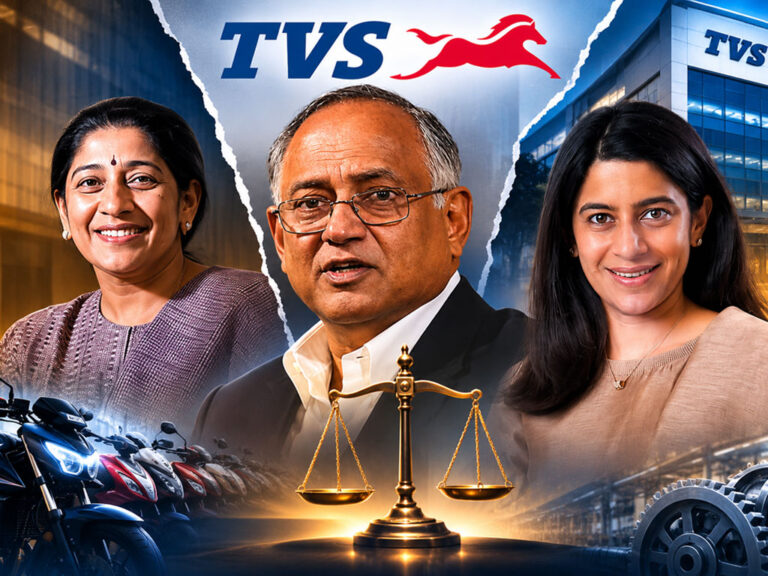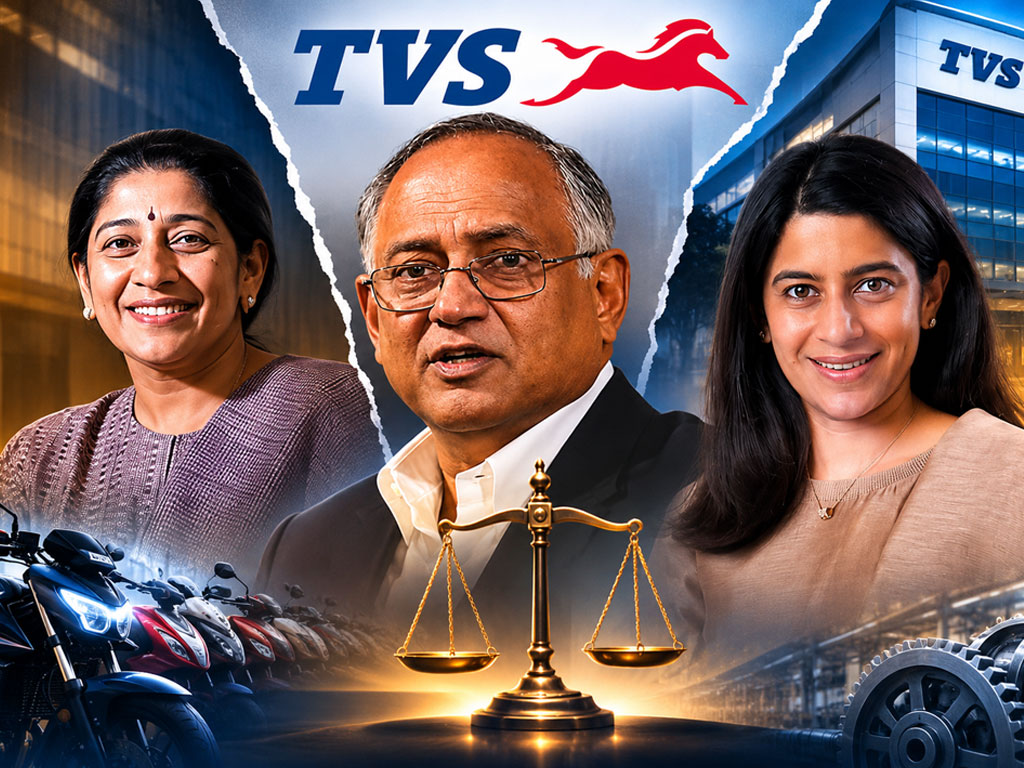
CHENNAI, November 18, 2026 — Lakshmi Venu has demanded a formal division of her family’s vast TVS business assets, challenging an earlier settlement that she says favoured her brother. Backed by her mother, the industrial heiress is asserting her legal inheritance rights.
A bitter inheritance dispute within India’s prominent TVS industrial family has escalated after Lakshmi Venu formally demanded the division of assets controlled by her father, Venu Srinivasan, challenging arrangements she says have concentrated valuable business interests in the hands of her brother, Sudarshan Venu.
The dispute concerns the ownership and control of substantial family wealth associated with TVS Motor Company, TVS Holdings, TVS Credit Services and Sundaram-Clayton, businesses that form part of one of India’s oldest and most influential industrial networks.
On November 16, Lakshmi issued a formal partition notice to her father, seeking what she describes as her lawful share of the joint family property under India’s Hindu Succession Act, 1956, as amended in 2005.
Her mother, Mallika Srinivasan, Chairman and Managing Director of Tractors and Farm Equipment Limited (TAFE), has publicly supported her daughter’s demand, arguing that both children should receive equitable treatment.
The disagreement centres on whether earlier agreements, particularly a wider TVS family settlement reached in 2020 and a memorandum of understanding signed in March 2024, constituted a genuine economic division of the assets belonging to Venu Srinivasan’s immediate family.
Venu Srinivasan and Sudarshan Venu maintain that the family’s wealth and business responsibilities were already divided through an agreed settlement.
Lakshmi and Mallika dispute that interpretation, contending that the arrangements did not provide a comprehensive or equitable partition of the family’s underlying economic interests.
The growing disagreement has already prompted members of the family to file legal caveats in Chennai courts, preparing for possible litigation.

Lakshmi Venu Demands Formal Division of Family Wealth
Lakshmi’s partition notice seeks to establish her legal entitlement to assets held within the Venu Srinivasan branch of the larger TVS family.
Her position is that the family arrangements implemented over recent years have concentrated beneficial ownership and control in favour of her brother without properly recognising her rights.
The demand goes beyond the question of which family member manages a particular company.
It concerns the underlying economic value of shares, trusts, holding companies and other assets associated with the family’s business interests.
Sudarshan Venu is Chairman and Managing Director of TVS Motor Company, while Lakshmi is associated with Sundaram-Clayton, the automotive components manufacturer.
According to Lakshmi’s position, allocating management responsibility for different businesses does not necessarily amount to an equal division of the wealth underlying those businesses.
She maintains that any settlement must account for the actual financial interests held by the family members rather than merely assigning different companies to each sibling.
Through the partition notice, Lakshmi has called on her father, as head of the family, to facilitate a lawful and equitable division of the assets.
Her demand places the structure of family ownership, the valuation of business interests and the legal effect of previous agreements under renewed scrutiny.
The 2020 TVS Agreement and the Disputed 2024 Settlement
The disagreement has its origins in the restructuring of the wider TVS family businesses.
In December 2020, members of the extended family agreed to separate business ownership and management arrangements among the principal family branches.
The agreement was intended to provide greater operational independence and clarify the control of companies previously associated with the larger TVS business network.
According to a subsequent stock-exchange disclosure, the wider settlement took effect on February 4, 2022.
A further memorandum of understanding was executed within Venu Srinivasan’s immediate family in March 2024.
The agreement was dated March 20 and completed on March 21, 2024.
Its signatories were Venu Srinivasan, Mallika Srinivasan, Lakshmi Venu and Sudarshan Venu.
The memorandum dealt with several matters, including the permitted use of TVS trademarks and restrictions on competing business activities.
Under the disclosed arrangements, Sudarshan agreed to restrictions involving certain automotive casting and agricultural machinery businesses.
Mallika and Lakshmi accepted restrictions concerning the use of TVS trademarks in two-wheeler and three-wheeler manufacturing, financial services and other specified activities.
The agreement was disclosed to stock exchanges by TVS Holdings on March 22, 2024.
Venu Srinivasan’s position is that the broader restructuring and subsequent family arrangements provided a transparent and agreed division of the relevant business interests.
Lakshmi, however, contends that the 2024 memorandum addressed corporate governance, brand rights and business restrictions without completing a proper economic partition of the immediate family’s wealth.
She argues that the agreement cannot be treated as a substitute for determining each family member’s lawful share of the underlying assets.
The central legal disagreement is therefore not whether the memorandum exists or was signed.
It is whether the agreements already executed extinguished or satisfied Lakshmi’s asserted right to seek a further partition.
TVS Motor and Sundaram-Clayton at the Centre of the Dispute
The division of responsibilities between Lakshmi and Sudarshan has become a major point of contention.
Sudarshan leads TVS Motor Company, the group’s flagship two-wheeler manufacturer, while Lakshmi has been associated with Sundaram-Clayton, a producer of automotive components.
The businesses differ considerably in scale, market position and financial structure.
TVS Motor is a major manufacturer with extensive operations in India and international markets.
Sundaram-Clayton operates in the automotive components sector, with a focus on precision manufacturing and die-casting.
Lakshmi’s argument is that the division should be examined according to economic value rather than the apparent allocation of leadership positions.
The assets identified in her claim reportedly include interests held through VS Trust and other family holding structures.
These encompass interests associated with TVS Holdings, TVS Motor Company, TVS Credit Services and Sundaram-Clayton.
The precise valuation of those interests, their beneficial ownership and the effect of existing legal arrangements are matters that would need to be determined through documentation and, if necessary, legal proceedings.
No court finding has established that Sudarshan unlawfully obtained assets belonging to his sister.
Equally, the existence of the 2024 memorandum does not by itself resolve the competing interpretations advanced by the family members.
Mother Mallika Srinivasan Supports Daughter’s Claim
The family disagreement has become particularly significant because Mallika Srinivasan has publicly supported Lakshmi’s position.
Mallika is herself one of India’s most prominent business leaders, heading TAFE, a major agricultural equipment manufacturer associated with the separate Amalgamations Group.
In statements reported following the latest developments, she expressed the view that Lakshmi was entitled to a share of the family assets comparable to that received by Sudarshan.
Her position has been clear: both children should be treated fairly in determining their rights to the family’s wealth.
Mallika has also expressed disappointment that efforts to reach an amicable settlement had not produced meaningful progress.
She has called for transparent discussions and a fair resolution rather than prolonged legal confrontation.
Her support gives the dispute an additional dimension.
Instead of a disagreement solely between a father and daughter, the family is divided over whether the earlier settlement adequately protected the interests of both heirs.
The disagreement has reportedly been aggravated by tensions over management and governance, including disputes involving Sundaram-Clayton.
Nevertheless, the publicly documented positions of Mallika and Lakshmi continue to include a willingness to pursue an amicable resolution.
Hindu Succession Act Forms Basis of Lakshmi’s Demand
Lakshmi has invoked Section 6 of India’s Hindu Succession Act, 1956, as amended in 2005.
The amendment strengthened the inheritance rights of daughters by recognising their equal status as coparceners in qualifying Hindu joint family property.
Under the amended framework, daughters may acquire rights in ancestral coparcenary property comparable to those of sons.
Lakshmi maintains that her legal entitlements cannot be displaced merely through corporate restructuring or agreements that did not amount to a valid and comprehensive partition.
Her position also challenges the assumption that leadership of family-controlled businesses should automatically pass predominantly through male heirs.
However, the application of the Hindu Succession Act to the assets in question is not necessarily straightforward.
The legal position may depend on whether particular holdings constitute coparcenary property, individually owned assets, trust interests or shares held through separate corporate structures.
The effect of existing family agreements and any legally binding settlements will also be relevant.
A court would need to examine those distinctions before determining whether Lakshmi is entitled to additional assets and, if so, the nature of her share.
The claim therefore concerns both the principle of equal inheritance rights and the specific legal character of the family’s business wealth.
Caveats Filed as Family Prepares for Possible Court Battle
The dispute had already reached the courts procedurally before Lakshmi issued her latest partition notice.
During October, members of the family filed caveats in courts in Chennai.
Reports identified filings involving Venu Srinivasan, Mallika Srinivasan, Lakshmi Venu and Sudarshan Venu.
A caveat is a legal mechanism through which a person requests an opportunity to be heard before a court makes certain orders that could affect that person’s interests.
It can protect a party against an adverse order being issued without notice.
The filing of a caveat does not establish that the court has decided the underlying inheritance dispute.
Nor does it necessarily mean that a substantive partition suit has already been filed.
The November 16 partition notice represents a further step in Lakshmi’s attempt to obtain a formal division of family assets.
If the dispute proceeds to full litigation, the courts may be asked to examine the validity and scope of previous agreements, the classification of family assets and the respective rights of the parties.
As of the latest reporting reviewed, no final judicial decision resolving the partition claim has been established.
Family Settlement Versus Equal Inheritance Rights
The dispute illustrates a recurring challenge within large family-controlled businesses: the distinction between corporate management, beneficial ownership and inheritance rights.
A family settlement can allocate responsibilities and establish governance arrangements without necessarily transferring equivalent economic value to each beneficiary.
Conversely, differences in the size or commercial profile of the companies managed by individual family members do not automatically demonstrate that the overall distribution of wealth was unequal.
Other holdings, liabilities, compensation arrangements and trust interests may affect the true financial position.
That is why the disagreement over the 2020 and 2024 arrangements is central to the TVS dispute.
Venu Srinivasan and Sudarshan maintain that an agreed division has already occurred.
Lakshmi and Mallika argue that the immediate family’s underlying economic interests have not been properly settled.
The competing claims cannot be resolved solely by comparing the public profile of TVS Motor and Sundaram-Clayton.
A determination would require detailed examination of financial valuations, corporate ownership records, trust arrangements and the binding effect of the agreements.
The case also raises broader questions about how traditional family enterprises reconcile succession planning with modern legal protections for daughters.
Those questions have significance beyond India, particularly in South Asian economies where substantial businesses remain under multigenerational family control.
What Happens Next in the TVS Family Dispute
The immediate question is whether the family can negotiate an agreement that addresses Lakshmi’s claims without prolonged litigation.
Mallika has called for a fair and amicable settlement, while Lakshmi’s partition notice formally asserts her entitlement under inheritance law.
Venu Srinivasan and Sudarshan continue to rely on the position that earlier arrangements already provided an agreed division of family assets.
Further legal proceedings could require the parties to establish the nature and value of the assets held through trusts, corporate entities and individual family holdings.
The courts may also have to determine the legal consequences of the 2024 memorandum and whether it limits or preserves the inheritance rights now being asserted.
For the TVS industrial family, the dispute has consequences extending beyond personal relations.
It places the governance and succession arrangements of a major corporate network under scrutiny, while highlighting the importance of clear agreements and transparent ownership structures.
Whether the matter is resolved privately or through the courts, its outcome will depend on the legal rights created by the family’s assets and agreements, rather than the public standing of either side.