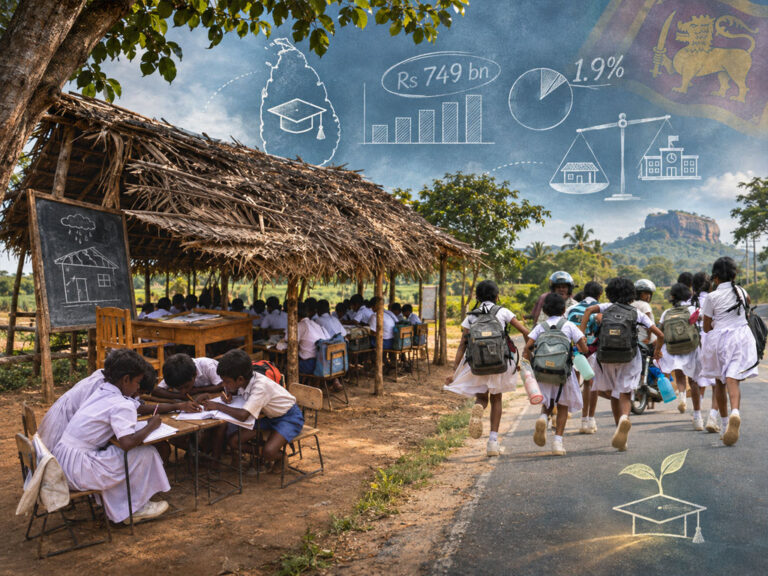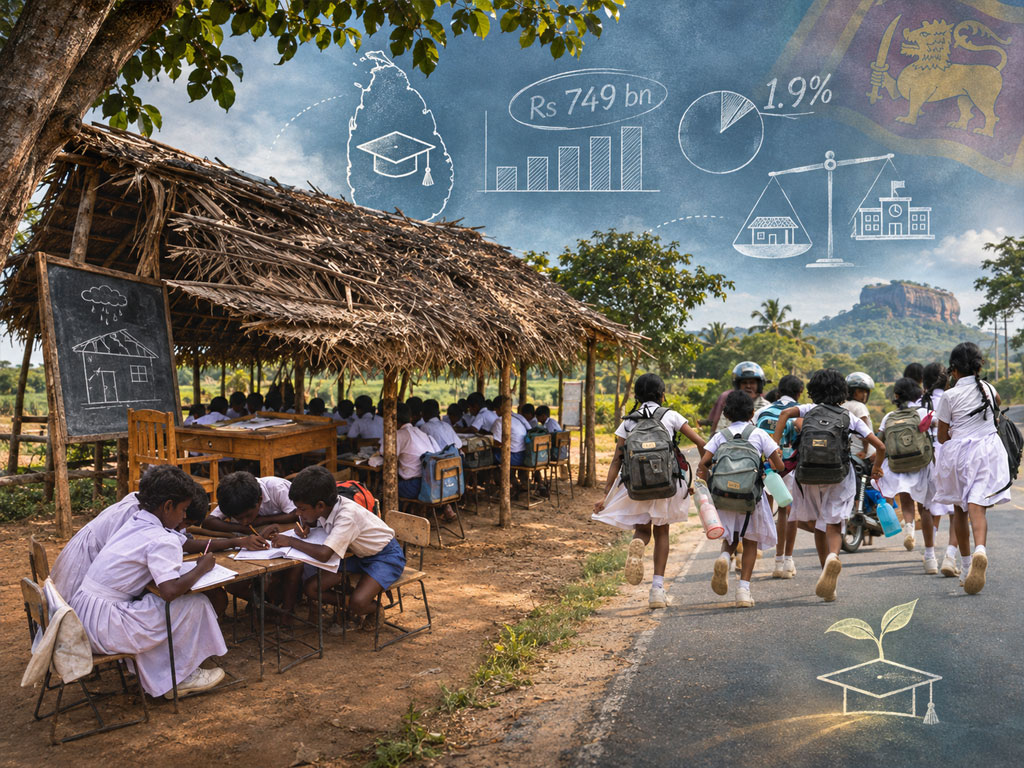
COLOMBO, November 19, 2026 — Sri Lanka’s Rs. 749 billion education allocation for 2027 has been presented as the largest in the country’s history, but teachers and university academics warn that higher spending alone will not resolve shortages, inadequate school facilities and the widening divide between urban and disadvantaged communities.
The Government’s decision to allocate approximately Rs. 749 billion to education in the 2027 Budget has renewed debate over whether Sri Lanka is investing enough in its children and, more importantly, whether the money will reach the schools and universities that need it most.
Prime Minister and Minister of Education, Higher Education and Vocational Education Dr. Harini Amarasuriya told Parliament on November 13 that the allocation represented 12.12% of Government expenditure and included Rs. 104 billion for capital investment.
The Government describes the commitment as the largest education allocation in Sri Lanka’s history.
Former Minister Kumara Jayakody has also defended the spending increase, stating that education expenditure will have risen by 48.6% between 2023 and 2027.
He described education as the wings given to children to conquer their future.
Yet the question confronting the Government is whether those opportunities will extend beyond well-resourced schools in Colombo and other major cities to children in remote villages, plantation communities and economically disadvantaged regions.
Teachers’ unions and university academics argue that the Budget must be judged not simply by its overall value, but by the distribution of resources, the ability of institutions to use the allocations and the improvements delivered to students.
The debate has also revived the longstanding demand for education expenditure to reach 6% of gross domestic product, a target championed by university academics during the 2012 campaign for increased public investment.
While the Government’s proposed education spending is substantial in nominal terms, critics maintain that the country’s education system continues to suffer from inadequate funding, teacher shortages, deteriorating facilities and declining academic capacity.

Rs. 749 Billion Allocation Requires Clear Accounting
One of the first questions concerns how the education allocation has been calculated.
Amarasuriya stated that the Government had provided Rs. 749 billion for the sector, including Rs. 104 billion for capital expenditure.
The official Citizens Budget confirms the broader sectoral allocation and provides the following breakdown:
| Education sector | 2027 allocation |
|---|---|
| School education | Rs. 562.7 billion |
| University education | Rs. 148.4 billion |
| Vocational education | Rs. 25.7 billion |
| Science and technology | Rs. 5.4 billion |
| Dhamma school education | Rs. 1.3 billion |
| Pre-primary education | Rs. 5.6 billion |
| Total, approximately | Rs. 749 billion |
The budget estimates separately identify approximately Rs. 328 billion under the Ministry of Education, Higher Education and Vocational Education.
These amounts reflect different reporting boundaries and cannot be treated as directly equivalent figures.
The broader Rs. 749 billion allocation includes expenditure associated with education across multiple levels and institutions, while the ministry-level appropriation covers the spending heads assigned to that ministry.
The Government should nevertheless publish a clear reconciliation explaining how the sector-wide total is distributed among ministries, provincial administrations, universities and other institutions.
Such transparency is especially important when assessing claims about education expenditure as a percentage of GDP.
The figure of approximately 1.9% has featured prominently in the public debate. It should be considered alongside the precise scope of expenditure included in the calculation.
A meaningful comparison with international benchmarks requires consistent accounting rather than selectively comparing different budget classifications.
The 6% Education Demand Remains Unfulfilled
The demand that Sri Lanka allocate 6% of GDP to education gained national prominence during the Federation of University Teachers’ Associations (FUTA) campaign in 2012.
Among those associated with the campaign was Dr. Harini Amarasuriya, who now serves as Prime Minister and Education Minister.
The demand was intended to address longstanding weaknesses in public education while recognising education as a national investment rather than merely a recurring government expense.
International education financing commitments provide an important reference point.
Under the Education 2030 Framework for Action, governments have been encouraged to allocate at least 4% to 6% of GDP and/or 15% to 20% of public expenditure to education.
These are international policy benchmarks rather than legal obligations requiring every country to achieve them immediately.
Nevertheless, they provide a basis for assessing the scale of Sri Lanka’s investment.
Critics argue that education expenditure equivalent to approximately 1.9% of GDP remains inadequate when compared with those benchmarks.
FUTA Secretary Professor Charudatta Ilangasinghe has proposed a more realistic medium-term approach.
Rather than demanding that the Government immediately reach 6%, he has called for a clear financial plan that progressively increases investment over six or seven years.
Such a programme could establish intermediate targets of 3% and 4% before moving towards 6%.
The advantage of a phased approach is that it allows expenditure to increase alongside improvements in the Government’s revenue position and the capacity of institutions to implement projects.
For education policy to remain credible, however, the Government would need to establish a timetable, identify funding sources and publish regular progress reports.
Without that commitment, the 6% target risks remaining a recurring political promise rather than an achievable national objective.
Rural Schools Remain at a Disadvantage
One of the strongest criticisms of the 2027 Budget concerns the unequal distribution of resources among Sri Lanka’s schools.
Ceylon Teachers’ Union President Priyantha Fernando has criticised the absence of a clearly identifiable programme devoted specifically to developing small rural schools.
He argues that educational reforms cannot succeed unless the basic facilities required for teaching and learning are available.
In many leading urban schools, students have access to laboratories, computers, libraries and additional support from parents and past pupils.
By contrast, some schools in remote and economically disadvantaged areas continue to face shortages of classrooms, subject teachers, sanitation facilities and reliable drinking water.
The difference affects the quality of education children receive, despite their formal entitlement to free schooling.
Children from plantation communities and schools in the Northern and Eastern Provinces may encounter additional obstacles relating to geography, transport, language and household income.
A school unable to provide a suitable classroom or qualified teacher cannot be expected to deliver the same educational outcomes as a well-resourced institution.
This makes the distribution of education funding as important as the total amount allocated.
Rather than distributing development funds solely through uniform formulas, the Government should consider mechanisms that give greater weight to schools facing the most severe disadvantages.
Such an approach would recognise that equal opportunity sometimes requires unequal levels of financial support.
Smart Classrooms Cannot Replace Basic Facilities
The Government has announced several initiatives to modernise school education through digital technology.
These include plans for 300 smart classrooms in 2027, the provision of smart boards to thousands of schools and expanded internet connectivity.
Amarasuriya has reported progress involving smart-board facilities for more than 4,570 schools and internet access for approximately 6,000 schools.
Budget documents also identify investment in digital infrastructure, including support for government schools and satellite internet connectivity for remote areas.
These measures represent an important attempt to improve access to modern learning tools.
However, providing equipment is not the same as ensuring that it is used effectively.
Sri Lanka has more than 10,000 classrooms serving Grades 1 to 6 alone, according to the source’s figures.
Against that scale, 300 new smart classrooms would represent only a limited part of the wider requirement.
The effective use of smart boards and digital learning platforms also depends on reliable electricity, functioning internet connections, teacher training and suitable educational content.
Equipment that cannot be maintained or incorporated into lessons may deliver little educational benefit.
There is also a danger that digital modernisation could widen existing inequalities if better-resourced schools are able to use the facilities more effectively than smaller institutions.
The Ministry should therefore assess not only how many devices have been distributed, but also how frequently they are used and whether they improve learning outcomes.
Teacher Shortage Threatens Educational Reform
Sri Lanka’s shortage of qualified teachers remains one of the most immediate obstacles to improving educational quality.
According to estimates presented by teachers’ unions, the country currently faces approximately 46,000 teaching vacancies.
The shortage could increase to around 56,000 as further retirements occur.
The Government has proposed recruiting approximately 23,000 teachers, but union representatives argue that the measure will not be sufficient to eliminate the deficit.
The figures are union estimates and should be distinguished from the Government’s final verified vacancy and recruitment records.
Even if the planned recruitment proceeds in full, shortages may persist in particular subjects and geographical areas.
Schools in remote provinces often face difficulties attracting and retaining teachers, particularly in science, mathematics, English and technology-related subjects.
Some institutions have teachers in excess of their requirements while others struggle to provide essential lessons.
A national recruitment programme must therefore be accompanied by a credible deployment policy.
Without a fair distribution system, additional appointments may fail to resolve shortages in the communities most severely affected.
Teachers also require adequate preparation before new curricula are introduced.
Launching reforms without the necessary personnel, training and teaching materials could place additional pressure on schools already struggling to maintain normal instruction.
Filling vacancies, improving deployment and strengthening professional development should be treated as foundational requirements of educational reform.
University Admissions Rise While Academic Staff Numbers Fall
Higher education faces a different but equally serious challenge.
Sri Lanka’s state universities have expanded student admissions over the past decade without a corresponding increase in academic personnel.
According to figures cited by the Federation of University Teachers’ Associations, approximately 25,000 students entered state universities in 2015, compared with about 45,000 in recent years.
Academic staffing has not kept pace with this expansion.
The source figures indicate that universities employed approximately 5,800 lecturers in 2015 and around 6,000 in 2022.
That number has reportedly declined to about 5,200, partly because academics have migrated overseas.
FUTA estimates that at least 12,000 lecturers would be required to provide an adequate standard of higher education to the present student population.
These estimates require reconciliation with current University Grants Commission staffing data, but the underlying concern is significant.
As student admissions rise and academic staff numbers decline, lecturers face heavier teaching responsibilities, greater supervision demands and less time for research.
The problem extends beyond salaries.
Academics have cited limited research facilities, inadequate professional development opportunities, economic pressures and concerns about academic freedom among the factors influencing decisions to leave.
Retaining qualified lecturers will require improvements in research funding, career development and working conditions alongside remuneration.
The loss of experienced university teachers also has long-term consequences for postgraduate education, research output and the development of future academics.
University Building Projects Face Delays
The Budget includes Rs. 2,250 million for developing university buildings, laboratories and academic facilities.
The proposed work covers several institutions, including the Universities of Eastern, Ruhuna, Sabaragamuwa, Jaffna, Kelaniya, Rajarata, Uva Wellassa and Colombo.
The allocations address longstanding requirements for teaching spaces, laboratory equipment and research facilities.
However, academics have raised concerns that much of the expenditure during 2027 will be devoted to assessments, planning and preparatory work, with major construction expected to begin in 2028.
For universities already operating with inadequate facilities, further delays could worsen overcrowding and constrain research.
Project planning is necessary to ensure that public expenditure produces viable infrastructure.
Nevertheless, prolonged administrative processes should not become an excuse for postponing essential improvements.
The Ministry should publish implementation schedules identifying which projects will begin during 2027, when construction is expected to commence and when the facilities are scheduled for completion.
Universities must also be provided with sufficient resources to operate and maintain new buildings once construction is finished.
Investment in physical infrastructure will have limited value if institutions cannot recruit the lecturers and technical personnel necessary to use it.
Teacher and Lecturer Allowances Increased
The 2027 Budget includes several proposals intended to ease financial pressure on teachers undergoing training and improve remuneration within higher education.
Among the measures announced are:
- An increase in the monthly allowance for students at National Colleges of Education from Rs. 10,500 to Rs. 20,000, effective April 2027.
- An increase of Rs. 25,000 in the monthly academic allowance for university lecturers, with half scheduled for July 2027 and the remainder for July 2028.
- A threefold increase in the hourly payment for visiting university lecturers, from Rs. 1,500 to Rs. 4,500.
- An allocation of Rs. 35,000 million for school digitalisation, teacher development and infrastructure improvements.
These measures could assist recruitment, retention and professional development.
The increased allowance for trainee teachers is particularly relevant at a time when the education system requires thousands of additional qualified personnel.
Higher payments to visiting lecturers may also help universities attract specialist expertise.
However, financial incentives alone are unlikely to resolve shortages caused by difficult working conditions or insufficient facilities.
The effectiveness of the proposals will depend on their timely implementation and the Government’s ability to sustain them over successive budgets.
Unspent Allocations Demand an Explanation
The debate over education funding cannot be separated from the question of whether previous allocations were fully utilised.
The source refers to audit information indicating that more than Rs. 351 billion allocated to the Ministry of Education, Higher Education and Vocational Education remained unspent in 2024.
That figure has also been cited in published discussion of the 2027 Budget.
However, it requires careful examination of the underlying National Audit Office records to determine the precise expenditure categories, accounting period and meaning of the reported balance.
Budgeted expenditure, released funding and actual spending are different financial measures.
A reported unspent allocation cannot automatically be interpreted as money that was available in cash but deliberately withheld from schools.
Nevertheless, persistent underutilisation of approved budgets may indicate weaknesses in planning, procurement, implementation or administrative capacity.
Teachers’ unions have also questioned the extent to which education allocations were utilised during 2025 and 2026.
Where funds intended for school repairs, laboratories or teacher development remain unused, the consequences may be felt directly by students.
The Government should therefore publish annual reports explaining how much of the education budget was allocated, released, committed and spent.
Those reports should identify the institutions receiving funds, the projects completed and the reasons for any delays.
Without such information, Parliament and the public cannot properly evaluate whether increases in education spending are delivering the intended results.
Debt Payments Limit the Government’s Spending Choices
Calls for greater investment in education must also be considered within Sri Lanka’s financial circumstances.
The 2027 Budget estimates Government revenue and grants at Rs. 6,180 billion, while expenditure is projected at Rs. 7,673 billion.
Interest payments on public debt alone are estimated at approximately Rs. 2,643 billion.
These obligations significantly restrict the Government’s ability to increase expenditure across all sectors simultaneously.
Sri Lanka is also attempting to maintain fiscal discipline under its economic recovery programme while funding reconstruction, infrastructure and essential public services.
An immediate increase in education expenditure to 6% of GDP would therefore require a substantial financial adjustment.
That could involve higher revenue, reductions in other spending or a gradual restructuring of expenditure priorities.
Yet financial constraints cannot justify indefinitely postponing improvements to public education.
Education contributes directly to labour productivity, technological development and economic growth.
Inadequate investment today may limit the country’s capacity to generate revenue and compete internationally in future decades.
The appropriate response is a credible medium-term financing strategy that links increased spending to measurable institutional improvements.
Free Education Must Provide Equal Opportunities
Sri Lanka’s commitment to free education is intended to ensure that a child’s opportunities are not determined by family income, geographical location or social background.
In practice, substantial inequalities remain.
Many leading urban schools receive financial and practical assistance from established past pupils’ associations and parents.
Smaller rural schools and institutions serving plantation communities often lack comparable support.
Children in disadvantaged areas may consequently encounter poorer facilities, fewer subject teachers and limited access to enrichment activities.
These inequalities can affect examination performance, university admission and subsequent employment opportunities.
The system also faces challenges involving excessive examination pressure, dependence on private tuition and unequal access to support for children with disabilities.
Educational equality cannot be achieved by allocating identical amounts to every school regardless of its circumstances.
A fairer approach would direct additional funding towards institutions with the greatest need.
That should include targeted improvements to sanitation, drinking water, classroom facilities, libraries, laboratories, transport access and specialised learning support.
Plantation schools and institutions in remote Northern, Eastern and rural communities should receive particular attention where objective assessments establish severe resource shortages.
Such measures would bring practical meaning to the principle that every child deserves access to quality education.
Reforms Must Be Developed With Teachers and Parents
Educational reform cannot succeed through changes to curricula and the distribution of equipment alone.
Teachers, principals, parents, academics and education specialists must be involved in planning changes that affect classroom instruction.
Reforms require adequate preparation, including updated textbooks, teacher guides, assessment procedures and training.
Introducing new teaching methods without these resources could disrupt learning and place additional responsibilities on teachers who already face staff shortages.
Policy decisions should also reflect the practical conditions in different schools.
A reform designed around the facilities of a leading Colombo school may be difficult to implement in a small rural institution.
The Government should therefore assess the readiness of schools before introducing major changes.
Consultation must also be meaningful rather than limited to announcing decisions after they have already been made.
Teachers and school administrators are often best placed to identify implementation difficulties and propose workable solutions.
An effective reform programme would combine clear national standards with sufficient flexibility to address local educational needs.
A National Education Investment Plan Is Needed
The 2027 Budget creates an opportunity to move beyond the recurring argument over whether education expenditure should immediately reach 6% of GDP.
What is required is a national financing and implementation strategy that connects expenditure targets with measurable improvements.
Such a programme should establish a gradual timetable for increasing education investment, supported by realistic revenue projections and clearly identified expenditure priorities.
It should also include a verified plan for filling teacher vacancies and ensuring that schools with the greatest shortages receive qualified personnel.
Infrastructure development must place greater emphasis on rural, plantation and disadvantaged schools rather than relying primarily on large national projects.
Universities require a strategy for retaining academic staff, expanding research facilities and improving teaching capacity.
The Government should also establish transparent reporting systems that allow the public to follow education expenditure from the national budget to individual institutions and completed projects.
Above all, the education community must be involved in determining the pace and substance of reforms.
Without those measures, higher budget allocations may produce limited improvements in educational quality.
Education’s Success Must Be Measured in Classrooms
The Government’s Rs. 749 billion allocation represents a substantial financial commitment to education.
It does not, however, establish that Sri Lanka has resolved the inequalities and institutional weaknesses affecting its schools and universities.
The real test will be whether children in disadvantaged communities receive qualified teachers, adequate classrooms and access to the learning opportunities available in better-resourced schools.
Success should also be measured through lower teacher vacancy rates, improved university research, stronger vocational training and better educational outcomes.
The longstanding demand for 6% of GDP should remain part of a wider discussion about national priorities, but achieving that figure will require sustained financing and effective implementation.
Education is not merely an expenditure that appears in an annual budget.
It determines the knowledge, skills and opportunities available to the next generation.
If education is intended to give children the wings to shape their future, those opportunities must extend equally to the child in Colombo, the village, the plantation community and every disadvantaged region of the country.
Only when the allocations translate into real improvements in children’s lives can the Government reasonably claim that its investment is preparing Sri Lanka for a stronger future.