COLOMBO, November 20, 2026 — Sri Lanka’s Cabinet has approved construction contracts worth Rs. 251.37 billion for the first phase of the Ruwanpura Expressway, but the combined budget allocations for 2026 and 2027 amount to just Rs. 45.68 billion, raising questions about how the government intends to finance the project and when motorists can expect to use the highway.
The disparity has prompted concerns over the practicality of completing the expressway within a reasonable timeframe without substantially increasing annual funding.
Cabinet approval was granted for 11 construction packages covering the Kahathuduwa–Ingiriya section, including the interchange connecting the proposed highway to the Southern Expressway.
The first phase was previously described in project documentation as extending approximately 24.3 kilometres. The latest contract announcement identifies the construction section as 22.18 kilometres, reflecting a more specific chainage measurement.
With the government seeking to advance the project through domestic funding arrangements, attention is turning to whether future budgets can sustain the expenditure required to complete the approved works.

Rs. 251.37 Billion Approved, but Only Rs. 45.68 Billion Budgeted
The financial figures reveal a substantial difference between the contracts approved by Cabinet and the amounts identified in the government’s two most recent budgets.
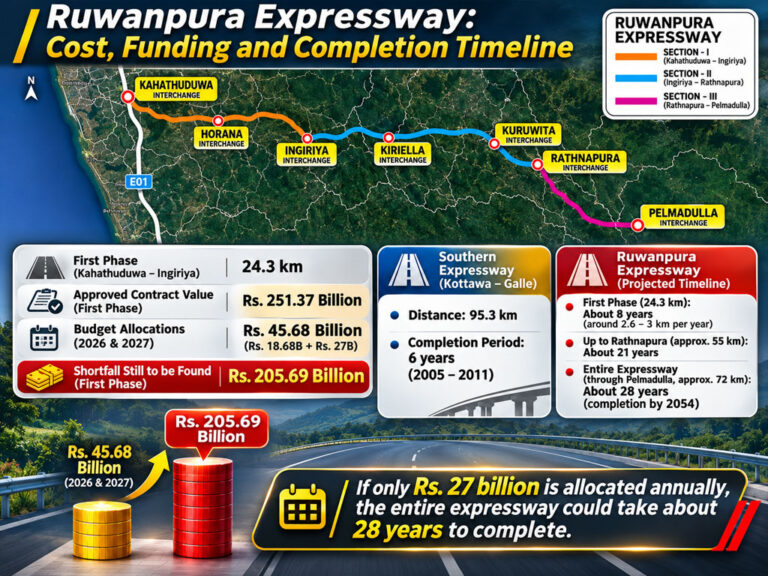
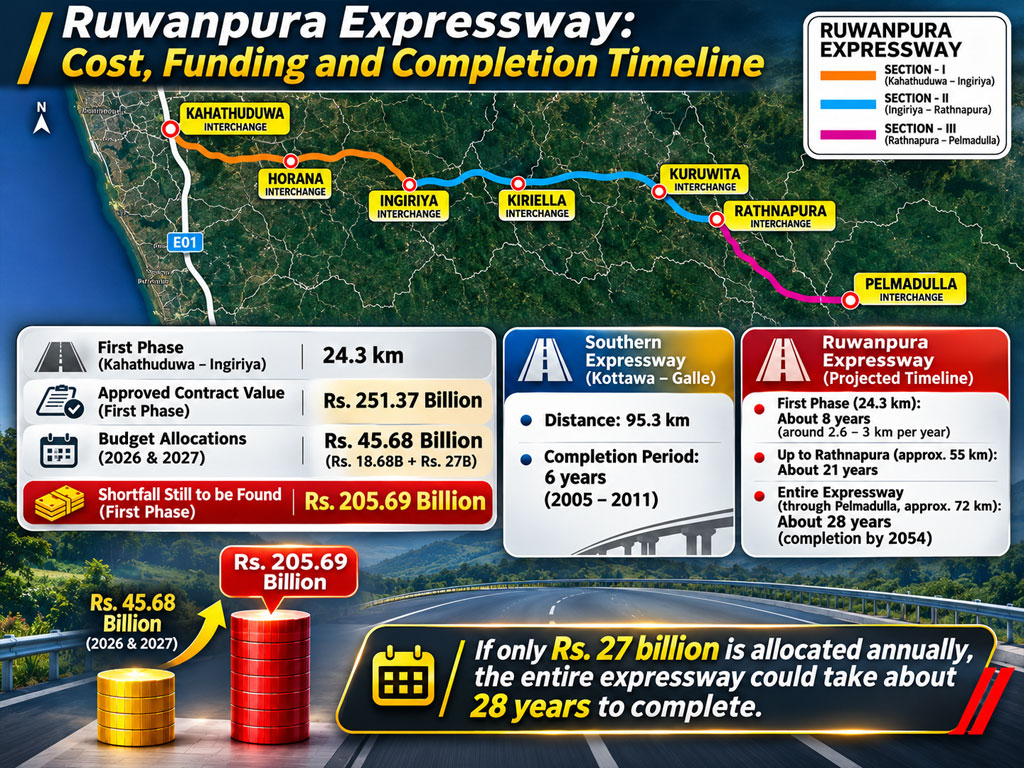
According to the 2027 Budget proposals, Rs. 18.68 billion was allocated in 2026 for initial activities associated with the first phase. A further Rs. 27 billion has been proposed for 2027.
The financial position can be summarised as follows:
- Total approved contract value for the first phase: Rs. 251.37 billion.
- Budget allocation for 2026: Rs. 18.68 billion.
- Proposed budget allocation for 2027: Rs. 27 billion.
- Combined allocations for 2026 and 2027: Rs. 45.68 billion.
- Difference between approved contract value and combined allocations: Rs. 205.69 billion.
The two-year allocations therefore represent approximately 18.2% of the approved contract value, leaving the equivalent of 81.8% to be covered through subsequent allocations or other financing arrangements.
This difference does not necessarily constitute a financing deficit. Large infrastructure contracts are ordinarily paid over several years as construction progresses, rather than being funded entirely through the budget of the year in which they are awarded.
Nevertheless, the figures demonstrate the scale of the future financial commitments facing the Treasury.
A comprehensive financing schedule would establish how much money is expected to be released each year, how payments correspond to construction milestones and whether the government has made sufficient provision for completing the approved works.
Could the First Phase Take Another Eight Years?
If the remaining Rs. 205.69 billion were financed exclusively through annual allocations of Rs. 27 billion, it would take approximately 7.6 additional years to provide the equivalent amount.
On that simplified assumption, funding for the first phase could extend into the mid-2030s.
Such an outcome would raise concerns about delays, contractor commitments and the time required before the investment begins generating its expected economic returns.
The calculation, however, is not an official construction timetable.
Annual budget allocations are not necessarily equivalent to the value of work completed in a particular year. Contractors may carry out construction according to agreed milestones, while the government distributes payments across several financial periods.
Future allocations could also increase, allowing the project to progress considerably faster than a calculation based on an unchanged Rs. 27 billion annual provision would suggest.
The central question is whether the government has established a realistic multi-year financing programme that supports the construction schedule attached to the contracts.
Could the Entire Expressway Take Until 2054?
The proposed Ruwanpura Expressway is intended to connect Kahathuduwa with Pelmadulla through the Ratnapura region, creating an additional expressway link between the Western and Sabaragamuwa provinces.
Earlier project documentation identifies the full route as approximately 73.9 kilometres, although other published descriptions have referred to a distance of around 71.8 kilometres.
Applying the first phase’s approved cost proportionately across the longer alignment produces an indicative overall construction cost approaching Rs. 740 billion to Rs. 765 billion.
Such an extrapolation is not an approved estimate for the entire highway. Actual expenditure will depend on the engineering requirements, land acquisition, terrain, structures and contract prices applicable to each section.
Critics of the current funding approach have suggested that completing the entire expressway could take as long as 28 years, potentially pushing completion towards 2054.
That projection assumes a prolonged construction programme without a substantial acceleration in annual investment.
It should not be interpreted as an official completion date or an inevitable consequence of the allocations announced so far.
Nor can the total construction period be calculated reliably simply by extending the first phase’s estimated annual funding requirements across the remaining kilometres. Different sections may have substantially different construction costs and could potentially proceed simultaneously.
The government has yet to establish, through the figures examined here, a consolidated financing and completion schedule for all sections extending to Pelmadulla.
Prolonged Construction Could Increase Costs
One of the principal risks associated with delayed infrastructure projects is the possibility that construction costs will rise before the work is completed.
Changes in material prices, labour expenditure, fuel costs and exchange rates can affect contractor payments, particularly where agreements include provisions for price adjustments.
Lengthy implementation periods may also increase administrative costs and delay the economic benefits expected from an investment.
For the Ruwanpura Expressway, a prolonged construction programme could postpone travel-time savings, improved regional connectivity and other advantages associated with the completed route.
The original criticism argues that the first phase could generate no toll revenue until the section between Kahathuduwa and Ingiriya becomes operational.
While a completed and commissioned section would normally be required before regular toll collection could begin, the absence of toll revenue during construction does not mean that public expenditure produces no economic value.
Construction activity can generate employment, business opportunities and other immediate effects, while the principal transport benefits are generally realised after the road becomes operational.
The more important financial consideration is whether the eventual benefits justify the investment, particularly if the completion date is delayed and the overall cost increases.
Building Without Borrowing: Can the Budget Sustain It?
The government’s approach to financing infrastructure without relying heavily on new borrowing has attracted scrutiny because of the substantial annual expenditure required for major road projects.
Funding construction through domestic budget allocations could reduce the need for additional external financing. It does not, however, eliminate the obligation to provide adequate funds throughout the project’s implementation.
If annual allocations remain substantially below the amounts required by the construction programme, contractors could face delayed payments or the project could experience slower progress.
Conversely, a phased budgetary approach may be financially manageable if expenditure is aligned with realistic construction milestones and supported by credible future funding commitments.
The argument that allocating only Rs. 27 billion in 2027 proves the government cannot raise additional revenue is not established by the budget figure alone.
That conclusion would require an examination of the Treasury’s broader capital expenditure programme, revenue projections, competing commitments and the financing arrangements agreed with contractors.
What remains clear is that a project carrying an approved first-phase contract value of Rs. 251.37 billion will require substantial expenditure beyond the allocations announced for 2026 and 2027.
Southern Expressway Offers a Historical Comparison
The original criticism compares the Ruwanpura project with the construction of the Southern Expressway under former President Mahinda Rajapaksa.
The approximately 95.3-kilometre section from Kottawa to Pinnaduwa was opened to traffic on November 27, 2011.
Although major construction packages progressed during the latter half of the 2000s, official project records indicate that implementation began in 2003, making the overall development period longer than the six years cited in the criticism.
The comparison nevertheless demonstrates the importance of coordinating project financing, procurement and construction schedules to deliver major transport infrastructure.
Differences in terrain, design, financing arrangements, land acquisition and construction requirements must also be considered before drawing direct conclusions about the relative efficiency of the two projects.
Government Must Clarify Funding and Completion Schedule
President Anura Kumara Dissanayake’s administration has identified the development of expressways and other transport infrastructure as part of its wider capital investment programme.
Cabinet approval of the Ruwanpura Expressway contracts provides a basis for construction to proceed, but it does not by itself establish when the first section will be completed or how the entire project will be financed.
The government and Road Development Authority should clarify the anticipated construction period, annual funding commitments, contractual payment arrangements and expected completion dates.
Such information would allow the public to distinguish between a project that is deliberately financed over several years and one whose progress may be constrained by insufficient funding.
For a highway expected to strengthen connectivity between Colombo and the Ratnapura region, the decisive measure will be whether the government can convert its approved contracts into completed infrastructure within a credible timeframe and at a financially sustainable cost.
Verified financial position: Cabinet approval for Rs. 251.37 billion in construction contracts was reported on November 17, 2026. The 2027 Budget speech confirms Rs. 18.68 billion for 2026 initial activities and Rs. 27 billion proposed for 2027. Newswire+1
Project length: Earlier official planning documentation identifies a 24.3 km first phase and a 73.9 km overall project. However, November 2026 contract reporting identifies the current first-phase construction section as 22.18 km. Both measurements have been distinguished in the article. Urban Development Authority+1
Completion by 2054: This is not an announced government deadline. Even the original calculation is not conclusive: 73.9 kilometres divided by 2.6–3 kilometres annually implies roughly 25–28 years of construction, depending on the assumed rate. A separate claim suggests approximately 21 years to reach Ratnapura, but neither forecast is established by an official works programme.
Southern Expressway comparison: The Kottawa–Pinnaduwa section opened in November 2011, but official records date project implementation to 2003. Describing the whole undertaking as a six-year project would therefore be misleading. 2013+1
Editorial distinction: The Rs. 205.69 billion difference is a gap between approved contract value and two years of budget allocations, not proof that the Treasury lacks that money or that the project cannot be completed sooner.