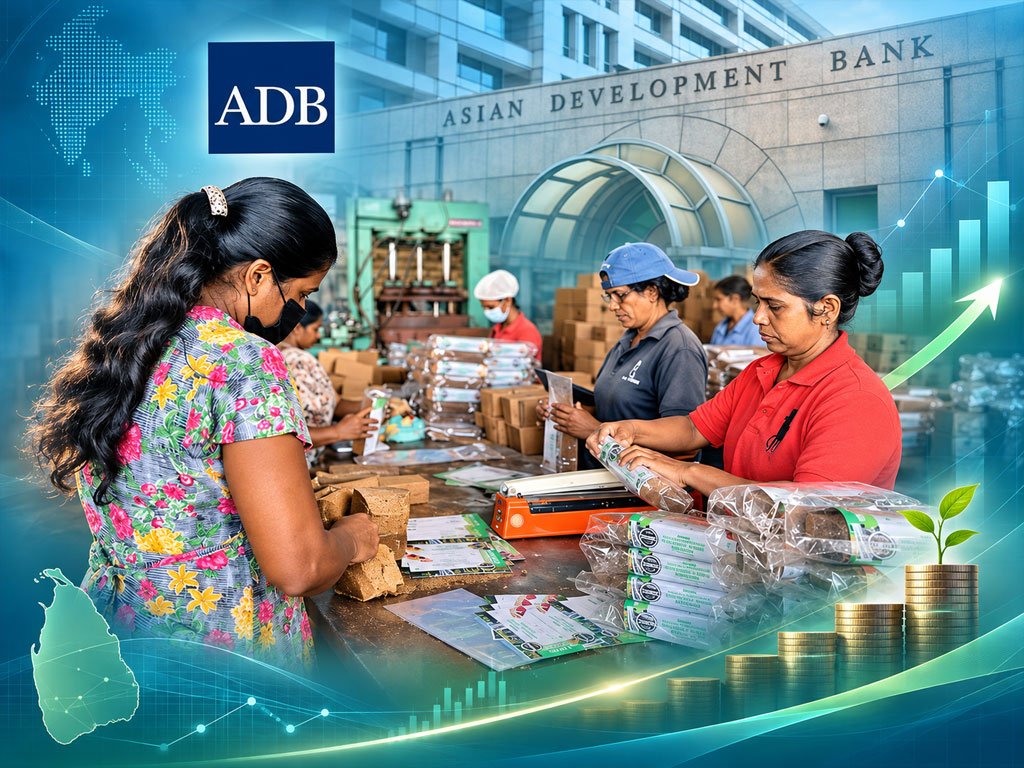
COLOMBO — The Asian Development Bank (ADB) has approved a $200 million financing package to strengthen Sri Lanka’s struggling micro, small and medium-sized enterprises (MSMEs), offering fresh opportunities for businesses still recovering from the economic crisis, high borrowing costs and weakened consumer spending.
Announced on November 20, 2026, the programme combines financial-sector reforms with investment lending intended to improve access to credit, particularly for smaller businesses that have struggled to obtain financing through conventional banking channels.
Yet the approval raises an important economic question: will the funding help revive enterprises weakened by successive crises, or provide temporary financial relief without resolving the structural problems threatening their survival?
The programme offers an opportunity to strengthen a sector responsible for more than half of Sri Lanka’s economic output. Its effectiveness, however, will depend on how successfully approved financing is translated into affordable loans, productive investment and sustainable business growth.

How the ADB’s $200 Million Financing Package Will Work
The ADB has structured the financing under its Building a Strong and Inclusive Financial Ecosystem for MSMEs Sector Development Programme, dividing the approved amount into two components:
1. A $100 million policy-based loan: Intended to improve the financial environment for MSMEs through regulatory reforms, stronger credit information systems, expanded credit guarantees, financial inclusion and improved consumer protection.
2. A $100 million financial intermediation loan: Designed to increase access to investment financing through participating domestic financial institutions, including $40 million specifically allocated for green loans.
The programme is intended to address longstanding weaknesses in Sri Lanka’s financial system that have prevented otherwise viable enterprises from obtaining the capital needed to expand, modernise or recover from economic disruption.
Importantly, the $200 million approval does not mean the entire amount will be distributed directly to entrepreneurs. Half the financing supports broader policy and institutional reforms, while the other half provides the basis for investment lending through financial institutions.
The distinction matters because the success of the programme cannot be measured simply by the total amount approved. Its impact will depend on the number of businesses gaining access to finance, the affordability of that borrowing and the economic activity it generates.
Small Businesses Remain Vulnerable Despite Economic Recovery
MSMEs form the backbone of Sri Lanka’s economy, contributing more than 52% of Gross Domestic Product (GDP) and accounting for approximately 45% of total employment.
Their importance extends beyond national economic statistics. Small enterprises sustain household incomes, support regional development, provide employment outside major urban centres and connect agricultural producers, manufacturers and service providers to domestic markets.
Many have nevertheless struggled to regain financial stability following the country’s economic collapse.
High operating costs, limited access to affordable credit, inadequate collateral, technological constraints and weaker consumer purchasing power continue to undermine business confidence.
For enterprises operating on narrow profit margins, even modest increases in borrowing costs or interruptions to cash flow can threaten their survival.
Access to additional financing could allow some businesses to replace equipment, improve productivity, expand operations or invest in new markets.
Borrowing alone, however, cannot resolve weak demand or an unsustainable cost structure.
A business already struggling to meet its existing financial obligations may find that taking on further debt increases its vulnerability rather than improves its prospects.
The challenge is therefore not simply expanding the supply of loans, but ensuring that financing reaches commercially viable enterprises on terms they can realistically sustain.
Banking Reforms Must Address the Barriers Facing Entrepreneurs
One of the programme’s principal objectives is to improve the financial system serving smaller businesses.
Limited credit histories, insufficient financial records, weak digitalisation and complicated banking requirements have prevented many entrepreneurs from accessing formal credit.
Businesses without conventional collateral frequently face greater difficulties, even when they have established customers and viable commercial operations.
These shortcomings can push borrowers towards expensive informal lending arrangements, exposing them to excessive interest charges and potentially exploitative practices.
The ADB-backed reforms seek to improve credit information, strengthen financial infrastructure, expand credit guarantees and encourage greater financial inclusion.
Measures to strengthen oversight of money lending and microfinance are particularly relevant.
Sri Lanka has already enacted the Microfinance and Credit Regulatory Authority Act, No. 9 of 2026, which came into force on March 20. The legislation provides for a new regulatory framework covering money lending and microfinance institutions.
The challenge now lies in making that framework effective through implementation, supervision and consumer protection.
Reforming regulations will have limited practical value if entrepreneurs continue facing complicated loan procedures, restrictive collateral requirements and repayment terms poorly suited to their businesses.
Banks and participating financial institutions will therefore play a decisive role in determining whether the ADB financing improves access to credit.
The programme’s effectiveness will depend on whether these institutions can assess borrowers fairly while maintaining responsible lending standards.
Green Financing and Women Entrepreneurs Receive Special Attention
The allocation of $40 million for green financing introduces an additional opportunity for smaller businesses seeking to improve environmental sustainability and resilience to climate-related disruptions.
Eligible investments could support environmentally sustainable business activities and measures that help enterprises mitigate or adapt to climate-related risks, subject to the programme’s lending criteria.
Such financing is particularly relevant to businesses vulnerable to floods, droughts, extreme weather and other disruptions affecting production, transport and supply chains.
The ADB also expects at least 20% of MSMEs supported in investments addressing climate-related shocks to be owned or led by women.
This objective recognises the difficulties women entrepreneurs may face when seeking conventional financing, including limited collateral and barriers to participation in formal financial services.
Broadening access could strengthen women-owned enterprises while creating opportunities for investment, employment and local economic development.
Beyond conventional lending, the programme also envisages innovative financing mechanisms to help growth-stage SMEs access equity capital.
This could provide an alternative for enterprises whose expansion requirements cannot be adequately addressed through additional borrowing alone.
The Real Test Is Whether Businesses Can Recover
Although the financing package represents a substantial commitment to Sri Lanka’s MSME sector, it cannot independently guarantee the recovery of struggling businesses.
Affordable credit must be accompanied by predictable economic policies, stronger domestic demand, competitive production costs and opportunities for technological improvement.
Businesses also require protection against climate-related disruptions and greater access to markets where they can increase sales and generate sustainable revenue.
Financial-sector reform can improve the conditions under which entrepreneurs operate. It cannot substitute for broader economic policies that encourage investment, productivity and employment.
For policymakers, the central question is how the programme’s benefits will be measured.
The amount of financing distributed is one indicator, but other outcomes will be equally important: how many previously underserved businesses secure funding, whether borrowing costs become manageable, how many enterprises expand operations and whether employment and productive investment increase.
Transparent reporting on the allocation of funds and the performance of participating financial institutions will be important in determining whether the programme achieves its intended objectives.
For businesses still carrying the financial consequences of successive economic shocks, access to suitable financing could provide an opportunity to rebuild.
But indiscriminate lending would risk replacing one financial problem with another.
Sri Lanka’s smaller enterprises need more than access to borrowed money. They need the economic conditions necessary to generate sufficient income to repay that borrowing while remaining competitive.
The ADB’s $200 million programme provides a potential foundation for that recovery. Whether it delivers lasting results will depend on effective implementation, responsible lending and the ability of financial institutions to reach enterprises that have remained outside the formal credit system.
Ultimately, the measure of success will not be the size of the international loan approved for Sri Lanka, but the number of businesses that become stronger, more productive and financially sustainable because of it.