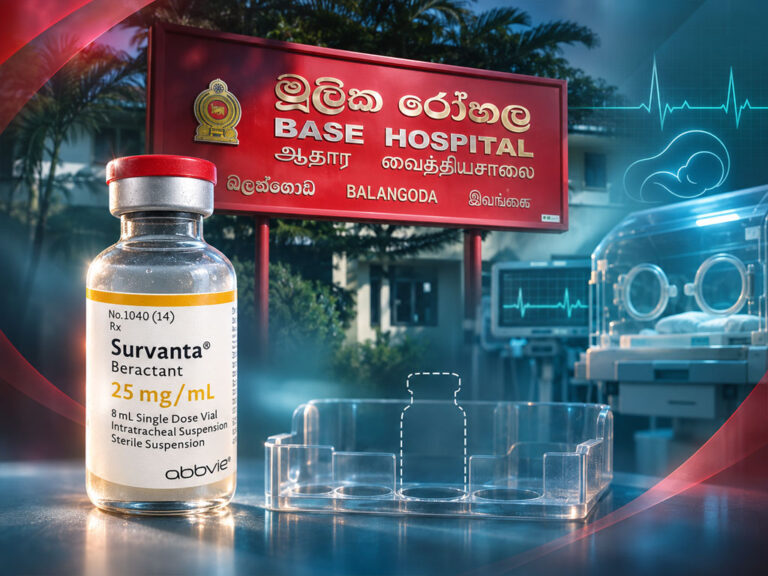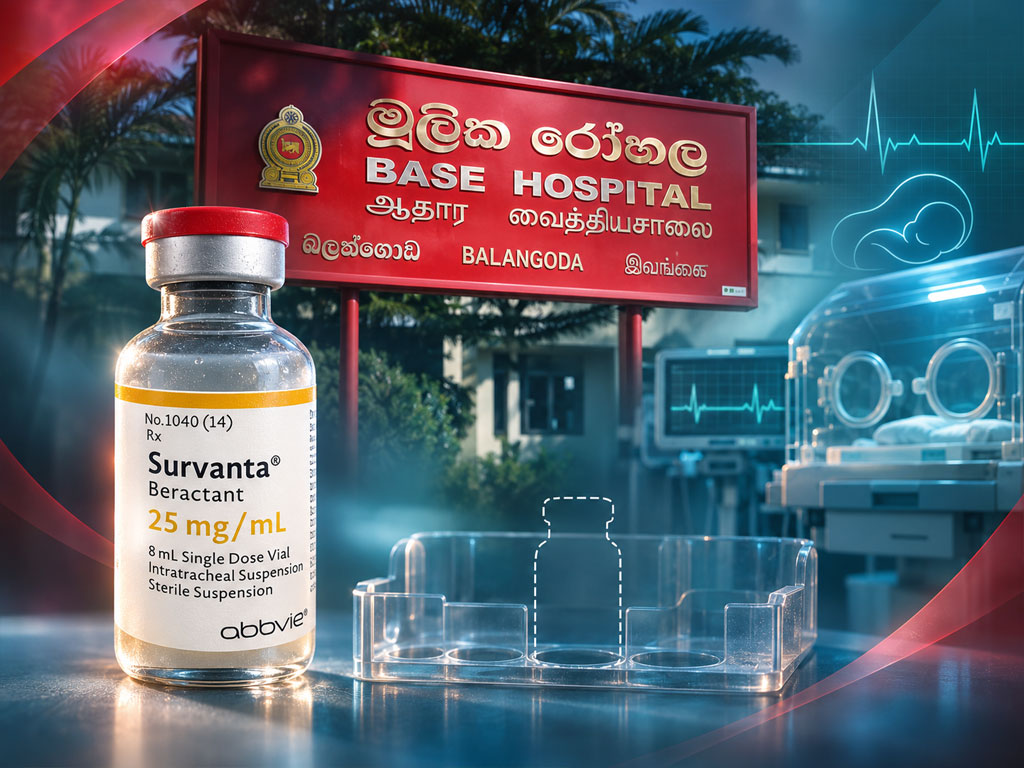
COLOMBO — The reported death of a premature newborn at Balangoda Base Hospital on November 24, 2026, has brought renewed attention to shortages of Beractant, a potentially life-saving medicine used to treat respiratory distress in premature infants, and to concerns about whether administrative procedures are delaying urgent medical supplies.
Health sector sources have raised suspicions that the reported unavailability of Beractant, also marketed as Survanta, may have affected the infant’s treatment. However, no medical investigation or official finding establishing a causal connection between the medicine’s availability and the child’s death has been presented.
The incident has prompted wider scrutiny of Sri Lanka’s medical supply system, particularly the availability of essential medicines for newborns whose survival may depend on treatment being administered without delay.
It has also revived attention to testimony given in the ongoing substandard medicines case, in which a former medical supplies official described taking extraordinary measures during the 2022–2023 economic crisis to obtain emergency medication for hospitals.

Beractant Shortage and the Critical Hours After Birth
Premature infants can experience respiratory distress syndrome because their underdeveloped lungs may not produce sufficient surfactant, a substance that reduces surface tension inside the lungs and helps keep the tiny air sacs open during breathing.
Beractant is a surfactant replacement medicine administered to eligible newborns experiencing respiratory distress syndrome. It helps improve lung function and can reduce the risk of serious complications.
Timely administration is particularly important in severe cases. Clinical guidance generally recommends early surfactant treatment when medically indicated, with some recommendations favouring administration within the first two hours of birth for intubated premature infants with respiratory distress syndrome.
Although the original account refers to a six-hour treatment window, the appropriate timing depends on the infant’s condition, respiratory support requirements and clinical assessment. There is no universal rule requiring every premature baby to receive Beractant within six hours.
Sri Lanka’s progress in reducing newborn mortality has depended partly on access to specialist neonatal care, including respiratory support and appropriate medicines.
That progress makes the reported shortage particularly concerning.
Health sector sources cited in reports surrounding the Balangoda death claim that Beractant stocks have been exhausted within the Medical Supplies Division (MSD) and parts of the government hospital system.
They further allege that hospitals have encountered difficulties obtaining the medicine through emergency procurement arrangements.
The extent of the reported shortage, including whether alternative surfactant preparations were available, requires confirmation from the Ministry of Health, the MSD and the hospital authorities.
Most importantly, the clinical circumstances surrounding the infant’s death must be independently established before concluding that a medicine shortage contributed to the outcome.
Court Testimony Recalls Emergency Medicine Supplies During the Economic Crisis
The Balangoda incident has also renewed attention to testimony reportedly delivered on October 30, 2026, before the three-judge High Court hearing the case concerning the procurement of substandard medicines.
Sujith Wasantha Kumara, a warehouse keeper identified as the fifth accused in the proceedings, described the difficulties faced by medical supply officials during Sri Lanka’s severe economic crisis in 2022 and 2023.
According to the account of his testimony, Beractant was among the medicines in critically short supply during that period.
Kumara told the court that approximately 250 vials were required each month, while only 25 vials were available at the State Pharmaceuticals Corporation (SPC) when urgent hospital requirements arose.
He described arranging their transportation before the relevant documentation had been completed, explaining that the paperwork followed the next day.
Recounting his actions, Kumara reportedly stated:
“I took a three-wheeler at my own expense, brought the medicine, and sent it to the hospitals. The documents came the next day. We worked like that and saved lives that day, Your Lordship.”
Kumara also reportedly described his work as a “meritorious job”, maintaining that his actions were motivated by concern for patients rather than any intention to compromise medicine safety.
His account highlights the operational pressures experienced by medical supply personnel during a period when economic conditions severely disrupted the availability of essential medicines.
Nevertheless, the testimony represents the accused officer’s account of events. Its evidential significance and any questions concerning compliance with procurement procedures remain matters for the court to determine.
Fear of Legal Consequences and Emergency Procurement Decisions
Beyond the immediate concerns surrounding Balangoda, the incident has brought attention to a more complicated question: whether fear of legal or administrative consequences is discouraging public officials from making urgent procurement decisions.
During the economic crisis, some health sector personnel reportedly adopted exceptional measures to secure medicines for patients when conventional supply arrangements could not meet immediate demand.
Today, several officials face judicial proceedings relating to procurement transactions undertaken during that period.
Within the health sector, concerns have reportedly been expressed that the possibility of disciplinary action or criminal prosecution may make some officials reluctant to exercise discretion, even when hospitals face urgent shortages.
Such concerns deserve examination, but they do not establish that the ongoing prosecutions have caused the present shortage or that procurement safeguards should be disregarded.
Public officials remain responsible for ensuring that medicines are obtained through lawful, transparent and clinically appropriate procedures.
At the same time, emergency supply systems must be sufficiently responsive to prevent administrative delays from compromising patient care.
The challenge is to ensure that officials can respond promptly to genuine medical emergencies while maintaining the safeguards necessary to prevent corruption, unsafe procurement and the misuse of public funds.
The Need for an Independent Examination of the Balangoda Death
The reported death of the premature infant requires an examination of both the clinical circumstances and the availability of essential treatment at Balangoda Base Hospital.
Such an assessment would need to establish whether the newborn suffered from respiratory distress syndrome, whether surfactant replacement was clinically indicated and whether Beractant or a suitable alternative was available when treatment was required.
It would also need to determine whether an emergency supply request was made, how that request was handled and whether any delay affected the treatment provided.
These questions cannot be answered solely through allegations about medicine shortages.
An independent clinical review, supported by hospital treatment records, medicine inventory information and the relevant medical findings, would be necessary to establish what happened.
The Ministry of Health and the Medical Supplies Division also have an opportunity to clarify the present nationwide availability of Beractant and other neonatal surfactant preparations, including measures taken to address any shortages.
For premature infants requiring urgent respiratory care, a reliable supply system can be as important as the clinical expertise available inside a neonatal unit.
The death reported at Balangoda therefore calls for more than an examination of an individual hospital’s circumstances. It warrants a clear assessment of whether Sri Lanka’s medical procurement and distribution arrangements can deliver essential neonatal medicines when they are needed.
Until the relevant medical findings are established, the reported shortage must not be presented as the proven cause of the child’s death. The immediate responsibility of health authorities is to establish the facts, explain the availability of treatment and ensure that avoidable supply failures do not place other newborns at risk.