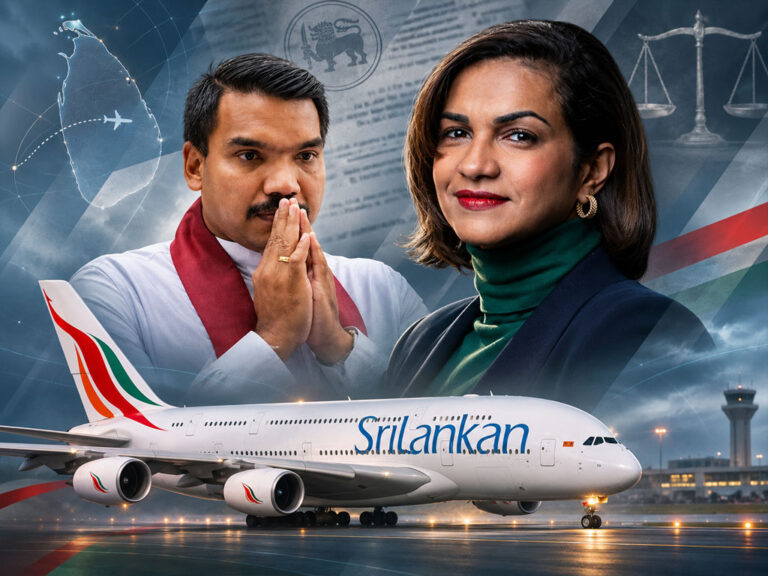
COLOMBO, November 27, 2026 — Rohitha Rajapaksa has been questioned for approximately four hours by the FCID over the SupremeSAT satellite venture, returning attention to businessman R. M. Manivannan’s investment arrangements, the project’s BOI approvals and conflicting parliamentary claims about its financial performance.
Rohitha Rajapaksa, the youngest son of former President Mahinda Rajapaksa, appeared before the Police Financial Crimes Investigation Division (FCID) on November 26 to provide a statement concerning the SupremeSAT satellite venture, renewing scrutiny of a private investment project launched in 2012 and the business arrangements surrounding it.
Rajapaksa reportedly spent approximately four hours with investigators before leaving the FCID premises.
The inquiry concerns a project promoted as Sri Lanka’s entry into the commercial satellite industry, involving SupremeSAT (Pvt) Ltd., businessman R. M. Manivannan and international partners, including China’s space industry.
The latest questioning has revived longstanding questions about the company’s financial capacity, the sources of its investment capital, the nature of its relationship with the Board of Investment (BOI) and Rajapaksa’s involvement in the venture.
Particular attention has also returned to contradictory financial figures presented in Parliament during August 2025, when Prime Minister Dr. Harini Amarasuriya initially cited revenue exceeding Rs. 343 billion before another Cabinet minister said the figures supplied by the BOI were incorrect.
Although the project has attracted political criticism for more than a decade, the publicly available record does not establish that State funds were used to purchase the satellite or that Rajapaksa committed financial wrongdoing.
The FCID’s continuing investigation must therefore distinguish questions arising from the original investment arrangements from allegations that could support criminal charges.

SupremeSAT Agreement Signed With BOI in May 2012
The SupremeSAT project was developed through SupremeSAT (Pvt) Ltd., a private company associated with businessman R. M. Manivannan.
On May 23, 2012, the company entered into an investment agreement with the Board of Investment of Sri Lanka to develop satellite-related infrastructure and provide telecommunications services.
Contemporary reporting identified ambitious plans involving international satellite partnerships, telecommunications facilities and future space-related investment.
Reports surrounding the project’s launch referred to investment ambitions exceeding US$300 million.
However, those figures must be distinguished from capital already invested or expenditure independently verified through audited financial statements.
An industry report published at the time of the agreement referred to an initial BOI arrangement of approximately US$20 million, while subsequent plans contemplated substantially larger investments.
The project was promoted as a commercial venture intended to develop satellite communications capabilities and related infrastructure.
In November 2012, SupremeSAT-1 was launched through a partnership involving China’s satellite industry.
The venture attracted considerable publicity because of its association with Rajapaksa, whose father was President at the time.
The original investment agreement and subsequent business arrangements remain relevant to the FCID investigation, particularly in determining the ownership, financing and contractual responsibilities of the parties involved.
Questions Surround R. M. Manivannan’s Business Network
Manivannan’s role as a principal businessman behind the SupremeSAT venture has long attracted scrutiny from political critics and anti-corruption campaigners.
The latest commentary calls for examination of his wider business network and the financial resources available when the satellite project was established.
One figure cited in the allegations is approximately Rs. 230 million, described as capital deployed during the project’s initial phase.
That amount has not been independently reconciled with the original BOI agreement or audited company accounts.
It should therefore not be treated as a verified measure of the project’s actual investment.
The central financial questions concern the origin of the capital used to establish the business, the identities of the beneficial owners, the source of subsequent investment and the contractual relationships between SupremeSAT and its international partners.
Such an examination would ordinarily require company registration records, audited financial statements, bank documentation, shareholder registers and investment agreements.
The existence of a complex corporate network does not, by itself, establish illegality.
Likewise, a company’s decision to undertake an ambitious project does not prove that the funds supporting it were improperly obtained.
Investigators would need to identify specific transactions or legal breaches before drawing such conclusions.
Public reporting has not established that Manivannan has been convicted of an offence involving the SupremeSAT venture.
Rohitha Rajapaksa’s Technical Role Draws Renewed Attention
Rajapaksa’s involvement has been one of the most politically sensitive aspects of the project.
During the original launch period, he was publicly associated with SupremeSAT in a technical capacity.
Critics questioned whether his academic qualifications and experience were sufficient for a senior role in an international satellite venture.
Space technology and satellite operations require specialised expertise, particularly in engineering, communications, orbital systems and commercial service delivery.
Rajapaksa’s critics maintain that his appointment warrants examination because he had not previously established a professional career within an international space agency.
However, employment in a space agency is not necessarily a legal prerequisite for holding a technical or advisory position in a private satellite-related company.
The relevant questions concern the responsibilities he actually exercised, the qualifications required for his position and whether the appointment was connected to any improper business advantage.
In statements made during earlier investigations, the Rajapaksa family maintained that he was employed by the company as Technical Director from July 2012 until July 2014.
They said he subsequently left the position to pursue further studies.
That account is important because it distinguishes his employment from allegations that he personally owned or controlled the project.
His precise duties, remuneration and authority would require verification through corporate and employment records.
Was Rajapaksa a Shareholder or Only a Technical Adviser?
Rajapaksa has previously denied being a shareholder in SupremeSAT.
His family also stated during earlier investigations that he held no direct or indirect ownership interest and had participated as a paid employee.
The supplied account describes his role as that of a technical adviser, although earlier public statements used the title Technical Director.
Those descriptions should not be treated as interchangeable without reviewing the relevant employment and corporate records.
A separate 2025 examination of the company’s business connections raised questions about a Singapore-registered entity identified as Dycer International and possible shareholding arrangements associated with Rajapaksa.
Those reported connections create a factual question that should be resolved through authenticated company documents rather than assumption.
An individual’s directorship, advisory appointment, employment and beneficial ownership are legally distinct relationships.
Holding a technical position does not automatically make a person a shareholder.
Conversely, a denial of direct shareholding would not necessarily resolve questions about indirect ownership if properly authenticated records demonstrated such an arrangement.
No conclusive finding establishing Rajapaksa’s beneficial ownership of SupremeSAT has been verified for this report.
The FCID investigation may need to examine those distinctions as part of its assessment of the company’s ownership and financial history.
Tax Concessions and Allegations of Political Influence
The original allegations also question whether Rajapaksa’s involvement helped SupremeSAT obtain BOI approval, tax concessions or favourable administrative treatment.
Critics argue that his position as the son of the President may have provided the company with political access unavailable to other businesses.
They have called for an examination of whether his appointment served a genuine technical purpose or was intended to strengthen the company’s relationship with the Government.
Such concerns warrant investigation where supported by documentary evidence.
However, a business employing a relative of a political leader does not automatically establish that its investment approvals were unlawful.
BOI projects may qualify for concessions under applicable investment laws and agreements. Determining whether any benefit was improperly granted requires examining the specific concessions, their legal basis and the eligibility criteria applied at the time.
Investigators would need to establish whether SupremeSAT received benefits beyond those available to comparable investors and whether any official decision was influenced by an undisclosed interest.
The available evidence does not establish that Rajapaksa secured an unlawful concession for Manivannan’s company.
The original BOI agreement, subsequent amendments, approvals and records of exemptions would provide a stronger basis for evaluating those allegations.
Government Maintained SupremeSAT Was Privately Funded
The question of whether taxpayers financed the satellite has been debated since its launch.
In 2012, then Minister of Telecommunication and Information Technology Ranjith Siyambalapitiya told Parliament that SupremeSAT-1 was a privately financed venture.
He identified Manivannan and Sanmuganathan Sudarshan as investors and stated that the Government had not contributed funds to the satellite project.
That position was reiterated in August 2025 when Prime Minister Harini Amarasuriya responded to questions raised by opposition parliamentarians.
Speaking in Parliament on August 6, she said official information provided to her indicated that the Sri Lankan Government had not invested money in SupremeSAT.
Her statement contradicted earlier political suggestions that substantial public funds had been used to finance the venture.
The issue requires an important distinction.
Direct Government investment, tax concessions, public infrastructure support and regulatory approvals represent different forms of State involvement.
Confirmation that public funds were not directly invested in a satellite does not establish that the company received no other economic benefit from its BOI arrangements.
Equally, the availability of lawful tax concessions does not mean taxpayers financed the project’s commercial investment.
Any assessment of public financial exposure must identify the specific payments, exemptions, guarantees or other commitments involved.
Rs. 343.9 Billion Revenue Claim Corrected in Parliament
The most significant contradiction in the public record emerged during the parliamentary debate in August 2025.
Prime Minister Amarasuriya initially presented financial information supplied by the BOI indicating that SupremeSAT had generated approximately Rs. 343.9 billion over several financial years.
The figure, reported as Rs. 343,909 million, was interpreted in public discussion as evidence of substantial revenue from the venture.
However, the following day, Minister Wasantha Samarasinghe told Parliament that the BOI had supplied incorrect statistics.
He said the company had generated approximately Rs. 342 million, rather than the amount initially announced.
Samarasinghe further clarified that the income concerned SupremeSAT as a company and should not automatically be attributed to the satellite itself.
The correction substantially changed the financial picture presented to Parliament.
August 6, 2025 – Rs. 343.9bn
Initially cited by Prime Minister Amarasuriya
August 7, 2025 – Rs. 342mn
Subsequently cited by Minister Samarasinghe
These are conflicting parliamentary statements, not independently audited financial results.
A discrepancy of this magnitude raises questions about the preparation, verification and presentation of official economic information.
It also demonstrates why company revenue, satellite-generated revenue, investment expenditure and payments received by the Government must be clearly distinguished.
Even accurate turnover figures would not establish profitability, tax liabilities or the financial benefits received by the State.
An independent review of SupremeSAT’s accounts and the BOI’s reporting methods would provide a more reliable basis for assessing the project’s economic performance.
Earlier Political Accusations Face Fresh Scrutiny
The financial correction also revived debate over the political positions taken by parties that criticised the project during the previous administration.
Politicians associated with the Janatha Vimukthi Peramuna (JVP), which forms the principal component of the governing National People’s Power (NPP) alliance, previously questioned the satellite venture and its association with the Rajapaksa family.
Some opposition figures now argue that the Government’s acknowledgment of private financing conflicts with earlier accusations that public money had been misused.
The contradiction has become part of the wider political debate surrounding the project.
However, the proposition that no direct Government investment was made does not automatically resolve every concern previously raised.
Questions concerning beneficial ownership, lawful investment, regulatory benefits and possible conflicts of interest require separate examination.
Similarly, a disputed parliamentary revenue statement cannot establish that SupremeSAT was either a financial success or a fraudulent venture.
The investigation must assess identifiable conduct and transactions rather than determine responsibility through competing political narratives.
Company Defends Its Private Business Operations
SupremeSAT and representatives associated with the venture have previously rejected suggestions that the business was fictitious or improperly financed.
Manivannan has publicly defended the company as a legitimate private enterprise operating through international commercial relationships.
During the August 2025 controversy, he criticised political discussion of the company’s accounts without its direct participation.
The company’s position is that its satellite-related operations and commercial arrangements should be assessed through the relevant business records rather than political speculation.
Rajapaksa has similarly rejected claims that he personally owned the project, maintaining that his involvement was professional rather than that of an investor.
Following his November 26 appearance before the FCID, he reportedly said that investigators had not put an allegation of fraud directly to him during the questioning.
That statement is his account of the interview and does not independently establish the precise scope or conclusions of the police inquiry.
Being questioned by investigators is not equivalent to being charged with an offence.
Neither the company nor the individuals associated with it should be treated as having committed financial wrongdoing without evidence establishing the relevant legal elements.
What the FCID Investigation Must Establish
The renewed investigation provides an opportunity to resolve several questions that have remained unanswered for more than a decade.
Among the most important are the source and amount of capital invested in SupremeSAT, the actual terms of the BOI agreement and the ownership arrangements associated with Manivannan’s wider business interests.
Investigators may also need to examine Rajapaksa’s employment records, technical responsibilities, remuneration and any documented financial interests linked to the company.
The financial reporting dispute requires particular attention.
The difference between the Rs. 343.9 billion initially presented to Parliament and the subsequent Rs. 342 million figure should be reconciled using authenticated accounts and BOI records.
Any review should distinguish money invested, company turnover, operational income, profits, taxes paid and revenue received by the Government.
Questions about tax concessions or regulatory approvals should be assessed against the laws and policies in force when those decisions were made.
The broader investigation would also benefit from establishing which parts of the original satellite project were implemented, how commercial arrangements evolved and what assets or services remain associated with the company.
These are matters that can be examined through contracts, corporate filings and financial documentation.
Investigation Must Separate Evidence From Politics
SupremeSAT has occupied an unusual place in Sri Lanka’s political debate since 2012.
The project combined an ambitious commercial satellite venture, international business partnerships and the involvement of a member of the then presidential family.
Its financial arrangements have subsequently been interpreted through competing political claims, often without the complete underlying documents being available to the public.
The questioning of Rohitha Rajapaksa on November 26 establishes that investigators continue to examine the venture.
It does not establish that the project was fraudulent, that Manivannan’s capital was unlawfully obtained or that Rajapaksa used political influence to secure financial benefits.
Equally, statements that the venture was privately funded do not eliminate the need to examine specific allegations concerning its financial and regulatory arrangements.
The most reliable outcome would be a documented investigation capable of establishing what was invested, who owned the relevant interests, what concessions were granted and whether any laws were breached.
Until those matters are resolved, the central questions surrounding SupremeSAT remain the accuracy of its financial records and the legality of its commercial arrangements, rather than the political affiliations of the individuals involved.