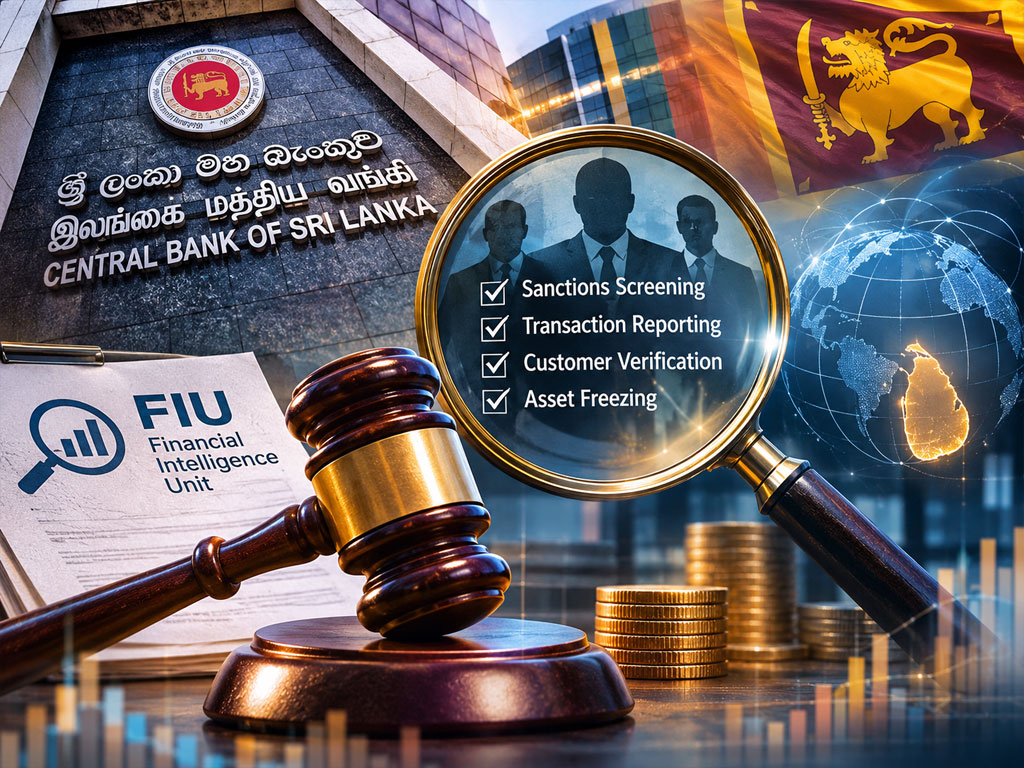
COLOMBO, November 27, 2026 — Sri Lanka’s Financial Intelligence Unit has collected Rs. 17.9 million in penalties from banks, finance companies, insurers and other businesses for failures involving financial reporting, sanctions screening and customer verification. The findings come as the country faces an international assessment of its safeguards against money laundering and terrorist financing.
Regulatory inspections have exposed serious weaknesses in the financial crime prevention systems of several Sri Lankan banks, finance companies, insurance providers and commercial businesses, including instances in which financial institutions maintained relationships with individuals designated under United Nations-related sanctions regulations.
The findings, published by the Financial Intelligence Unit (FIU) of the Central Bank of Sri Lanka, show that institutions failed to meet obligations involving customer identification, transaction reporting, sanctions screening and asset freezing.
According to two official enforcement notices, the FIU collected Rs. 14.6 million in administrative penalties between October 2025 and March 2026, followed by Rs. 3.3 million between April and June 2026.
The combined Rs. 17.9 million was credited to the Government’s Consolidated Fund.
Among the institutions penalised were Commercial Credit & Finance PLC, Citizens Development Business Finance PLC, Sanasa Life Insurance Company PLC, Indian Overseas Bank, Swarnamahal Jewellers Ltd., Harbour Village (Pvt) Ltd. and New Natasha (Pvt) Ltd.
The violations are especially significant because Sri Lanka has recently completed the on-site assessment stage of its third Mutual Evaluation by the Asia/Pacific Group on Money Laundering (APG).

The assessment examines whether the country’s financial institutions and regulatory authorities are effectively implementing measures designed to prevent money laundering, terrorist financing and the financing of weapons proliferation.
Although Sri Lanka has strengthened its legislation, the FIU’s findings demonstrate that weaknesses persist in the practical application of existing requirements.
Such failures expose institutions to regulatory sanctions and create vulnerabilities that criminals could exploit.
They do not, however, establish that every institution penalised engaged in money laundering or knowingly provided financial services to terrorists.
Rs. 17.9 Million Collected in Two Enforcement Periods
The FIU imposed financial penalties under Section 19 of the Financial Transactions Reporting Act, No. 6 of 2006.
The law empowers the regulator to take administrative action against institutions that fail to comply with applicable reporting and financial crime prevention requirements.
The penalties reflected violations identified through on-site inspections, follow-up examinations and other supervisory activities.
FIU PENALTIES COLLECTED · OCTOBER 2025–JUNE 2026
Rs. 17.9 million
Official FIU administrative penalties collected across two reporting periods, in millions of Sri Lankan rupees.
0 million4 million8 million12 million16 millionOct 2025–Mar 2026Apr–Jun 2026
Source: Central Bank of Sri Lanka FIU enforcement notices published July 20 and November 18, 2026.
The Rs. 17.9 million total covers the institutions included in the two announcements, not merely the seven businesses highlighted in the original allegations.
The FIU said penalties were determined with reference to the nature and seriousness of non-compliance.
The question for regulators is whether financial penalties, accompanied by corrective supervision, are sufficiently effective to prevent repeated violations.
Commercial Credit Maintained Relationship With Designated Person
Commercial Credit & Finance PLC was fined Rs. 3 million on April 9, 2026, following an FIU inspection.
The penalty was paid on April 21.
According to the regulator, the institution had established a business relationship with a person designated under United Nations-related regulations.
The FIU found that the company failed to verify the customer’s status effectively when establishing the relationship.
Commercial Credit also failed to screen its existing customer database adequately when designated-person lists were updated.
The regulator identified failures to incorporate relevant changes published through gazette notifications dated June 3, 2024, and February 20 and May 30, 2025.
These findings demonstrate the importance of monitoring customers throughout the duration of a business relationship.
An institution cannot satisfy its obligations merely by checking a customer’s identity at account opening.
Sanctions designations can change, requiring systems to identify existing customers who subsequently become subject to restrictions.
The official notice establishes the compliance failures but does not state that Commercial Credit knowingly participated in terrorist financing.
CDB Failed to Freeze Assets of Three Designated Individuals
Citizens Development Business Finance PLC (CDB) received a Rs. 3 million penalty on December 30, 2025.
The institution paid the penalty on January 19, 2026.
Its violations were particularly serious because the FIU identified business relationships with three individuals designated under United Nations Regulations No. 1 of 2012, associated with Security Council Resolution 1373.
The regulator found deficiencies in the company’s procedures for screening prospective customers and reviewing its existing customer database.
As a consequence, the institution maintained financial relationships with designated individuals.
The FIU further established that CDB had failed to freeze the relevant funds, financial assets and economic resources.
It also failed to provide the required notification to the FIU within 24 hours of identifying the designated persons.
Asset-freezing obligations are a central component of targeted financial sanctions.
Their purpose is to prevent designated individuals and entities from accessing funds or economic resources through regulated institutions.
Failure to implement these measures can undermine the effectiveness of the country’s financial crime prevention framework.
The FIU’s findings establish that CDB failed to comply with those obligations.
They do not independently establish that the company deliberately assisted a terrorist organisation or that the transactions themselves financed terrorism.
Sanasa Life Failed to Report Nine Cash Transactions
Sanasa Life Insurance Company PLC was fined Rs. 2 million on January 5, 2026, with payment made on January 26.
The FIU identified several deficiencies in the company’s reporting and customer-screening arrangements.
Among them was the failure to report nine cash transactions exceeding Rs. 1 million within the required period.
The regulator also found that Sanasa Life had failed to maintain complete sanctions lists, update its screening systems promptly and adequately verify customers and beneficiaries under group insurance arrangements.
A further breach concerned a politically exposed person (PEP) who had been accepted as a customer without the required senior management approval.
A politically exposed person is someone whose public position or connections may require additional scrutiny because of the potential risk of bribery, corruption or misuse of public resources.
PEP status does not mean that a person has committed an offence. Nor does it automatically prohibit a financial institution from establishing a business relationship.
Instead, financial institutions must apply enhanced due diligence and obtain the approvals required by law.
The FIU specifically stated that its examination of Sanasa Life did not reveal business relationships with designated individuals or entities.
That distinction is important because inadequate sanctions screening and actual dealings with designated persons are different regulatory findings.
Indian Overseas Bank Penalised Over Reporting and Screening
Indian Overseas Bank was fined Rs. 1 million on January 5, 2026, following an examination of its compliance procedures.
The bank paid the penalty on January 21.
The FIU found that it had failed to report 13 transactions exceeding Rs. 1 million within the prescribed period.
Inspectors also identified shortcomings in the screening of customers involved in wire transfers, the maintenance of updated sanctions lists and the timely incorporation of designated-person information into screening systems.
These requirements are particularly important for international banking transactions.
Financial institutions handling cross-border payments must verify that customers and other relevant parties are not subject to applicable sanctions.
A failure to update screening databases can create gaps between the restrictions imposed by authorities and the controls operating inside a bank.
Nevertheless, the FIU stated that its examination did not identify business relationships with designated individuals or entities at Indian Overseas Bank.
The penalty therefore concerned failures in reporting and compliance procedures, not a confirmed instance of knowingly financing a prohibited person.
New Natasha Failed to Maintain Customer Information
New Natasha (Pvt) Ltd. received a Rs. 300,000 penalty on May 15, 2026.
The penalty was paid on June 3.
The FIU’s findings concerned weaknesses in customer due diligence for transactions exceeding Rs. 200,000 or the equivalent in foreign currency.
The company failed to obtain mandatory information, including the purpose of transactions, source of funds, contact details, occupation and politically exposed person status.
Inspectors also identified failures to obtain and retain identification documents.
Further weaknesses concerned the company’s assessment of money laundering and terrorist financing risks and its verification of customers against applicable designated-person lists.
The FIU stated that the examination did not reveal existing relationships with designated individuals or entities.
Although the fine was considerably smaller than those imposed on some larger financial institutions, the identified failures demonstrate that effective oversight must extend beyond the banking sector.
Businesses involved in financial transactions must maintain reliable records and identify their customers.
Otherwise, gaps in due diligence can make it more difficult for authorities to detect suspicious activity or trace funds.
Jewellers and Other Businesses Face Enforcement
The FIU’s enforcement actions extended to designated non-financial businesses and professions, including businesses operating outside traditional banking and insurance.
Swarnamahal Jewellers Ltd. was fined Rs. 2 million on February 17, 2026.
The regulator found that the company had failed to obtain and verify required information about customers and beneficial owners.
It had also failed to retain necessary identification records, conduct an adequate money laundering and terrorist financing risk assessment, and screen customers against applicable sanctions lists.
The company paid the penalty on March 10.
Harbour Village (Pvt) Ltd. was separately fined Rs. 1 million on March 18, 2026, for deficiencies involving sanctions screening.
The FIU found that the company had failed to verify customers adequately when establishing or continuing business relationships and had not implemented a mechanism to screen existing customers when sanctions lists were updated.
Payment was made on April 9.
In both cases, the regulator stated that it had not identified business relationships with designated individuals or entities during the examinations.
The findings illustrate why financial crime prevention requirements extend beyond banks.
High-value commercial transactions can create risks where ownership is concealed, identification records are inadequate or the origins of funds cannot be established.
Regulators must therefore ensure that jewellery businesses and other relevant non-financial institutions apply the required customer checks.
A failure to comply with those requirements does not, however, establish that the businesses knowingly handled criminal proceeds.
International Review Puts Enforcement Effectiveness Under Scrutiny
Sri Lanka’s third Mutual Evaluation by the Asia/Pacific Group on Money Laundering has made the effectiveness of domestic financial regulation particularly important.
The APG is a regional body that assesses implementation of international standards developed by the Financial Action Task Force (FATF).
The assessment examines the country’s legal framework, supervisory practices, law-enforcement capacity, financial intelligence systems and implementation of measures against money laundering and terrorist financing.
Sri Lanka’s on-site assessment took place in Colombo from October 26 to November 6, 2026.
The exercise included engagement with public authorities and private-sector institutions to assess how anti-money laundering requirements operate in practice.
The evaluation is not limited to determining whether suitable laws have been enacted.
Assessors also examine whether regulated institutions understand their obligations, whether supervisors detect violations and whether enforcement measures produce meaningful improvements.
The FIU’s published penalties therefore provide evidence of active regulatory supervision.
At the same time, the underlying breaches show weaknesses that institutions must correct.
These two aspects must be considered together.
The discovery and punishment of non-compliance can indicate that supervision is functioning, even while the violations themselves reveal shortcomings in the financial system.
The APG’s full assessment is expected to be considered in 2027.
Grey-Listing Could Increase Financial Pressure
Sri Lanka has previously been placed under increased monitoring by the FATF, commonly referred to as the grey list.
The latest evaluation carries implications for whether the country could face renewed international scrutiny.
Grey-listing is not an automatic consequence of identifying administrative violations at individual institutions.
It involves a separate FATF decision-making process, based on wider strategic deficiencies and the progress made in addressing them.
Nevertheless, persistent weaknesses in financial crime prevention systems can affect international confidence.
If Sri Lanka were again placed under increased monitoring, possible consequences could include higher compliance costs, greater scrutiny of international payments and additional difficulties for some businesses seeking financial services.
Foreign banks may apply enhanced due diligence when dealing with institutions operating in jurisdictions considered to present elevated risks.
Such measures can affect the cost and efficiency of cross-border transactions.
For an economy dependent on exports, imports, tourism, remittances and international investment, maintaining reliable banking relationships is particularly important.
However, grey-listing does not automatically prohibit international banking transactions, force all foreign investors to leave or bring import-export trade to a halt.
The actual consequences would depend on the measures adopted by financial institutions, counterparties and regulators.
Sri Lanka’s objective should be to address vulnerabilities before they become more serious, rather than treating an adverse international assessment as inevitable.
Three Anti-Financial Crime Laws Strengthened in August
Sri Lanka amended three important laws in August 2026 to strengthen its framework against illicit finance.
Parliament passed the relevant legislation on July 9, and the Speaker certified the amendments on August 4.
The measures comprised:
- Prevention of Money Laundering (Amendment) Act, No. 16 of 2026.
- Financial Transactions Reporting (Amendment) Act, No. 17 of 2026.
- Convention on the Suppression of Terrorist Financing (Amendment) Act, No. 18 of 2026.
The amendments were intended to improve compliance with international standards relating to money laundering, terrorist financing and the financing of weapons proliferation.
They strengthened aspects of customer due diligence, financial reporting, targeted sanctions and the regulatory framework governing relevant financial activities.
The legislation formed part of Sri Lanka’s preparations for its international assessment.
However, legal reform alone cannot guarantee effective financial supervision.
Banks, insurers, finance companies and other reporting institutions must translate statutory requirements into functioning procedures.
These include timely sanctions-list updates, accurate customer identification, transaction monitoring and staff training.
Senior management must ensure that compliance teams have the resources and authority necessary to identify and address weaknesses.
Without those arrangements, legislation may exist without providing the level of practical protection intended.
Are Financial Penalties Sufficient to Change Behaviour?
The penalties imposed by the FIU also raise a question about whether the financial consequences of non-compliance are proportionate to the size and resources of the institutions involved.
A fine of Rs. 1 million, Rs. 2 million or Rs. 3 million may be significant for a small business.
For a large financial institution, the same amount may represent a comparatively modest cost.
That does not establish that the penalties were improperly calculated.
The Financial Transactions Reporting Act provides a statutory framework for determining administrative penalties, and the regulator must operate within the powers available to it.
The effectiveness of enforcement also depends on measures beyond the monetary amount collected.
These may include remedial instructions, additional inspections, stronger internal controls and the consequences of repeated non-compliance.
The central issue is whether institutions correct the weaknesses identified by regulators.
A fine that is paid without corresponding improvements in screening, reporting and risk management may provide little lasting protection.
By contrast, an enforcement action followed by effective remediation can strengthen the wider financial system.
The FIU should therefore assess not only whether penalties have been paid, but also whether institutions have implemented the required corrective measures.
Boards and Chief Executives Must Ensure Compliance
Responsibility for financial crime prevention cannot rest solely with junior compliance officers or software providers.
Boards of directors and senior executives are responsible for ensuring that their institutions maintain appropriate systems of governance, risk management and internal control.
Sanctions screening requires reliable technology, accurate information, trained personnel and effective escalation procedures.
Senior management must also ensure that compliance requirements are not overridden by commercial priorities.
Where institutions repeatedly fail to update screening databases or identify designated customers, regulators should examine whether the failures arise from inadequate procedures, insufficient resources or wider governance weaknesses.
Those findings may justify additional supervisory action, subject to the relevant legal requirements.
However, an administrative penalty imposed on a company does not automatically establish personal criminal liability for its directors or chief executive.
Any action against individual officials would require a legal basis and evidence of the conduct or omissions attributed to them.
Similarly, suspending or revoking an institution’s licence would require consideration of the applicable statutory powers, seriousness of the breaches and procedural safeguards.
Such measures can have consequences for depositors, policyholders, employees and other customers.
Effective enforcement therefore requires proportionate decisions rather than assuming that every regulatory violation demands the most severe available sanction.
Financial Integrity Requires More Than New Laws
The FIU’s enforcement notices show that Sri Lanka has functioning mechanisms for detecting and penalising financial crime compliance failures.
They also reveal that several institutions failed to implement safeguards that are fundamental to preventing illicit funds from entering the regulated economy.
The most serious findings involved established business relationships with persons designated under sanctions regulations and failures to freeze assets when required.
Other institutions were penalised for delayed reporting, inadequate screening and incomplete customer information.
The distinction between those findings matters.
A failure to maintain records creates a regulatory vulnerability, while maintaining financial relationships with designated individuals raises additional concerns about the effectiveness of targeted financial sanctions.
Neither should be ignored, but the legal and factual significance of each violation must be assessed accurately.
As Sri Lanka awaits the outcome of the APG evaluation, the challenge is to demonstrate that regulatory enforcement produces lasting improvements across the financial system.
The Central Bank and FIU must continue identifying weaknesses, ensuring corrective action and applying available sanctions where justified.
Financial institutions, meanwhile, must demonstrate that their compliance systems operate effectively rather than merely satisfying documentary requirements.
For Sri Lanka, the stakes extend beyond the Rs. 17.9 million collected in penalties.
The more important question is whether the country’s financial sector can provide credible safeguards against illicit finance while preserving the international confidence needed for trade, investment and economic recovery.