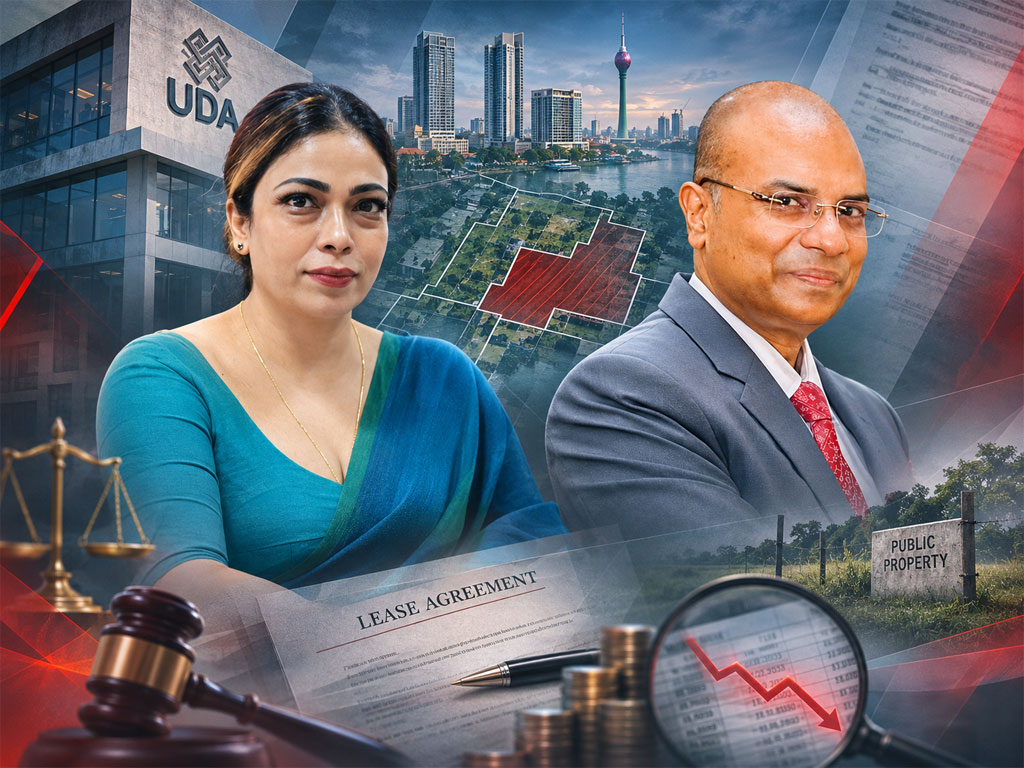
COLOMBO, November 28, 2026 — Allegations involving three Urban Development Authority property transactions have renewed scrutiny of financial controls, disputed lease agreements and the recovery of public funds. Parliamentary findings confirm irregularities in a major Colombo land lease, while other claims require further investigation.
UDA Land Deals Under Scrutiny Over Alleged Financial Losses
COLOMBO — Allegations of financial irregularities involving three property transactions handled by the Urban Development Authority (UDA) have renewed scrutiny of the institution’s management of valuable state-owned land, its internal approval procedures and the measures taken to recover public funds.
Sources within the Authority allege that irregular agreements and financial decisions involving properties associated with Shang Properties, Lake Leisure and the Krrish development may have exposed the State to losses approaching Rs. 1 billion.
The precise value of any resulting loss has not been independently established, and no publicly available audit finding reviewed for this report confirms the combined figure.
Concerns have also been raised about the handling of disciplinary proceedings involving a former UDA Director of Legal and whether the Authority has pursued all available remedies to address the alleged irregularities.
The source account states that the former official was dismissed in connection with the disputed transactions. That reported dismissal, including its grounds and effective date, requires confirmation from the Authority.
Available parliamentary findings nevertheless establish that serious shortcomings were identified in at least one major UDA land lease, including the inclusion of contractual conditions that had not received the necessary approval.
The central issue is whether the Authority has adequately investigated those shortcomings, established any financial consequences and taken appropriate action against those responsible.

Shang Properties Land Agreement and Questions Over Board Approval
One of the principal allegations concerns a valuable parcel of UDA-owned land on Sir James Peiris Mawatha in Colombo, associated in the source account with Shang Properties.
The allegation is that irregularities occurred during the preparation of the lease agreement, potentially exposing the Authority to financial losses and undermining the approval process governing the disposal or leasing of public property.
These concerns have a documented precedent in findings presented to Parliament’s Committee on Public Enterprises (COPE).
In July 2024, Parliament disclosed that approximately six acres of land on James Peiris Mawatha, Colombo 02, had been leased for Rs. 12 billion over 99 years in 2019 without the required approval of the UDA Board of Directors.
COPE was informed that the agreement contained additional conditions that had not been approved by the Board.
Parliament further reported that disciplinary investigations were underway against the Director of Legal in connection with the drafting of the relevant agreement. Development of the land had also remained stalled.
Those findings establish deficiencies in the approval and contractual processes. They do not, by themselves, determine whether criminal conduct occurred or establish the amount of any financial loss.
Although the source account identifies Shang Properties, the available parliamentary summary does not conclusively establish that the 2019 six-acre transaction and the specific agreement described by the sources are the same transaction.
Confirming the identity of the contracting company, the relevant lease documentation and the outcome of the disciplinary proceedings is therefore essential before attributing responsibility for the alleged losses.
Lake Leisure Transaction and Disputed Interest Calculations
A second set of allegations concerns the treatment of money deposited by Lake Leisure in connection with a UDA land transaction.
Internal sources allege that interest was calculated and credited or paid without the necessary authorisation, resulting in a financial benefit to the company at public expense.
They further claim that the disputed arrangements were subsequently suspended, but that sufficient action has not been taken to establish and recover any resulting loss.
Earlier public reporting provides important context.
In 2024, reports concerning a lease agreement between the UDA and Lake Leisure Holdings identified disputed adjustments to payments associated with a property on D.R. Wijewardene Mawatha.
According to those reports, the Authority had agreed to deduct approximately Rs. 330 million from the land’s valuation after considering an interest-related claim on previous payments, without proper Board approval.
The same reporting stated that the UDA had sought advice from the Attorney General regarding the cancellation of the disputed agreement.
The distinction between an unauthorised accounting adjustment, an interest credit and an actual payment is significant.
Each could have different financial and legal consequences. Establishing whether public money was disbursed, whether the deduction was implemented and whether any amount remains recoverable requires examination of the relevant financial records and contractual documents.
The available information does not establish that a particular former official personally authorised an unlawful payment or received any financial benefit.
Krrish Project and Alleged Unauthorised Lease Extension
The third allegation concerns the Krrish development in Colombo, a project that has previously attracted attention over its prolonged development timetable and associated legal disputes.
According to the internal sources, an extension affecting the project’s lease or development period was allegedly arranged without the approval of the UDA Board or another competent authority.
The accusation concerns the validity of the approval process and whether the contractual change was properly authorised.
Previous reporting established that the Krrish investor had sought an extension of the development period until 2027, following an earlier timetable due to expire in 2024.
The existence of such a request does not establish that the extension was granted improperly.
Determining whether an unauthorised contractual amendment occurred requires confirmation of the relevant Board decisions, ministerial approvals where applicable, the original lease conditions and any subsequent agreements.
The Krrish project has also been the subject of separate bribery investigations involving allegations connected to the acquisition and approval of UDA-owned property.
Those proceedings should not be treated as proof of the distinct allegation concerning an unauthorised lease extension.
Any investigation of the lease amendment must establish its own factual and legal basis.
Disciplinary Proceedings and the Recovery of Public Funds
The allegations also concern the effectiveness of internal accountability procedures within the Urban Development Authority.
Sources claim that disciplinary action against the former Director of Legal has not been accompanied by sufficient measures to recover the financial losses allegedly arising from the three transactions.
They question whether the Authority’s present management and legal division have fully examined the possibility of civil recovery proceedings or referred all potentially criminal conduct to the appropriate investigative bodies.
Disciplinary action, civil recovery and criminal proceedings serve different purposes.
A disciplinary inquiry determines whether an employee breached applicable employment or administrative requirements.
Civil proceedings may be necessary to recover money or obtain remedies arising from an unlawful or disputed agreement.
Criminal proceedings require evidence sufficient to establish the elements of an offence under the relevant law.
Removing an employee from office does not automatically establish that a financial loss occurred, identify everyone responsible or recover money owed to the State.
Equally, the absence of publicly announced criminal proceedings does not necessarily mean that no investigation has taken place.
Sources allege that complaints relating to the transactions have been submitted to the Commission to Investigate Allegations of Bribery or Corruption (CIABOC).
The dates, reference numbers, scope and current status of those alleged complaints have not been independently verified.
Confirmation from CIABOC would help establish whether the matters remain under preliminary examination, have progressed to formal investigation or have resulted in any legal action.
Allegations of Delays Within the UDA Administration
Further concerns have been expressed about whether senior officials within the Authority have delayed decisions regarding the disputed transactions.
Internal sources suggest that professional relationships involving the former Director of Legal may have influenced the institution’s response.
These claims remain unsubstantiated. No documentary evidence reviewed for this report establishes that named or unnamed officials deliberately obstructed an investigation, concealed evidence or improperly protected a former employee.
Any allegation of deliberate interference would require evidence demonstrating the relevant individual’s actions, authority and intention.
The sources also question whether the current subject Minister, Wimal Ratnayake, has been fully informed about the financial and legal concerns surrounding the transactions.
There is no verified evidence in the material examined establishing that information was intentionally withheld from the Minister.
The absence of a publicly available explanation, however, leaves important questions about the status of the disciplinary, administrative and legal processes unresolved.
UDA Accountability and the Need for a Clear Official Response
The controversy extends beyond the conduct of any individual officer.
As the institution responsible for managing substantial public land assets, the Urban Development Authority must maintain reliable systems for approving transactions, drafting agreements, recording financial adjustments and safeguarding the State’s contractual interests.
The parliamentary findings concerning the James Peiris Mawatha lease demonstrate the importance of ensuring that agreements reflect the conditions actually approved by the appropriate authority.
They also underline the need for internal controls capable of detecting departures from approved contractual terms before potentially binding commitments are made.
For the three transactions now under scrutiny, several matters remain unresolved: the precise contractual provisions disputed, whether the alleged losses were realised, the outcome of internal disciplinary proceedings and the steps taken to protect or recover public funds.
A comprehensive official account would also help distinguish established administrative shortcomings from allegations of fraud, corruption or deliberate misconduct.
The UDA, the relevant ministry and CIABOC have not been shown in the material available for this report to have issued responses addressing all three allegations. Their positions should be obtained before any definitive conclusions are drawn.
Ultimately, establishing responsibility requires more than identifying disputed transactions or disciplinary action against a former official. It requires a documented assessment of what was approved, what was executed, whether public funds were lost and what remedies remain available to the State.
Until those questions are answered through verifiable records and appropriate legal processes, the allegations involving Shang Properties, Lake Leisure and Krrish remain an important test of transparency in the management of Sri Lanka’s public property.