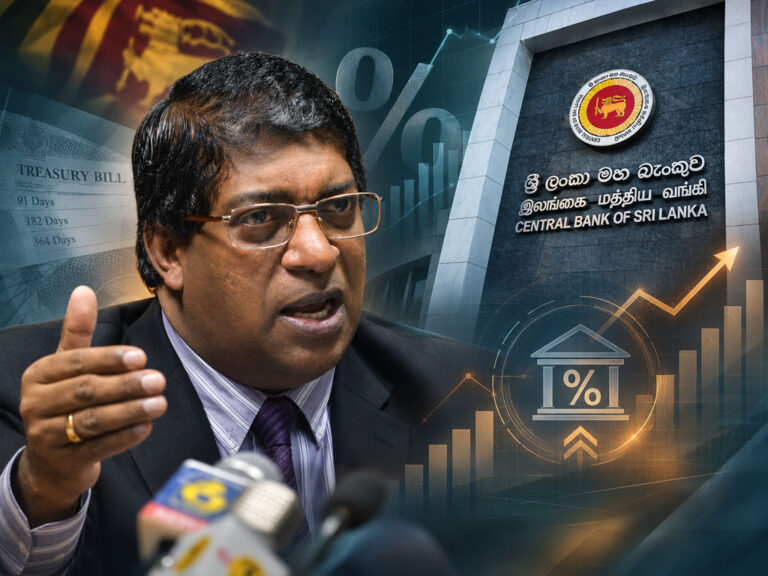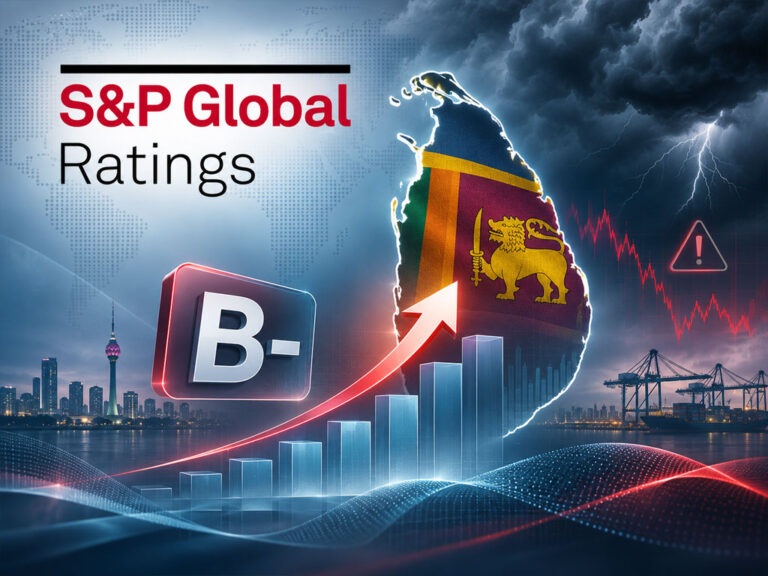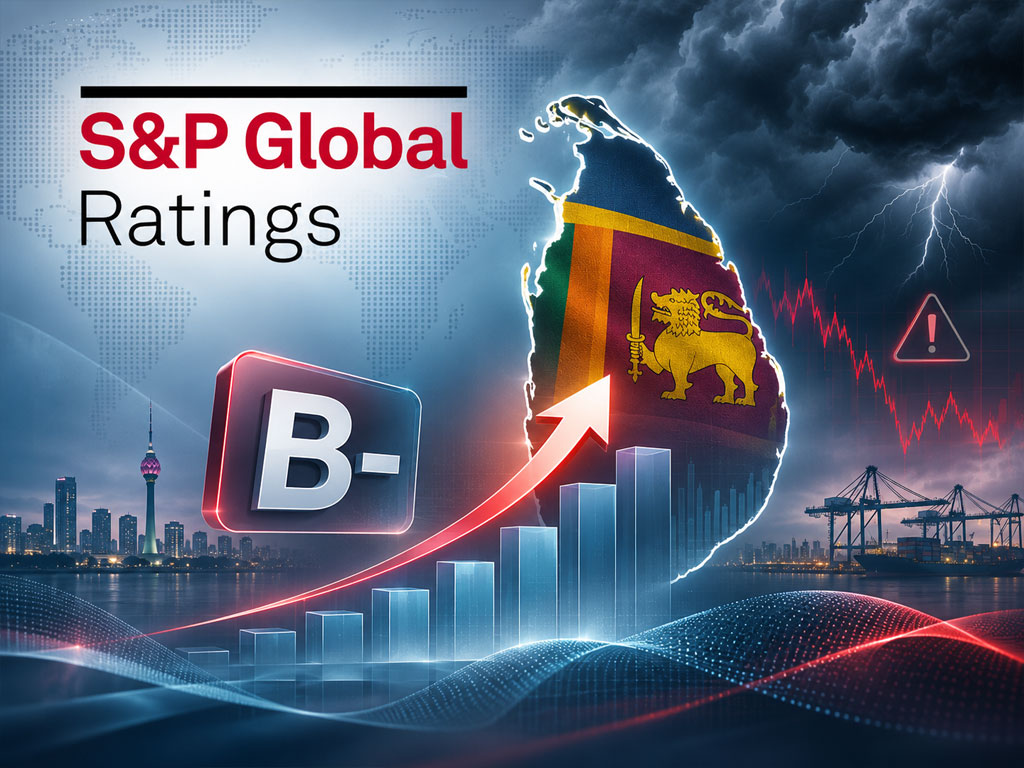
COLOMBO, November 29, 2026 — Sri Lanka’s sovereign credit rating has been upgraded to B- by S&P Global Ratings, reflecting stronger government revenue, rising foreign reserves and improved economic stability. However, mounting energy costs, climate risks and a heavy debt burden could complicate the country’s recovery.
Sri Lanka’s economic recovery received an important endorsement on November 27 when S&P Global Ratings upgraded the country’s long-term sovereign credit rating from CCC+ to B-, assigning a stable outlook after years of financial instability and debt restructuring.
The decision marks Sri Lanka’s exit from the CCC rating category and reflects improvements in government revenue, foreign exchange reserves, fiscal management and the country’s capacity to meet its financial obligations.
Yet the assessment carries a clear warning. Despite the progress made since the 2022 economic crisis, Sri Lanka remains vulnerable to prolonged conflict in the Middle East, rising energy costs, inflationary pressures, unpredictable weather conditions and substantial public debt repayments.
S&P’s findings indicate that economic stability has improved considerably, but the country’s ability to withstand another major external shock remains an important test of its recovery.
The agency expects Sri Lanka’s economy to expand by 4% in 2026 and 4.5% in 2027, supported by continued fiscal reforms, improving government finances and greater policy predictability.
Its stable outlook reflects expectations that economic conditions will remain relatively resilient over the next six to twelve months, provided the Government maintains its commitment to strengthening fiscal and external financial buffers.

Stronger Revenue and Reserves Support the Upgrade
One of the most important factors behind the rating improvement is Sri Lanka’s stronger government revenue performance.
Revenue increased by approximately 20% during the first nine months of 2026 compared with the corresponding period in 2025.
S&P expects general government revenue to exceed 17% of gross domestic product (GDP) for the full year, approximately twice the proportion recorded in 2022.
This represents a substantial improvement in the Government’s capacity to finance public services, meet expenditure commitments and manage its debt obligations.
Foreign exchange reserves have also strengthened.
Gross official reserves increased from approximately US$6.5 billion in June to US$7.09 billion in October 2026, providing an improved financial buffer against external payment pressures.
Political stability following the National People’s Power’s electoral victories in 2024 and subsequent local government gains in May 2025 has also contributed to S&P’s assessment of greater policy predictability.
The agency expects Sri Lanka to maintain its structural reform commitments under the International Monetary Fund programme, even as the existing arrangement approaches its scheduled conclusion in March 2027.
Nevertheless, the improvements do not eliminate the risks associated with external financing requirements and future debt repayments.
Middle East Conflict Threatens Energy Costs and Inflation
Sri Lanka’s dependence on imported fuel and fertiliser leaves the economy particularly exposed to developments in the Middle East.
Prolonged regional conflict, disruptions to international shipping routes and shortages of crude oil and petrochemicals could increase import expenditure and place additional pressure on domestic prices.
Fuel imports rose by more than 100% year-on-year in rupee terms during April and May 2026, while the Sri Lankan rupee depreciated by approximately 6.8% against the US dollar during the first ten months of the year.
Higher energy and transportation costs have already contributed to rising inflation.
Colombo’s consumer price inflation increased from 1.6% in February to 8.3% in October 2026.
In response, the Central Bank raised its policy interest rate by a cumulative 125 basis points during the year, including a one-percentage-point increase in May.
Although tighter monetary policy can help contain inflation and support currency stability, higher borrowing costs can also discourage investment and place additional financial pressure on businesses and households.
For small and medium-sized enterprises, increased lending rates may affect working capital, business expansion and employment.
S&P cautions that a prolonged Middle East conflict could further increase energy costs and disrupt supply chains, weakening economic growth.
Sri Lanka initially introduced measures including fuel rationing and a shorter working week to manage supply disruptions. However, the effectiveness of such measures becomes more difficult to sustain if external pressures continue for an extended period.
Remittances and Tourism Face External Pressure
The Middle East conflict also threatens two important sources of foreign exchange: workers’ remittances and tourism.
Approximately 40% of Sri Lanka’s remittances originate from the Middle East, making the country particularly sensitive to regional economic instability.
Although remittance inflows continued to increase during 2026, their rate of growth slowed considerably.
Annual growth exceeded 30% in May but declined to 5.6% by September.
A prolonged deterioration in employment conditions or financial activity across Middle Eastern economies could affect the incomes of Sri Lankan workers abroad and the money they send home.
Tourism faces similar exposure.
According to the figures cited in S&P’s assessment, tourism earnings declined by 9.2% during the first nine months of 2026, while visitor arrivals fell by 1.8%.
Although tourists originating directly from Middle Eastern countries account for a relatively small proportion of arrivals, approximately one-third of visitors to Sri Lanka travel through aviation hubs in the region.
Disruptions affecting international airlines, connecting flights or airport operations could therefore influence tourism arrivals from other markets.
Against these pressures, S&P expects Sri Lanka’s current account to record a deficit equivalent to 1.4% of GDP in 2026.
The agency also forecasts gross external financing requirements at approximately 109% of current account receipts and usable reserves, compared with 104% in 2025.
Although this remains below the pre-crisis average exceeding 120%, the increase demonstrates the importance of maintaining adequate external financial buffers.
El Niño Could Affect Agriculture and Electricity Generation
Beyond geopolitical developments, S&P has identified the possibility of a severe El Niño weather pattern in 2027 as another risk to Sri Lanka’s economy.
Changes in rainfall patterns could affect agricultural production, water availability and electricity generation.
Sri Lanka’s tea, rubber and paddy sectors are particularly vulnerable to prolonged dry conditions, irregular monsoon rainfall and flooding.
Reduced agricultural output could increase food prices while placing additional financial pressure on farming communities.
Hydroelectricity generation is another area of concern.
Hydropower typically accounts for approximately 25% to 35% of Sri Lanka’s electricity generation, although its contribution varies according to rainfall and reservoir levels.
Periods of inadequate rainfall could reduce hydroelectric output and increase dependence on more expensive alternative energy sources.
This would place additional pressure on electricity generation costs, particularly if international fuel prices remain elevated.
Although recent rainfall has improved reservoir storage, S&P warns that prolonged dry conditions could create further difficulties.
The combination of higher energy costs and weaker agricultural production could complicate efforts to contain inflation while maintaining economic growth.
Public Debt and Interest Payments Remain Major Challenges
Despite the improvement in Sri Lanka’s credit rating, public debt remains one of the country’s most significant economic vulnerabilities.
S&P expects the overall fiscal deficit to reach approximately 1.8% of GDP in 2026, while the Government is projected to record its fourth consecutive annual primary surplus.
A primary surplus means that government revenue exceeds expenditure before interest payments on existing debt are deducted.
This reflects progress in fiscal management.
However, the agency expects the overall fiscal deficit to widen in subsequent years, averaging approximately 3.5% of GDP between 2026 and 2029.
Government spending pressures include changes to personal income tax thresholds, the removal of VAT on school supplies, targeted levy reductions and expenditure associated with reconstruction following Cyclone Ditwah in November 2025.
Capital expenditure is also budgeted to increase by more than 30% in 2027, supporting improvements to ports, energy infrastructure and transportation networks.
These investments could strengthen long-term economic productivity but will require careful financing and implementation.
Net general government debt, including relevant state-owned enterprise guarantees and adjustments associated with an RMB 10 billion currency swap with China’s central bank, is projected at approximately 92% of GDP in 2026.
S&P expects the ratio to decline gradually towards 83% by 2029.
The country’s interest burden remains particularly substantial.
Interest payments currently absorb approximately 40% of government revenue, despite a significant reduction from around 64% in 2024.
S&P projects this burden could decline further to approximately 34% by 2029.
Nevertheless, even at that level, debt servicing would continue to consume a considerable share of public resources that could otherwise support infrastructure, education, healthcare and social protection.
Macroeconomic-Linked Bonds Create Additional Obligations
Sri Lanka’s restructured debt arrangements introduce further considerations for future government finances.
Certain macroeconomic-linked bonds contain provisions under which coupon payments and principal obligations may increase if specified economic and currency-related conditions are met.
Stronger economic performance can therefore trigger additional debt servicing commitments under the relevant bond agreements.
Although such instruments formed part of the debt restructuring process, their financial implications must be considered when evaluating future repayment requirements.
Domestic banks also hold more than 20% of their total assets in government debt instruments.
This creates an important relationship between public debt sustainability and financial sector stability.
Any renewed pressure on government borrowing conditions could therefore have consequences beyond the Treasury, potentially affecting bank balance sheets, lending capacity and wider financial confidence.
S&P’s assessment highlights why improvements in government revenue must be accompanied by continued reductions in debt vulnerabilities.
What Could Lead to Another Rating Upgrade?
While Sri Lanka has moved into the B rating category, S&P has identified several conditions that could support further improvements in its sovereign credit standing.
These include a sustained reduction in interest payments as a proportion of government revenue, further strengthening of the country’s external financial position, a more manageable increase in net government debt and continued improvements in macroeconomic stability.
The agency has indicated that further positive rating action could become possible if progress across multiple areas makes the country’s financial position more resilient.
Conversely, renewed funding constraints, liquidity pressures or deterioration in external financing conditions could result in negative rating action.
The B- rating remains within the speculative-grade category, indicating that financial vulnerabilities have not disappeared.
Nevertheless, the upgrade reflects S&P’s assessment that another sovereign default over the next two years is unlikely under its current expectations.
That assessment is not a guarantee against future financial difficulties.
Recovery Now Depends on Sustained Economic Resilience
Sri Lanka’s latest sovereign credit upgrade represents measurable progress from the conditions that produced the 2022 economic crisis.
Stronger government revenue, improved reserves, continued primary surpluses and reduced near-term default risks indicate that the country’s financial position has strengthened.
However, the economic environment remains difficult.
A prolonged Middle East conflict could increase import costs and reduce foreign exchange inflows. Unfavourable weather could weaken agricultural production and raise electricity costs, while substantial interest payments continue to restrict the Government’s fiscal flexibility.
For policymakers, maintaining the present recovery will require continued fiscal discipline, effective management of public investment, stronger export earnings and careful monitoring of external risks.
The central challenge is to translate improved sovereign creditworthiness into sustainable economic activity, investment, employment and household financial stability.
Sri Lanka has regained part of the international financial confidence lost during the crisis. Preserving that progress will depend on whether the country can strengthen its ability to withstand future shocks while progressively reducing the debt burden that continues to constrain its economy.