- Note that the above image is AI generated
For decades, weak tax policies in Sri Lanka have robbed children of their right to education, drained public trust, and left a nation trapped between political vanity and economic collapse, as a damning Human Rights Watch report makes clear.
Sri Lanka has always prided itself on being the pioneer of free education in South Asia, celebrating the landmark Free Education Ordinance of 1945 as a national achievement. Yet today, that proud legacy lies battered by decades of short-sighted tax policies, irresponsible fiscal decisions, and political gamesmanship that have turned the promise of opportunity into a daily struggle for survival. A report released by Human Rights Watch on October 14 paints a devastating picture of how weak taxation policies have not only undermined the economy but also stripped away the rights of children to an equal education. What should have been a story of progress is now a tale of regression, with the young generation made to bear the burden of an elite’s failure to govern responsibly.

The report draws on data analysis, economic research, and more than seventy interviews with experts and ordinary citizens who have felt the full weight of the economic crisis. At its core, the findings reveal how the state’s dependency on indirect taxation and its chronic inability to generate direct tax revenue have crippled essential social spending. Education, supposedly a free and sacred right in Sri Lanka, has become one of the worst victims of this fiscal mismanagement.
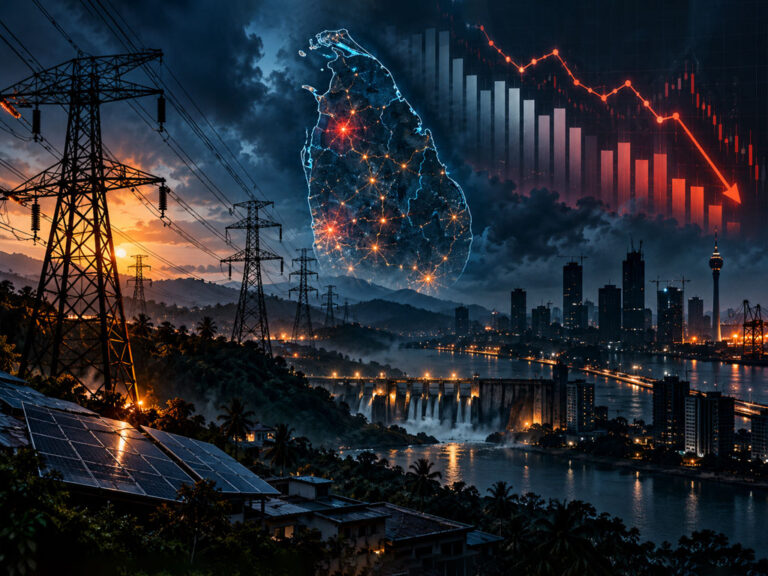
The economic crisis that unfolded over the last decade brought these flaws to the surface in a brutal way. At the height of the collapse, one million Sri Lankans lost their jobs. Another million households were plunged into darkness as electricity tariffs soared beyond affordability, cutting them off from basic power. Four million people fell below the poverty line in a matter of months. Daily life became unbearable for ordinary families as the state, burdened by debt and trapped by its own short-sighted choices, struggled to provide relief.
This was no act of fate but the direct consequence of poor tax policy and political arrogance. Sri Lanka’s reliance on indirect taxes has long undermined equality. By definition, indirect taxes such as VAT and sales tax are applied equally to everyone, whether rich or poor. A wealthy businessman and a low-wage worker both pay the same rate at the supermarket or the pharmacy. The outcome is obvious: the poor, who spend most of their income on essentials, shoulder a far heavier burden relative to their earnings than the rich, who can absorb the cost with ease. This inequity is at the heart of the Human Rights Watch report’s indictment.
The decline in government tax revenue as a share of GDP began in the late 1970s and has only worsened since. Tax cuts introduced in 2019 accelerated this collapse. By 2022, Sri Lanka’s allocation to education had fallen to 1.5 percent of GDP, ranking among the lowest in the world. The contrast with international standards is staggering. Global benchmarks call for between four and six percent of GDP to be invested in education, or at least 15 to 20 percent of overall government expenditure. Instead, Sri Lanka’s 1.5 percent put it on par with fragile states such as Haiti and Laos.
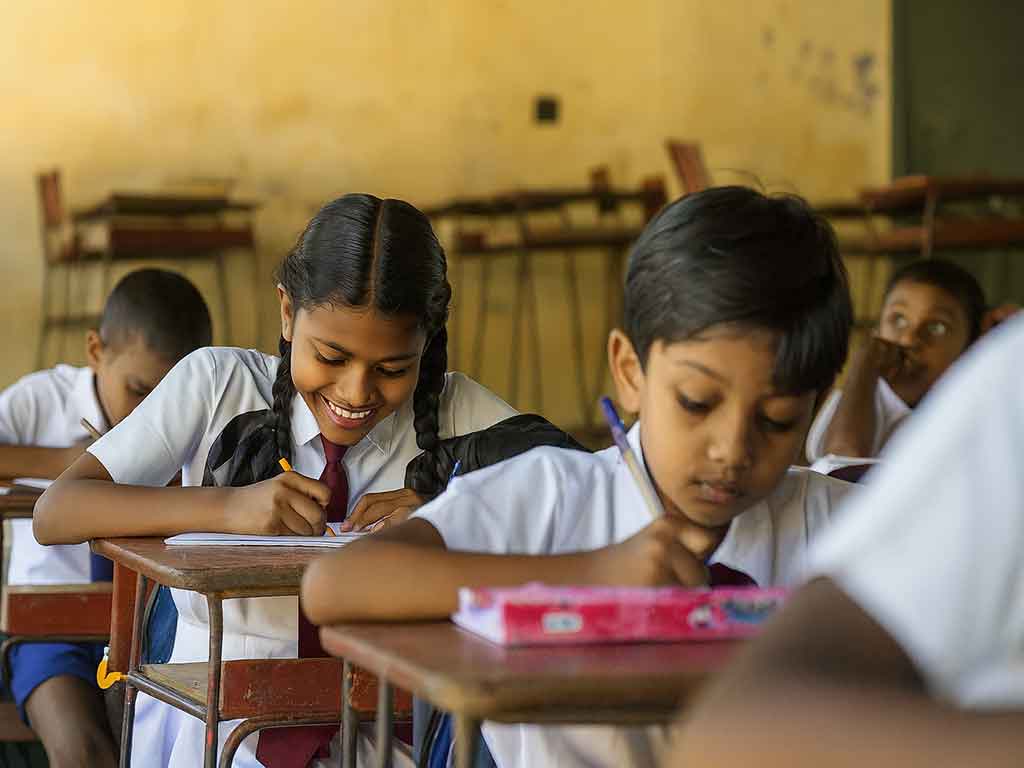
The true cost of these decisions is felt in classrooms across the island. Despite the promise of free education, schools routinely demand “development fees” from parents. Electricity bills, water charges, examination fees, and classroom repairs are pushed onto families who are already struggling to survive. For parents unable to pay, schools soldier on with broken desks, leaking roofs, and insufficient supplies. Teachers, underpaid and demoralized, are left to manage classrooms with inadequate resources.
The disparity between the privileged and the poor has become glaring. Wealthier parents contribute generously to schools in affluent neighborhoods, where children enjoy access to better libraries, computer labs, and extracurricular programs. Meanwhile, children in rural and underfunded schools fight for basic necessities like textbooks and chairs. Human Rights Watch interviews with principals reveal desperation: many admit that without parental contributions, their schools would collapse.
This widening inequality exposes a system that has failed to live up to its founding promise. The Free Education Ordinance of 1945 was a revolutionary milestone, making Sri Lanka a global model of accessible schooling. But eighty years later, that proud legacy has been tarnished by years of underfunding, corruption, and an unwillingness to reform.
The country’s financial collapse in 2022 deepened the crisis. By April of that year, foreign reserves had dwindled to just 1.9 billion dollars, while debt soared to 114 percent of GDP. Sri Lanka defaulted on its obligations for the first time in its history, triggering mass protests and nationwide outrage. Lines for fuel stretched for miles, power outages lasted up to thirteen hours a day, and hospitals ran out of essential medicines. At the center of this chaos was a taxation system that had failed to provide the state with sufficient revenue to protect its citizens.
The IMF stepped in with an Extended Fund Facility, imposing strict targets to reduce debt-to-GDP ratios. Debt servicing consumed 57 percent of government revenue by 2024, leaving little room for social spending. As a result, children’s right to education, guaranteed in principle, became hostage to austerity. Teachers’ salaries stagnated, classrooms crumbled, and families were forced into exploitative tutoring networks described by experts as a “mafia” that preyed on parental anxiety.
The numbers are damning. In 1977, direct taxes accounted for 33 percent of revenue. Between 1980 and 2018, that figure averaged just 19 percent. By 2024, reliance on VAT reforms had pushed millions further into poverty, with the World Bank estimating that such reforms increased poverty by nearly 4 percent. Adding insult to injury, multinational corporations continue to exploit loopholes by shifting profits abroad, costing Sri Lanka an estimated 413 million dollars annually. These are funds that could have transformed schools, raised teacher salaries, or fed children in impoverished regions.
Human Rights Watch emphasizes that the consequences of these failures are not abstract. They are human rights violations. The right to education is enshrined in international law and in Sri Lanka’s own constitution. Yet decades of weak taxation have systematically deprived children of that right, leaving them vulnerable to cycles of poverty and exclusion. The report makes clear that the blame lies not just in economic mismanagement but in deliberate policy choices that favor short-term political gains over long-term national welfare.
In the midst of this damning report, the new government has attempted to signal a shift. The 2025 budget proposes a 3.5 percent increase in allocations to the Ministry of Education, Higher Education, and Vocational Training compared to the previous year. Promises have been made to raise teachers’ salaries, with Prime Minister and Education Minister Harini Amarasuriya herself having once campaigned for six percent of GDP to be allocated to education. Yet even with these increases, Sri Lanka falls far short of global standards.
The recommendations from Human Rights Watch are straightforward but urgent. The government must commit to increasing education spending to between four and six percent of GDP, in line with international guidelines. Hidden school fees must be eliminated, ensuring that free education remains truly free. School feeding programs should be expanded to ensure that children in vulnerable areas are nourished. Public transportation should be made accessible to students, particularly in rural areas where children often walk miles to reach their schools. And teacher salaries must be raised not just as an election promise but as a structural investment in the country’s future.
The deeper issue, however, is whether Sri Lanka is willing to confront the entrenched political culture that perpetuates this crisis. For decades, politicians have used tax cuts as populist tools, sacrificing revenue for votes while ignoring the long-term damage. At the same time, tax evasion by the wealthy and profit shifting by corporations have gone largely unchecked. The result is a system that protects privilege while punishing the vulnerable.
The irony is brutal. A nation that once led South Asia in free education now lags behind its neighbors in both investment and outcomes. The very system designed to uplift children has become an engine of inequality. Unless structural reforms are made, Sri Lanka risks condemning yet another generation to the same cycle of hope and betrayal.
Human Rights Watch’s report is more than a critique; it is a call to action. Sri Lanka stands at a crossroads. It can continue to treat taxation as a political game, sacrificing children’s futures for short-term popularity, or it can adopt a rights-based approach that prioritizes education as the foundation of national recovery. The path chosen will determine not only the fate of the current generation but also the legacy of a nation that once believed education was the key to freedom.
If Sri Lanka is serious about rebuilding after its bankruptcy and avoiding further descent into dependency, it must recognize that taxation is not merely an economic tool but a moral one. Tax justice is education justice. Every rupee lost to evasion or wasted on vanity projects is a classroom left without light, a teacher left underpaid, a child left behind.
The time for half-measures is over. What the Human Rights Watch report lays bare is that Sri Lanka cannot afford to postpone reform. The children of today will inherit the consequences of inaction tomorrow. Only a bold, honest, and rights-centered approach can break the cycle.
Until then, Sri Lanka’s children remain trapped in a cruel paradox: citizens of a country that promised them free education yet continues to charge them for survival.