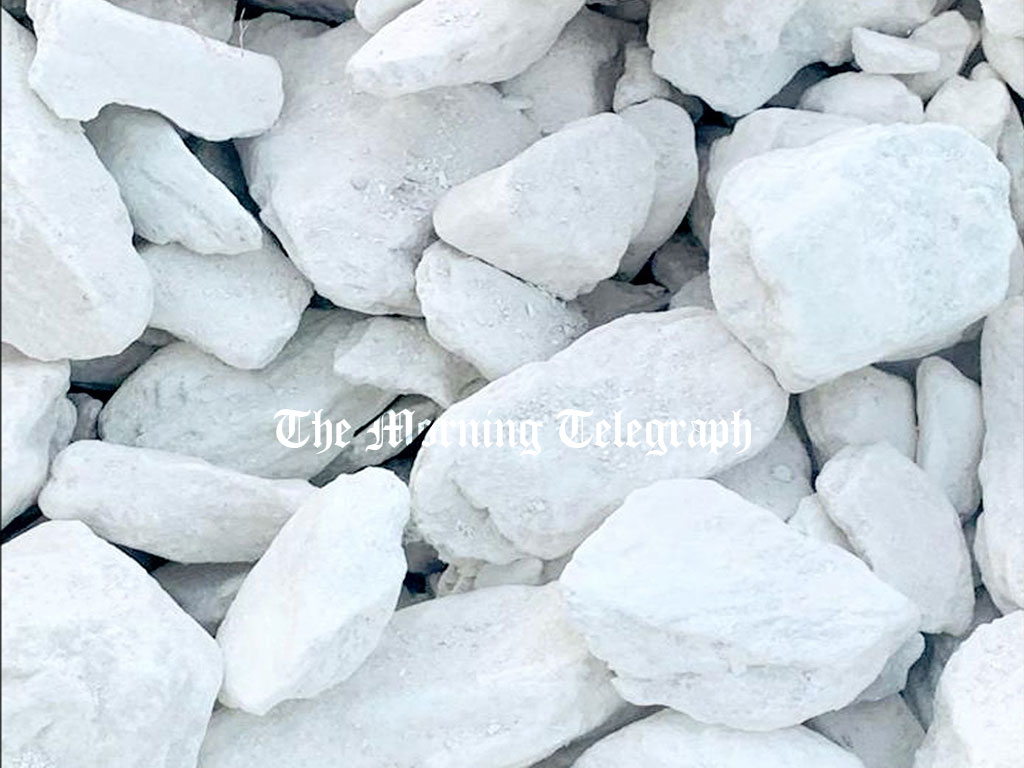
A shocking laboratory revelation confirms the white substance dramatically seized by authorities was ordinary talc, not the drug ‘ice,’ raising serious questions about a manufactured narcotics scare and political deception at the highest levels.
A senior police officer has confirmed that the white rocks and powder found in a house in Kandana and an adjacent paddy field were not chemicals used to produce the drug ‘ice.’ The official analyst’s report, which identifies the substance as talc rock, has been forwarded to the Kandana Police Station and will be presented to the court, completely dismantling the government’s initial narrative.
This revelation directly contradicts public statements made by ministers and officials, who had previously insisted the material was a dangerous narcotic precursor. The discovery of the substance last year originated from two containers imported from Iran, declared as a rock called calc. The shipment triggered a major operation after an international intelligence agency tipped off authorities that the containers might contain drugs. Officers from the Police Narcotics Bureau and Sri Lanka Customs conducted a thorough inspection.

That initial inspection revealed the containers held talc, a common mineral, and no illegal drugs. Consequently, the two containers were released. Investigations traced the containers’ journey, revealing they were sent by an individual named Kehelbaddara Padme. The consignment was then taken to Middeniya by Sampath Manamperi, a local government election candidate for the Sri Lanka People’s Front, via a person named Backo Saman.
Sampath Manamperi became a central figure in the case. After an arrest warrant was issued, he fled and remained in hiding before eventually surrendering to the court. He was remanded in custody and later handed over to the Western Province Northern District Crime Division on a detention order. Throughout his questioning, Manamperi maintained that he knew nothing about the contents being drugs.
Despite the initial clearance and Manamperi’s claims, the police later asserted that the white granules and powder were indeed chemicals for manufacturing ‘ice.’ Their investigation claimed that portions of the material from the two containers were moved to Nuwara Eliya and Kandana, with the remainder buried in a field in Middeniya.
The case escalated on September 5th when officers from the Western Province Northern Crime Division located and, on the 6th, excavated the buried substance in Middeniya. The scene involved laboratory inspectors from the National Dangerous Drugs Control Board, lending an air of scientific credibility to the operation. That same evening, the police media spokesperson made an official announcement that sent shockwaves through the country: five out of twenty samples tested by the Dangerous Drugs Control Board were positive for ‘ice.’
By September 12th, the narrative intensified. The National Dangerous Drugs Control Board informed the crime division that 19 out of 20 samples contained the drug. The Police Media Spokesperson reinforced this with another official statement within two days. Parallel to these drug board analyses, the Government Analyst’s Department, a separate and authoritative body, had also launched its own examination. Officials from the Analyst’s Department had collected their samples from Middeniya on September 7th.
It is the final report from this Government Analyst’s Department that has now exposed the discrepancy. Their conclusive finding that the material is harmless talc rock raises profound and disturbing questions. It challenges the accuracy and motives behind the previous positive drug tests and the high-profile police media briefings. The entire episode now appears to be a catastrophic error or a deliberate deception, leaving the public to wonder why ministers propagated ‘ice’ stories and whether the government deceived the entire country with a manufactured narcotics scare.