
A landmark population report reveals a rapidly ageing Sri Lanka, declining fertility, rising literacy, and deep structural changes that could redefine the country’s economic future and social balance.
Sri Lanka’s latest Census of Population and Housing 2024 presents a powerful snapshot of a nation undergoing significant demographic transformation, with an ageing population, improved literacy levels, and evolving social patterns shaping the country’s future trajectory.
Released by the Department of Census and Statistics, the final report offers an extensive analysis of population distribution, growth patterns, and socio economic indicators. It captures critical insights into age and sex distribution, ethnic composition, birth and mortality rates, and the structure of the working age population. The report also highlights trends in labour force participation, education, health conditions, and population mobility across the island.

Population Expansion and Density Trends
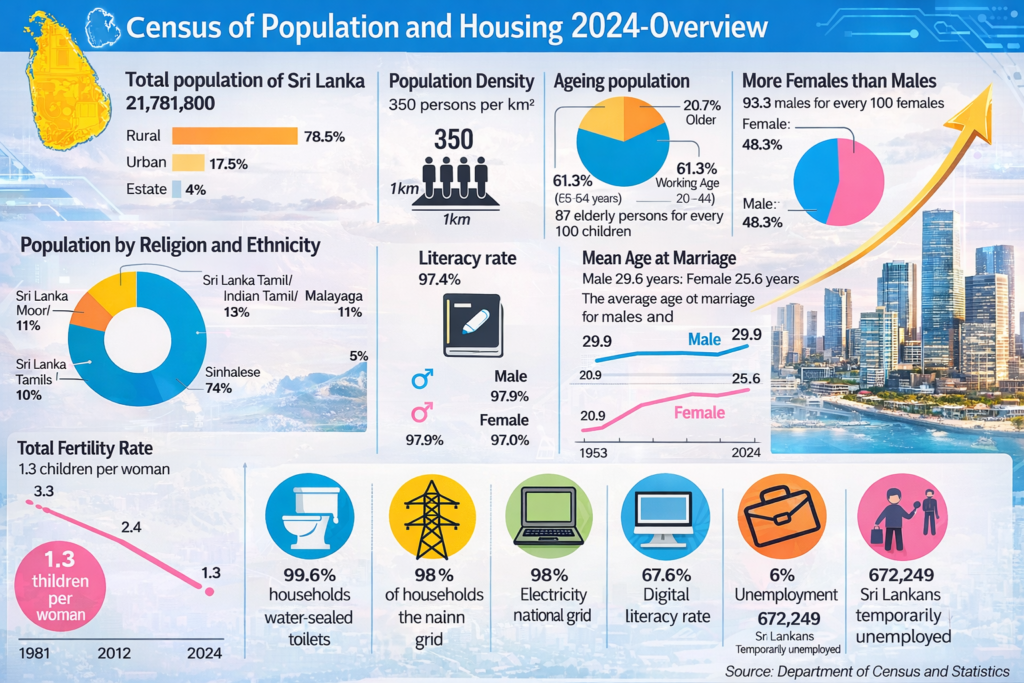
Sri Lanka’s population density has shown a consistent upward trend over the decades, reflecting increasing pressure on land and urban infrastructure. From 230 persons per square kilometre in 1981, density rose to 300 in 2001 and further to 325 in 2012. By 2024, it has reached 350 persons per square kilometre, marking a steady long term rise.
The Western Province remains the most densely populated region, accounting for 28.1 percent of the total population. Gampaha District has emerged as the most populated district with 2.43 million residents, surpassing Colombo District which records 2.37 million. A significant concentration of people continues to reside in four provinces, namely Western, Central, Southern, and North Western. In contrast, Mullaitivu District remains the least populated area with just over 122,000 residents.
Age Structure and Growing Elderly Population
One of the most striking findings of the census is Sri Lanka’s shift toward an ageing population. Elderly individuals now account for 18 percent of the population, while the proportion of children has declined to 20.7 percent. This indicates that for every 100 children, there are now 87 elderly persons, highlighting a clear demographic transition.
The median age has increased to 35 years, reflecting a rise of at least five years compared to the 2012 census. This shift suggests long term implications for healthcare demand, labour supply, and social welfare systems as the country moves toward an ageing society.
Gender Balance and Marriage Patterns
The gender composition of the population shows a slight female majority, with women making up 51.7 percent and men 48.3 percent. Marital trends also reveal changing social patterns, with 41.8 percent of individuals never having been married.
The average age of marriage stands at 29 years for males and 25 years for females. Among older adults, a notable disparity exists in widowhood, with 44.2 percent of women aged over 65 being widowed compared to only 10.5 percent of men. This highlights gender differences in life expectancy and social vulnerability among elderly populations.
Declining Birth Rates and Fertility Patterns
Fertility rates in Sri Lanka have continued to decline, reaching a total fertility rate of 1.3 in 2024. This marks a significant drop from 3.3 in 1981 and 2.4 in 2012, signaling a long term shift toward smaller family sizes.
There are also notable variations across sectors and ethnic groups. Women in estate sectors record a higher fertility rate of 1.6 compared to urban and rural populations. Among ethnic communities, Muslim women show the highest fertility rate at 2, while Sinhala women record the lowest at 1.2. These differences reflect varying socio economic and cultural dynamics across the country.
Ethnic Distribution and Changing Composition
The ethnic landscape of Sri Lanka continues to evolve, with Sinhalese remaining the majority at 16.14 million. This is followed by Sri Lankan Tamils at 2.68 million and Sri Lankan Moors or Muslims at 2.28 million.
Comparative data between 2012 and 2024 shows a slight decline in the proportion of Sinhalese from 74.9 percent to 74.1 percent, while the Indian Tamil population has decreased from 4.1 percent to 2.8 percent. In contrast, the Sri Lankan Muslim population has grown from 9.3 percent to 10.5 percent, and Sri Lankan Tamils have increased from 11.5 percent to 12.3 percent, indicating gradual demographic shifts among ethnic groups.
Education Levels and Literacy Growth
Sri Lanka continues to make strong progress in education, with the national literacy rate rising to 97.4 percent in 2024 from 95.7 percent in 2012. The gap between male and female literacy has nearly closed, with male literacy at 97.9 percent and female literacy at 97.0 percent.
This improvement reflects sustained investment in education and increased access to learning opportunities across the country, strengthening human capital and long term economic potential.
Health Challenges and Disability Statistics
The census reveals that 3.2 million individuals report at least one physical or mental difficulty, equivalent to 157 per 1,000 population. Additionally, 727,293 people have been identified with disabilities related to vision, hearing, mobility, cognition, self care, and communication, representing a significant national concern.
Non communicable diseases continue to rise, with 4.18 million people affected. Conditions such as high blood pressure and diabetes are the most prevalent, particularly among older adults and females. The report also highlights a complex relationship between education levels and health outcomes, suggesting that higher education does not necessarily eliminate the risk of such diseases.
Migration Patterns and Workforce Dynamics
Migration patterns show that 13 percent of the population are lifetime migrants, with marriage identified as the leading reason, followed by employment opportunities.
Gampaha and Colombo districts report the highest levels of internal migration, driven largely by economic activity and job availability. The labour force participation rate stands at 47.3 percent, while 52.7 percent of the working age population remains economically inactive.
Among those outside the labour force, 50.6 percent are women engaged in household and caregiving roles, while 41.3 percent of men are inactive due to education or training commitments. These figures highlight ongoing gender roles and structural patterns in the workforce.
Living Standards, Sanitation, and Energy Use
Sri Lanka continues to maintain high standards in sanitation, with 99.6 percent of households using water sealed toilet facilities, reflecting strong public health infrastructure.
The National Water Supply and Drainage Board provides the primary water source for 38.9 percent of households. However, in terms of energy usage, 55.4 percent of households still rely on firewood for cooking, despite a growing shift toward Liquefied Petroleum Gas, now used by 42.4 percent of households.
The Census of Population and Housing 2024 ultimately paints a detailed picture of a nation in transition, balancing progress in education and infrastructure with emerging challenges related to ageing, health, and workforce participation. These demographic trends are expected to play a decisive role in shaping Sri Lanka’s economic planning, policy direction, and long term development strategy.