A controversial parliamentary move raises serious concerns over transparency and accountability as key witnesses, including the President, are shielded from testifying in a high-stakes customs investigation.
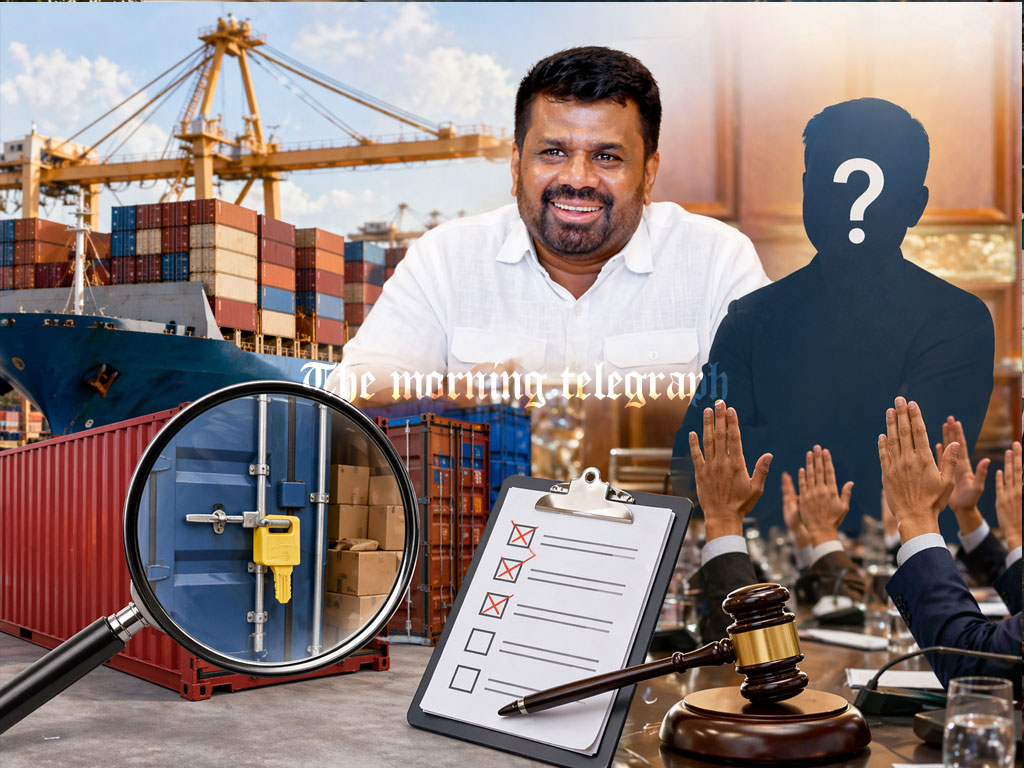
An attempt to summon President Anura Kumara Dissanayake to testify before a Parliamentary Special Committee probing the controversial release of 323 containers without customs inspection has failed, triggering fresh debate over transparency, accountability, and the integrity of the investigation process.
The request was made by opposition members of the committee, including Ajith P. Perera, Dayasiri Jayasekara, Mujibur Rahuman, and D. V. Chanaka, who formally wrote to Committee Chairman and Minister Harshana Nanayakkara on April 07. They sought to have the President appear before the committee in his capacity as Minister of Finance, Planning and Economic Development, given that Sri Lanka Customs falls directly under that ministry.

In addition to the President, the opposition also called for the summoning of Bimal Ratnayake, who was the subject minister at the time of the incident, Janith Ruwan Kodithuwakku, who served as Deputy Minister, and the Secretary to the Ministry of Finance. According to opposition MPs, these individuals are central to understanding how such a large scale customs irregularity could have occurred and why standard procedures were bypassed.
However, the proposal to summon these key witnesses was defeated by a majority vote of government members within the committee. Speaking to the media, MP Ajith P. Perera expressed strong disappointment, stating that the request was rejected through a vote led by the committee chairman. He described the move as unprecedented, noting that parliamentary committees traditionally do not decide on summoning witnesses through majority voting.
Perera emphasized that calling these four individuals was essential to uncover the truth behind the release of hundreds of containers without inspection. He argued that such a decision undermines the credibility of the committee and raises serious concerns about whether justice can be achieved through its proceedings.
He further stated that this development sets a troubling precedent for parliamentary democracy in Sri Lanka. According to him, never before has a Select Committee or any parliamentary body refused to summon witnesses through a vote, making this incident a historic departure from established practice. He warned that public confidence in the investigation process could be severely damaged as a result.
The controversy stems from revelations made in early 2025 by a Customs Trade Union, which claimed that over 300 containers had been released from the Colombo Port without undergoing mandatory customs inspection. The union alleged that 323 imported containers were cleared on January 17 and 18 despite being categorized under high risk classifications requiring strict physical and scanning procedures.
At the time, union representatives highlighted that nearly 80 percent of these containers belonged to the red channel category, which requires thorough inspection. They alleged that the release was carried out by a group of officials with the backing of senior authorities, raising serious questions about systemic lapses and possible misconduct.
In response to the allegations, the Ministry of Finance appointed a special committee to investigate the incident. The committee, chaired by Deputy Treasury Secretary A K Seneviratne, included senior officials from multiple departments, including transport, trade policy, management audit, and customs. Their findings were later presented to Parliament in June 2025 by opposition MP Mujibur Rahuman.
During the parliamentary presentation, Rahuman outlined key observations from the report, explaining the classification system used by Customs. Containers marked under the red label require full physical and scanning inspections, while yellow label shipments undergo sample checks and scanning. Only green label shipments are cleared based on documentation alone. The report indicated that established procedures were not properly followed in the case of the 323 containers.
The issue also prompted several complaints to the Criminal Investigation Department, further intensifying scrutiny over the matter. As pressure mounted, the opposition pushed for a broader parliamentary investigation, leading to the establishment of the current Special Committee in November 2025.
The committee, chaired by Minister Harshana Nanayakkara, includes a mix of government and opposition MPs. Members include Chathuranga Abeysinghe, Sunil Watagala, Arkam Ilyas, Dayasiri Jayasekara, Ajith P. Perera, D. V. Chanaka, Mujibur Rahuman, Najith Indika, Mailwaganam Jegadeeswaran, Lakmali Hemachandra, and Upali Pannilage.
The committee held its first meeting on January 21, 2026, with the chairman expressing confidence that the investigation would be completed within three months. However, the recent decision to block the summoning of key witnesses has cast doubt over the committee’s independence and effectiveness.
As the controversy continues to unfold, questions remain about whether the full truth behind the container release scandal will be uncovered. The outcome of this investigation is likely to have far reaching implications for governance, accountability, and public trust in Sri Lanka’s institutions.