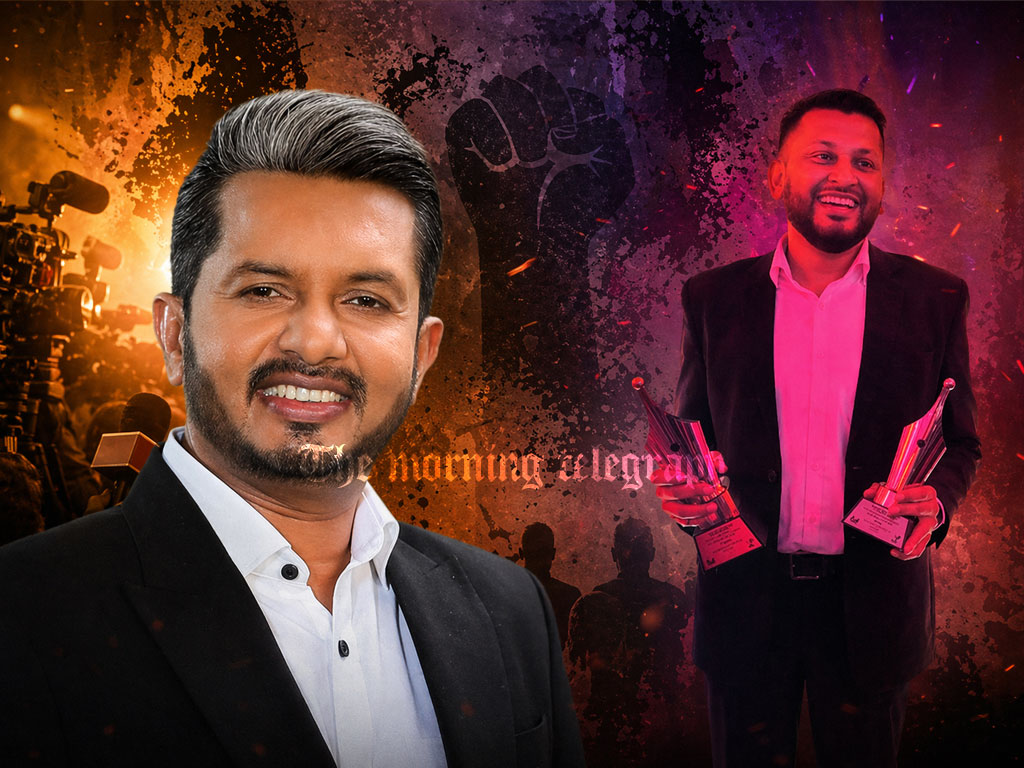
A shocking confrontation at a peaceful religious event has sparked outrage after a government media advisor was accused of physically assaulting and intimidating a journalist, raising serious concerns about press freedom and media safety in Sri Lanka.
A complaint has been formally lodged with the Kandy Police over an alleged incident in which Presidential Media Advisor Chandana Sooriyabandara physically assaulted and attempted to remove a journalist covering the Peace Walk. The incident has triggered widespread concern over journalist safety and freedom of media during public events.

According to Buwaneka S. Perera, a journalist attached to the Sunday Observer of the state owned Lake House institution, the confrontation occurred while he was reporting on the non violent ‘Ehipassiko’ Buddhist monks’ Peace Walk. He stated that Sooriyabandara approached him and another Lake House journalist and claimed that they did not have permission to report on the event, ordering them to leave immediately.
Perera further explained that he showed his official government issued media identification card from the Department of Government Information, which he was wearing visibly around his neck. He also clarified that he was representing a government affiliated media organization. However, he alleged that Sooriyabandara disregarded these credentials and responded aggressively.
The journalist claimed that despite identifying himself, he was pushed aside and verbally abused in front of participants and onlookers. He described the incident as humiliating and said the media advisor used harsh and degrading language during the altercation, intensifying the situation in a public setting.
He added that even after objecting to the treatment, Sooriyabandara continued to insist that he was not allowed to cover the event, repeating his demand and allegedly continuing verbal abuse. The situation, according to Perera, escalated unnecessarily during what was meant to be a peaceful and spiritually focused gathering.
Following the incident, the journalist informed his organization and relevant government officials about what had taken place. He later proceeded to lodge an official complaint with the Kandy Police, seeking legal redress and protection under media rights and law enforcement processes.
Meanwhile, the Sri Lanka Professional Journalists’ Association issued a strong statement condemning the alleged assault and intimidation. The association expressed deep concern over what it described as a violation of press freedom and an attack on the rights of journalists performing their professional duties.
In a formal letter addressed to the President, the association stated that it views the alleged physical assault and intimidation by the Presidential Media Advisor with strong disgust. It emphasized that such actions undermine democratic values, media independence, and the safety of journalists operating in the country.
The incident has now intensified debate around media freedom in Sri Lanka, particularly in relation to the treatment of journalists covering sensitive or high profile public events. Observers note that ensuring the protection of journalists is essential for maintaining transparency, accountability, and public trust in governance.