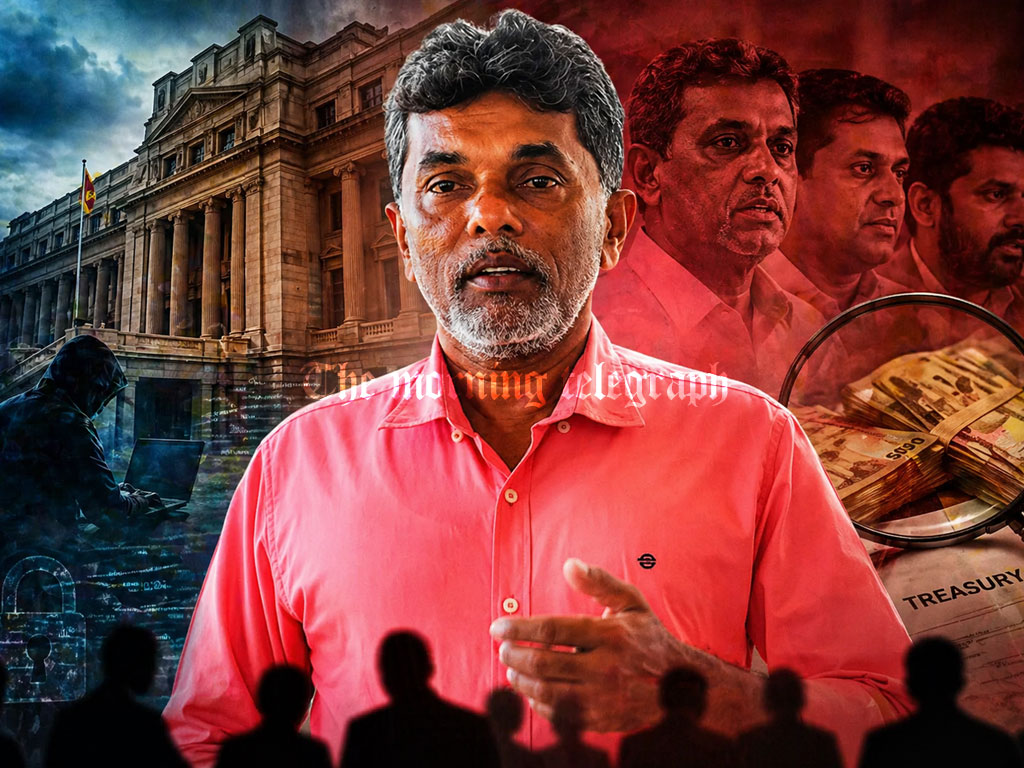
A political storm deepens as fresh claims suggest insider knowledge, raising serious questions about whether opposition figures had early access to details of the Treasury fraud and what it means for Sri Lanka’s financial security.
Deputy Minister T.B. Sarath has raised serious concerns over the controversial Treasury fraud, stating that any crisis within the Treasury is not just a financial issue but a direct blow to President Anura Kumara Dissanayake as the head of state. Speaking on the ongoing Treasury scam in Sri Lanka, the Deputy Minister stressed that such incidents carry national consequences that go beyond politics.
According to Sarath, the fraud in question involves an amount estimated between Rs. 2.5 million and Rs. 5 million, adding another layer to the growing concerns over financial irregularities within the Ministry of Finance. The Treasury fraud investigation has now taken a political turn, with new questions emerging over how information about the incident surfaced even before official confirmation.

The Deputy Minister pointed out that it is highly suspicious that key opposition figures, including Sajith Premadasa, Namal Rajapaksa, and Wimal Weerawansa, began raising questions about the Treasury hacking incident before it was formally disclosed. He noted that such financial frauds typically take weeks, sometimes even months, to be uncovered through official channels, making the early awareness of certain individuals particularly concerning.
He further emphasized that investigators must now examine whether there is any connection between these political figures and the Treasury fraud, especially considering that details appeared to circulate among them before being publicly revealed. This development has intensified the political debate surrounding the incident, shifting the focus from a purely financial crime to a broader national security concern involving potential insider information.
Sarath also remarked that while the Treasury crisis represents a serious challenge for the President and the government, it does not appear to have been treated with the same level of urgency by opposition leaders. He described this contrast as troubling, given the scale of the implications for Sri Lanka’s economic stability and public trust.
In his concluding remarks, the Deputy Minister called for unity across political lines, urging all parties to set aside differences and confront what he described as a common threat to the country’s financial system. He stressed that protecting state institutions like the Treasury is a collective responsibility and warned that failure to act decisively could further damage Sri Lanka’s already fragile economic environment.