
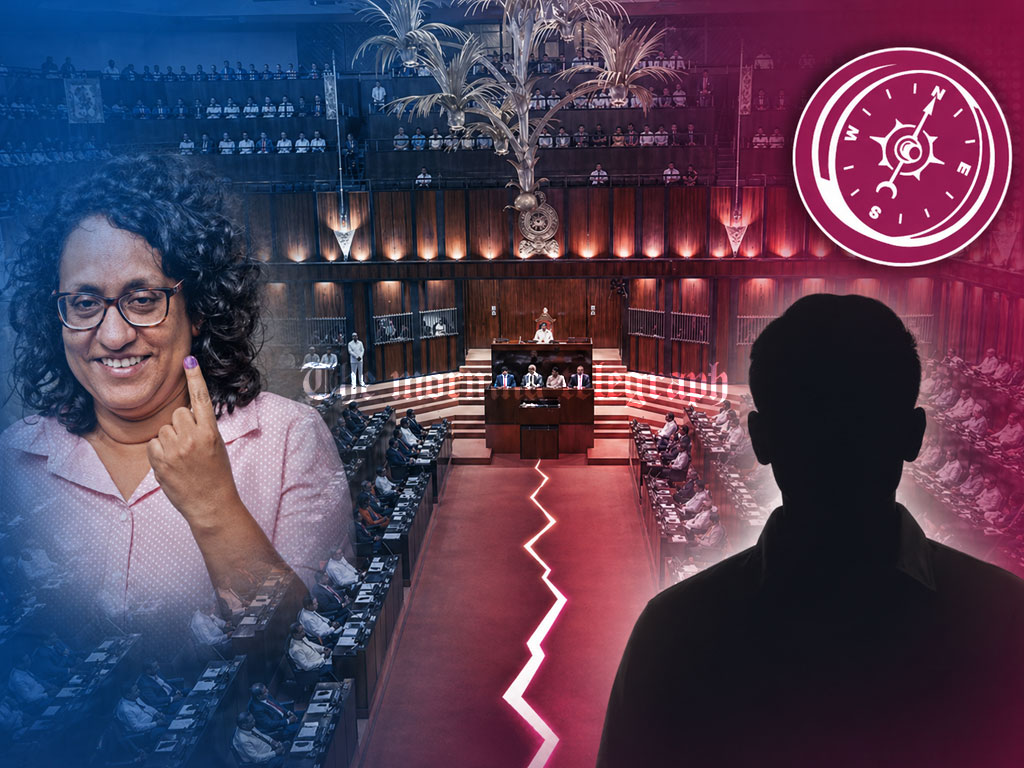
Prime Minister shake-up talks intensify as senior government MPs reportedly propose Chandana Abeyratne amid internal crisis and unrest.
Prime Minister shake-up discussions have reportedly emerged inside the government, with a group of senior government MPs proposing a change to strengthen the administration’s defence in Parliament.
The move comes amid a crisis situation that has developed within the government in recent days, raising fresh questions about internal unity, parliamentary strategy, and the future balance of power.

According to reports, the proposal has been submitted to the Pelawatte office by a group of senior MPs representing the Janatha Vimukthi Peramuna. The group is said to include fairly hardline members who entered Parliament.
It is further reported that a senior Deputy Minister from the Rajarata region is leading the group pushing for the change.
Their proposal is that Minister of Public Administration Professor Chandana Abeyratne should be appointed as Prime Minister in response to the current political crisis.
The move appears to be aimed at creating a stronger parliamentary voice for the government at a time when criticism, pressure, and allegations have placed the administration under growing strain.
Trusted government sources indicate that a special discussion has been scheduled for May 7 to discuss the proposal with senior party leaders.
What happens at that meeting could be critical, as it may determine whether the proposal is treated as an internal pressure tactic or the beginning of a deeper realignment within the government.
It is also understood that if the group’s proposal is rejected, they have sought legal advice on the possibility of acting as an independent group of MPs in Parliament without crossing over to another party.
This raises concerns about whether the government could face a new internal bloc from within its own parliamentary ranks, even if those MPs do not formally join the opposition.
Such a move could complicate parliamentary management, especially during debates involving financial irregularities, corruption allegations, and the government’s handling of recent controversies.
Additionally, the government’s popularity has reportedly been declining due to financial irregularities and corruption allegations that have surfaced recently.
Before this, around twelve MPs had informed the General Secretary in writing that these issues needed to be resolved urgently.
They had also indicated that they were ready to resign from their positions if the concerns were not addressed.
It is reported that the group of twelve includes two senior Cabinet ministers, three Deputy Ministers, one person holding a high parliamentary office, and seven or eight MPs who are professionals.
However, questions remain over how far this unrest has spread inside the government and whether the reported Prime Minister proposal reflects a limited internal dispute or a more serious political fracture.
The possibility of senior MPs acting independently in Parliament, without crossing over to another party, adds another layer of uncertainty to an already tense political moment.
For the government, the challenge now is not only to manage public criticism, but also to contain internal dissatisfaction before it becomes a visible parliamentary rebellion.
What happens next could be critical as senior party leaders prepare to discuss the proposal, with the future of the Prime Minister’s position, government discipline, and parliamentary stability all hanging in the balance.
SOURCE :- LANKACNEWS.COM



Eran Wickramaratne’s appointment could add fuel to the burning issues.