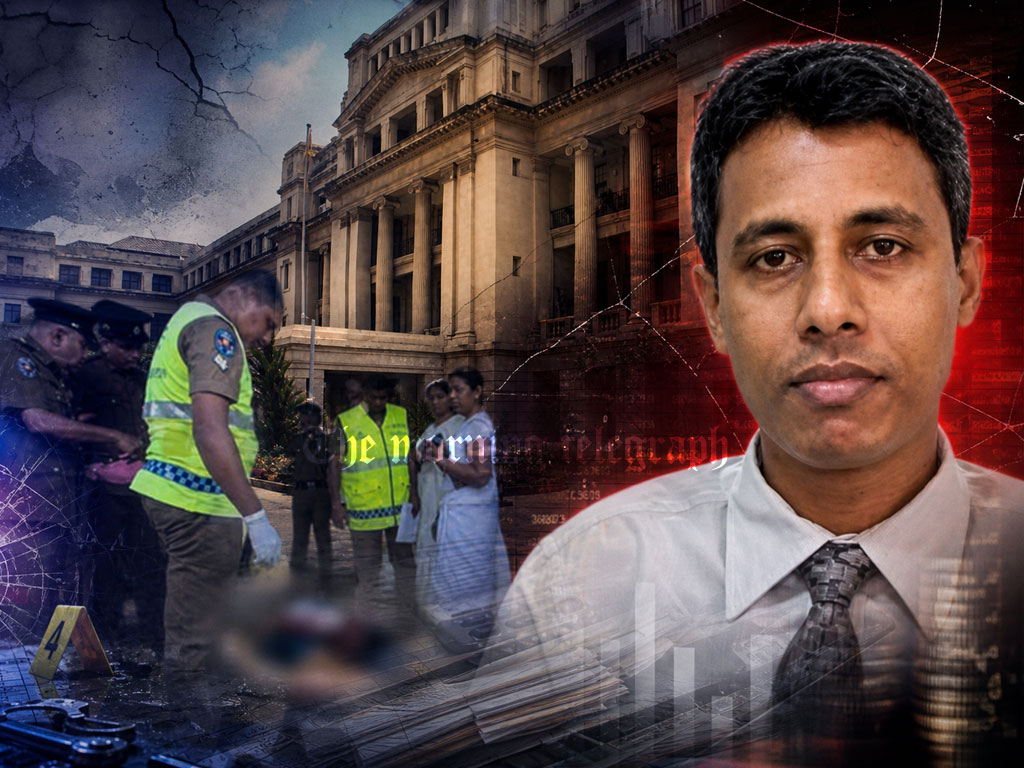
Treasury officer death raises new questions over the $2.5M Treasury scandal, CID complaint, suspended officials and political accountability.
Treasury officer death has intensified public concern over the alleged $2.5 million Treasury scandal, after Assistant Director Ranga Rajapaksa died under circumstances now drawing serious questions.
Rajapaksa’s death has added a new and troubling layer to a case that has already placed the Ministry of Finance, the Treasury, and the government under growing pressure.
The wider Treasury dollar scandal has been surrounded by suspicion from the beginning, with critics questioning how such a major financial transfer could have gone wrong and why the matter was not handled with greater urgency.

The Treasury falls under the purview of Minister of Finance Anura Kumara Dissanayake.
After Mahinda Siriwardana retired as Secretary to the Ministry of Finance, Harshana Suriyapperuma, who had been serving as Deputy Minister of Finance and Planning, resigned from that post and was appointed Secretary to the Ministry of Finance.
The position of Secretary to the Ministry of Finance is, by protocol, regarded as the second highest position after the Secretary to the President in the State Administration Service.
Critics have described Suriyapperuma’s appointment as a political appointment, arguing that such an appointment to the Finance Secretary’s post is exceptional and unprecedented.
There is also a rumour circulating that Harshana Suriyapperuma is a dual citizen.
If such a claim were ever proven, questions could arise over his earlier position as a Member of Parliament. At the same time, his qualifications for the position of Secretary to the Ministry of Finance are also being challenged by critics.
Harshana Suriyapperuma was appointed Secretary to the Ministry of Finance on June 23, 2025.
Within three months of his appointment, the Ministry of Finance’s computer system was reportedly subjected to a hacker attack.
The complaint to the Criminal Investigation Department regarding the alleged loss of $2.5 million was lodged by Ranga Rajapaksa, the Assistant Director who has now died under circumstances that have triggered public suspicion.
Investigations have reportedly revealed that Rajapaksa was the first person to respond to the message connected to the crediting of money through a fraudulent email.
His role in the process has now become central to public questions about what happened inside the Treasury and how the fraudulent communication was handled.
Rajapaksa had reportedly been a Janatha Vimukthi Peramuna activist since his university days.
Later, he is said to have become a full-time JVP cadre.
Of the five persons suspended from work in connection with this incident, two are said to be JVP cadres.
According to information now coming to light, the $2.5 million loan installment was paid on ten separate occasions.
This raises a critical question. Could an installment sent from one government to another, reportedly requiring the approving signatures of 13 people, be wrong all ten times?
That is the puzzle now troubling critics, officials, and citizens watching the case closely.
The Minister of Finance is the JVP leader, the Secretary to the Ministry of Finance is being described by critics as a political appointee, and of the five persons suspended in connection with this alleged robbery, two are alleged to be full-time JVP cadres.
This combination has made the case politically explosive.
The first issue that investigators may need to examine is whether the email address through which the fraudulent payment instructions were sent had any connection to any political network or individual.
Given the sequence of events, critics argue that citizens are entitled to ask whether this was merely a mistake or something more organized.
Did the fund transfer actually happen by mistake? Or was it a deliberate fraud carried out by people who understood the Treasury process?
Those questions have now become even more urgent after the death of Ranga Rajapaksa.
Several possibilities are being discussed publicly regarding his death, though none should be treated as proven until official investigations and forensic findings are completed.
Did he take his own life due to shame, pressure, or disgrace?
Was he silenced because he may have known important details about the alleged Treasury fraud?
Was he under intense pressure because of his political background, official role, or knowledge of the internal process?
Or was his death unrelated to any wider conspiracy, but made suspicious because of the timing and sensitivity of the case?
These are difficult questions, and they require answers based on evidence rather than political speculation.
However, questions remain because his death is likely to have a significant impact on the ongoing investigation into the alleged $2.5 million Treasury robbery.
Within just one and a half years, the government is now facing not only allegations of theft and fraud, but also growing public suspicion surrounding a death linked to a sensitive financial investigation.
Even an ordinary citizen can understand that the death of a person connected to the complaint and early response to the alleged fraudulent email could affect the direction, credibility, and public perception of the investigation.
Sri Lanka has a long political memory when it comes to loyalty, sacrifice, fear, violence, and silence inside political movements.
Critics have recalled past stories of JVP cadres who were said to have endured extreme torture without betraying their party.
Against that background, some are now asking whether Ranga Rajapaksa was caught in a political and institutional storm far bigger than himself.
Was he a man overwhelmed by personal pressure?
Was he a witness who knew too much?
Or has his death become another unresolved political tragedy in a country where public trust in official explanations is often weak?
The issue is further complicated by the recent death of Nandana Gunathilaka, who had been severely criticizing the government.
His relatives have reportedly complained that his death was suspicious and possibly involved foul play.
That comparison has now strengthened calls for full transparency in the case of Ranga Rajapaksa.
Whatever appears in the post-mortem report, erasing public doubt about this death will not be easy unless the investigation is handled with complete independence and openness.
The Treasury scandal already raised questions about financial safeguards, official responsibility, cyber vulnerability, and political accountability.
Now, the death of a Treasury Assistant Director connected to the CID complaint has transformed the matter into something far more serious.
What happens next could be critical.
The government must ensure that the investigation into both the alleged $2.5 million Treasury fraud and Ranga Rajapaksa’s death is seen to be independent, credible, and free from political interference.
If the authorities fail to provide clear answers, the suspicion surrounding this case may deepen further, leaving a lasting stain on Anura Kumara Dissanayake’s government and the public institutions it promised to reform.