JVP funding during Sri Lanka’s second insurrection reveals robberies, gold seizures, prison breaks, sacrifice, ideology and hidden costs.
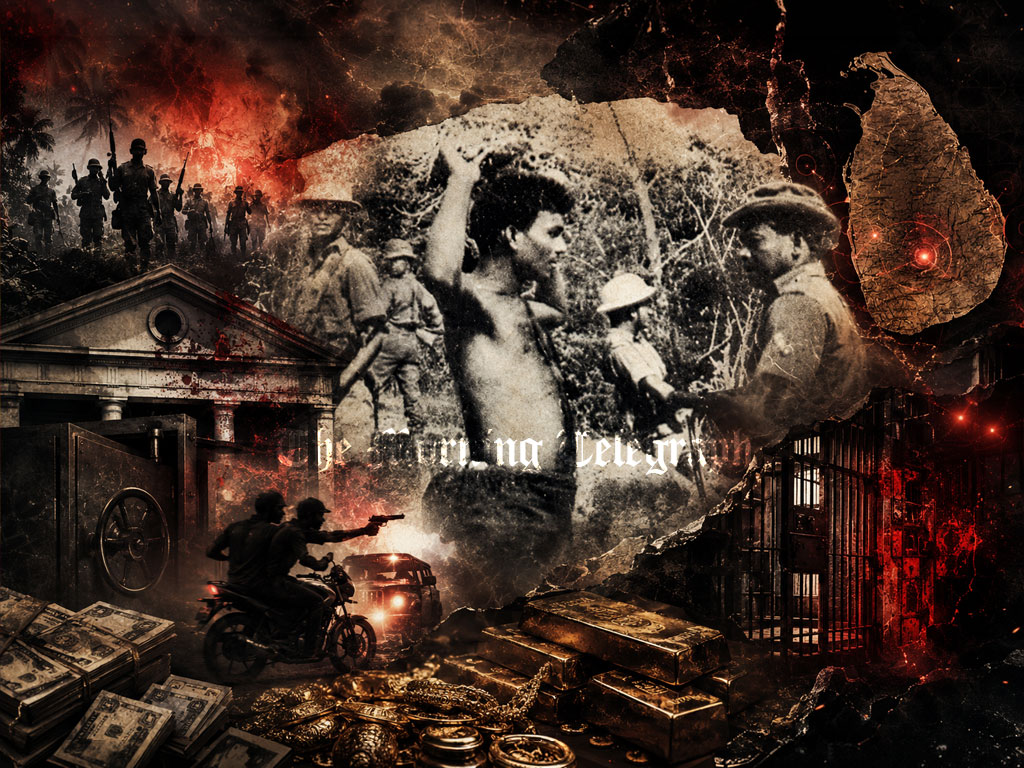
JVP funding during Sri Lanka’s second insurrection was built through a violent underground campaign of bank robberies, vehicle hijackings, salary thefts, sacrifice, and ideology.
A special unit was formed in late 1984 under the leadership of Ragama Somasiri to raise money for the JVP. Acting on the instructions of this team, members broke into major banks and rural banks, seized cash, hijacked cars, motorcycles, bicycles and other vehicles, robbed wealthy individuals in rural and semi-urban areas, and stole salaries.
All money collected through these operations was reportedly governed by strict discipline and internal ethics. It was allocated to JVP activities, its armed wing, the Patriotic People’s Movement, and the needs of full-time cadres. The insurgents described these robberies as “economic work.”

Hundreds of insurgents died while raising money for the JVP between 1985 and 1990. The first was Sunil Abeyratne of Gampaha, who died in 1985 after being seriously injured during a motorcycle hijacking, arrested by police, and taken to hospital.
Sarath Wijesinghe of Anuradhapura, a full-time member of the student wing, was also killed by gunfire during a robbery. A powerful JVP regional leader from Matara, Thalpawila Vidane Kankanamge Dharmasena, known as Thalpawila Dharma, was killed after being captured by Ambalantota police in 1985 during a teacher’s salary robbery.
There was internal criticism within the JVP over the use of someone like Thalpawila Dharma for such operations, as he had been involved in responsible party work, including conducting education camps. Similar criticism surfaced when a bomb being carried to another target exploded in the hand of Nimal Balasuriya, an engineering student at the University of Moratuwa, killing him while he was serving as the convener of the Antaray.
The JVP’s fundraising activities included breaking into 62 state banks and stealing cash and gold between 1985 and 1990. There were also 131 allegations of money-related crimes, including the theft of salaries at the Kelabokka estate.
Nearly a thousand cases of property theft involving more than Rs. 20,000 were also reported after residents were allegedly intimidated at gunpoint.
The largest bank robbery in Galgamuwa took place on September 23, 1986. On August 22, 1988, the Digana People’s Bank was broken into, with cash and gold worth Rs. 60 lakhs looted. The five men who carried out the Digana Bank robbery took control of the bank and injured the security guard with a razor blade.
The Maradagahamula Bank was broken into on May 11, 1987, and Rs. 35 lakhs was looted. Rebels also looted the People’s Bank in Katubedda, Moratuwa, and the Bank of Ceylon in a densely populated part of Colombo on January 16, 1989.
They stole Rs. 22 million in cash and gold ornaments from the People’s Bank in Wellawatte on February 8, 1989, and Rs. 8 million worth of cash and gold ornaments from the People’s Bank in Kudawella, Tangalle, on February 7, 1989. Similar cash collection operations were carried out across the country from 1985 to 1990.
Several of these cases were prosecuted by the government. Some suspects were detained at Borella Magazine Prison, and the JVP later succeeded in freeing all of them by breaking into the prison in December 1988.
Indrare, also known as Pannala Kottal Bhadraarachchige Indraratne, who led the Galgamuwa Bank robbery, later served for a period as the Kegalle and Kurunegala District Secretary and, in later years, became a member of the JVP Central Committee.
A resident of Weweldeniya, Mirigama, he had been a rebel in April 1971 and retreated to Wilpattu after the defeat. Mirigama Chandrare, also known as Nanaykakarage Chandradas, who led the Digana People’s Bank robbery on August 22, 1988, had also been involved in the 1971 rebellion and was a member of the Central Committee.
Most of the rebels assigned to raise large sums of money were armed and had received training. Among them were individuals who had deserted the army. They had trained at arms camps in Ampara, Trincomalee, Siyambala, Udawalawe, Sripada, Ratnapura Erathna, Knuckles, Hambegamuwa and the Sinharaja mountains, among other places.
Although casteism did not emerge as a major issue during the second JVP rebellion, it appeared occasionally. Sri Lanka has about 15 castes, historically divided according to traditional occupations.
These include Govigama, linked to land-owning elites, farming and cattle husbandry; Karawa, linked to the fishing industry; Salagama, linked to cinnamon processing; Durawa, linked to toddy tapping; Navandanna, linked to metalwork; Rada, linked to cloth weaving; Vahumpura, linked to jaggery making; Kumbal, linked to pottery; Dura, linked to elephant handling; Berawa, linked to astrology and dance; Bathgama, linked to labourers and servants; Gahala, linked to drumming; Kinnara, linked to the flax industry; and Hulawali, linked to coir production, among others.
Among those exposed for bank robberies and related activities during the second JVP rebellion, many reportedly belonged to the Vahumpura caste. Historically, they lived near kitul trees and were regarded as traditional armed groups who had served the country in the distant past.
After the British invasion of Kandy in 1803, members of the Devavanshika or Vahumpura clan are said to have played a role in resisting them.
Sixty kilos of gold stolen by rebels to raise funds were seized by security forces at a house in Boralesgamuwa. The house had been purchased by the JVP in the name of Don Ariyadasa of Matara.
Ariyadasa was sentenced in 1992 by High Court Judge F.D.N. Jayasuriya to two years of imprisonment with hard labour, suspended for 10 years. He had attended a JVP meeting at Hyde Park in 1977, was working at the Dehiwala Zoo at the time, and later joined the party.
He later worked at the Department of Labour and became a full-time member in February 1988. He had also purchased a house in Moratuwa worth Rs. 45 lakhs in his name. Ariyadasa admitted that gold stolen from banks had been stored in the house. Security forces also recovered Rs. 23 lakhs from the house at the time of his arrest.
With the defeat of the second JVP rebellion, more than ten thousand people were killed or disappeared. A few remaining rebels then took steps to support affected families. One such activist was Udaya Kumara Ranatunga, a resident of Kadawatha.
Ranatunga had also been among the page setters at the newspaper where the writer worked as an editorial staff member at Divaina. He joined the Upali Newspaper Company on February 2, 1982, and the writer recalls completing his Employees Provident Fund application, numbered 383.
He was also among the first employees involved in launching the Divaina Sunday edition as an apprentice.
Ranatunga joined the JVP through Monaragala Ranasinghe, a page setter. On April 22, 1988, Monaragala Ranasinghe, who was part of a JVP group that attacked the Katunayake Air Force Base for the second time and stole a large stock of weapons, was shot dead inside the base.
Ranatunga later followed his path and became a full-time activist. His mother was a teacher, and he had two brothers and a sister.
The first issue of the Borella-based Lakdiva newspaper was published on January 26, 1992, and Ranatunga worked as its chief layout artist before leaving in mid-1992.
Police investigating the Rs. 4.8 million railway salary robbery in Ratmalana on August 14, 1992, eventually arrested Ranatunga. He had carried out the act with a group on behalf of the JVP to support the families of fallen comrades. During the robbery, three railway workers were killed and nine others were injured.
Ranatunga, while in police custody, was later transferred to Mahara Prison. The case was also brought to the attention of Amnesty International. In a letter to his mother dated September 2, 1993, he wrote that “the earth is full of blood and tears.”
On September 6, 1993, five remand prisoners, including Udaya Kumara Ranatunga, were killed in a clash at Mahara Prison. The others killed were Gampaha Lakshman Dharmasiri, Gampaha Ravindra Beddevitharana, Rajanganaya Rohitha Senadheera and Badulla Wimaladasa. The Prisons Department later stated that the clash occurred during an escape attempt.
Ranatunga’s body was laid to rest at his residence in Sooriyagama, Kadawatha. The writer witnessed his wife, Swarna Rajapaksa, who was in custody, being brought under guard to mourn briefly near his body. His daughter, Sigithi, was playing on the Hela Medhani grounds.
Veteran journalist Ajith Samaranayake spoke at the funeral, stating, “This is not a thief or a robber, but a human hero. However, this will be recognized not in the present, but in the future.”
Thousands of lives were lost during the second JVP rebellion while raising party funds. Whatever path they followed, their stated aspiration may have been to create a socialist society with free, fair and equal opportunities.