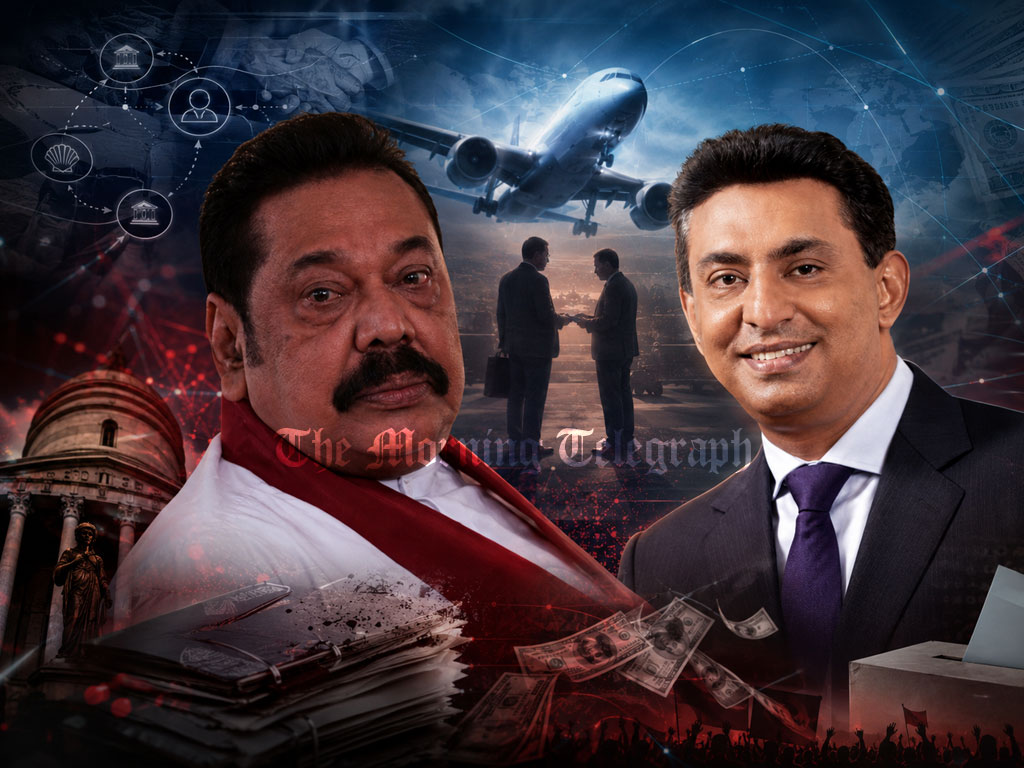
Airbus deal bribe worth $2 million was allegedly routed to Mahinda Rajapaksa’s 2015 campaign, Bribery Commission tells court.
Airbus deal bribe allegations took a dramatic turn yesterday (5) after the Bribery or Corruption Investigation Commission informed the Colombo Chief Magistrate’s Court that $2 million, allegedly obtained from a European aircraft manufacturing company, had been directly channelled to former President Mahinda Rajapaksa’s 2015 presidential election campaign.
The Commission told court that the amount, equivalent to Euro 1,454,645.54, was allegedly obtained during the 2013 process to purchase ten new aircraft for SriLankan Airlines.

The revelation raises a serious question over whether a multi-million-dollar transaction linked to the proposed upliftment of the national airline was ultimately diverted to fund an election campaign during a political power struggle.
In connection with this large-scale financial irregularity, former SriLankan Airlines CEO Kapila Chandrasena, his wife Priyanga Niyomaali, and former Minister Chamal Rajapaksa’s son Shameendra Rajapaksa have been named as suspects.
Appearing before Colombo Chief Magistrate Asanga S. Bodharagama, the Commission stated that the relevant election campaign office had been led by suspect Shameendra Rajapaksa, while its operations were carried out by former Southern Province Governor Willie Gamage.
The alleged route through which this black money was moved using a shell company established in Brunei was described as shocking.
According to the explanation given to court by the Bribery Commission, the funds had flowed from “Biz Solutions” in Singapore through Standard Chartered Bank to a local entity named “Ago.”
Thereafter, the money was allegedly channelled by cheque through Nations Trust Bank to Samaraweeragama Saman Sampath, a partner of “Sadisi Media Creation.”
During questioning, it was confirmed that election propaganda activities had been carried out under the leadership of Shameendra Rajapaksa. It was also revealed that a cheque for Rs. 9 million had been obtained on one occasion, and that those funds were spent on the 2015 election campaign.
Former President Mahinda Rajapaksa, former Minister Piyankara Jayaratne, and Willie Gamage have been summoned before the Commission to record statements regarding the incident.
However, the investigation has not been straightforward.
The Commission informed court that HSBC Bank no longer has detailed information on the accounts of primary suspect Kapila Chandrasena, because bank records are usually destroyed after seven years under standard procedure.
This has complicated efforts to trace the exact destinations through which the money had circulated. Nevertheless, the Commission confirmed that the original relevant documents remain safely in its custody.
An even more serious issue is that named suspects Priyanga Niyomaali and Shameendra Rajapaksa are currently evading the law.
The Commission informed court that steps are now being taken to obtain Interpol Red Notices for their arrest.
When the controversial case was called, Kapila Chandrasena, who had been in remand custody since March 12, was produced before court.
After considering submissions made by President’s Counsel Riensi Arsekularatne on behalf of the suspect, the Magistrate observed that the prosecution had not presented any special reason to deny bail.
Accordingly, Chandrasena was granted bail. He was released on a cash bail of Rs. 500,000 and three sureties of Rs. 10 million each.
A strict foreign travel ban was also imposed on him.
The Bribery Commission was further ordered to report the next progress of the investigation to court by July 14.
Time will tell whether the final beneficiaries of this large-scale transaction, allegedly carried out under the guise of uplifting a national asset, will escape the reach of the law, or whether the truth will emerge from the shadows of missing bank records.