By Marlon Dale Ferreira
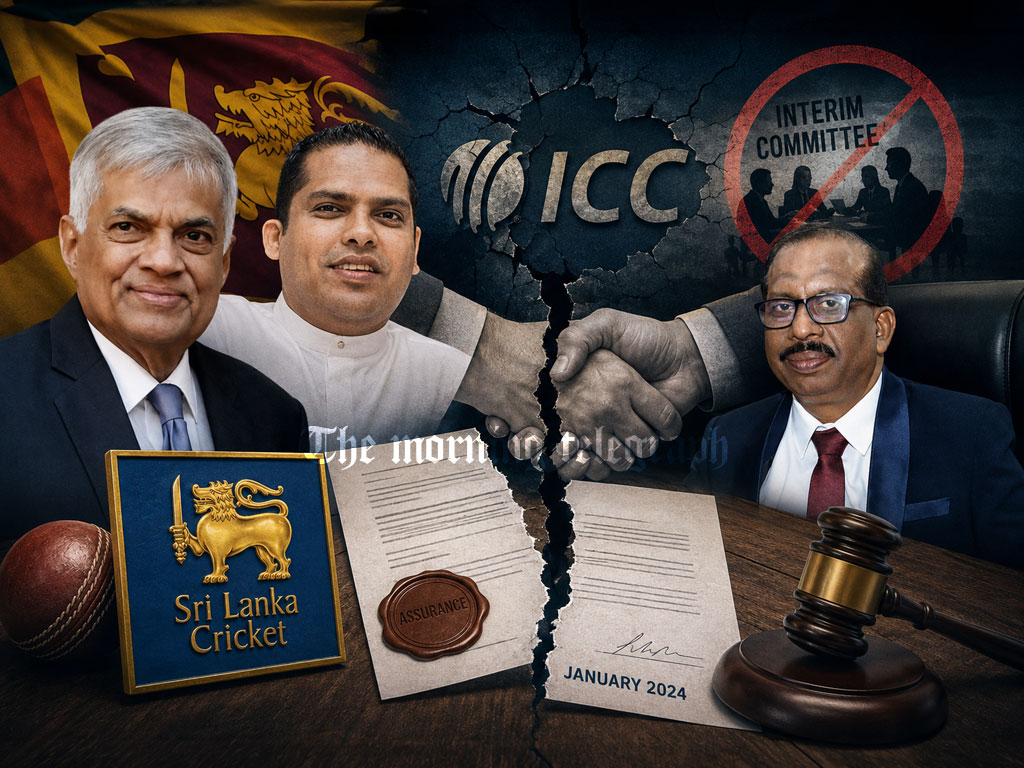
A dossier of email correspondence seen by The Morning Telegraph shows that the Government of Sri Lanka had given written assurances to the ICC that sports bodies, including Sri Lanka Cricket, would retain autonomy and that Interim Committees would not be entertained. The latest SLC suspension now raises the explosive question: has the current government broken a state-level promise made to world cricket?
Based on a dossier of email correspondence in the possession of The Morning Telegraph, exchanged between the then Government of Sri Lanka, the International Cricket Council, and Sri Lanka Cricket, this story is written in chronological sequence to examine one central question:
Has the Government of Sri Lanka broken the promise it previously gave the ICC before the earlier suspension of Sri Lanka Cricket was lifted?
This is no longer merely a question about which political regime was in power then, or which political regime is in power now.
The written assurance given to the ICC in January 2024 was not a private promise made by one individual politician. It was a commitment given on behalf of the Government of Sri Lanka at a time when Sri Lanka Cricket was under ICC suspension during the previous administration led by President Ranil Wickremesinghe and then Sports Minister Harin Fernando.

Therefore, regardless of the change in government, the present ruling National People’s Power government and its Minister of Sports now inherit the weight of that state-level undertaking.
That is why the decision by current Sports Minister Sunil Kumara Gamage to suspend Sri Lanka Cricket by Gazette and appoint a politician-led Cricket Transformation Committee has raised a far more serious issue than domestic cricket politics.
It has raised the question of whether Sri Lanka has broken the very assurances it gave the ICC that sports bodies would be allowed to function with autonomy, that ministerial interference would be removed, and that Interim Committees would be discouraged and not entertained.
If so, the damage may go beyond Sri Lanka Cricket.
It may have shaken the trust between Sri Lanka and the ICC.
November 2023: ICC Suspends Sri Lanka Cricket
In November 2023, the International Cricket Council suspended Sri Lanka Cricket after concerns were raised over political interference in the administration of the game.
That suspension placed Sri Lanka in an embarrassing position internationally and forced the Government of Sri Lanka, SLC, and the ICC into direct discussions over how cricket administration should be protected from political control.
What followed was not just a few diplomatic conversations. It became a trail of written assurances, official emails, reinstatement conditions, governance commitments, and constitutional correspondence.
Those documents now hang heavily over the events of 29 April 2026.
11 January 2024: Harin Fernando Gives Written Assurances to the ICC
On 11 January 2024, then Sports Minister Harin Fernando wrote to then ICC Chief Executive Geoff Allardice under the subject line “Assurance of GOSL’s Commitment Towards ICC and Its Members.”
In that email, Fernando stated that he was pleased with the meetings Allardice had held with him and with His Excellency the President of Sri Lanka.
He then gave several clear assurances on behalf of the Government of Sri Lanka.
Most importantly, Fernando assured the ICC that all sports bodies, including but not limited to Sri Lanka Cricket, would have the autonomy to operate within their own governance structures.
He also stated that the appointment of Interim Committees would be discouraged and would not be entertained by either himself as Minister or by the President.
The email further stated that the draft of the new Sports Law would be shared with the ICC for technical input once ready. Fernando also assured that the new Sports Act would take away the powers of the Minister and introduce an independent Sports Development Committee.
He further said the new law would remove personality-based directions and interference, and that the Government would only make observations on the draft SLC Constitution as an observer in support of good governance.
Fernando also assured that the Government would ensure through the Sports Law that the handling of finances of sports bodies would not be subject to Government interference.
Finally, he stated that the Government would assist SLC and the ICC with arrangements for matches and events, including visas, security, licences, and other related matters.
The purpose of the email was clear. Sri Lanka was seeking a favourable ICC decision to lift the provisional ban placed on Sri Lanka Cricket.
12 January 2024: ICC Acknowledges the Government’s Assurances
On 12 January 2024, Geoff Allardice replied to Harin Fernando.
In his response, Allardice thanked the Minister for his email, for the meeting held earlier that week, and for arranging the meeting with the President.
He stated that the discussions helped him understand the intentions of the Government of Sri Lanka regarding Sri Lanka Cricket, as well as the broader intention to create a good governance framework for all national sporting organisations through a revised Sports Law.
Most significantly, Allardice said he would convey the contents of Fernando’s email and their discussions to the ICC Board when it next convened to consider the suspension of SLC.
That response is important because it confirms that the ICC was not merely relying on verbal assurances. The Government’s written commitments were to be placed before the ICC Board.
17 January 2024: ICC Writes Directly to Shammi Silva
The next key development came on 17 January 2024, when Geoff Allardice wrote directly to then SLC President Shammi Silva under the subject “Suspension of Sri Lanka Cricket.”
Allardice referred to meetings held with SLC representatives, the Sports Minister, and the President regarding the suspension of SLC.
He explained that when the ICC Board agreed to suspend SLC in November 2023, it had asked ICC management to draft reinstatement conditions for the Board to consider.
Allardice then informed Silva that, after discussions with then ICC Chairman Greg Barclay, the ICC was prepared to ask the Board to reconsider SLC’s suspension before the March Board meeting.
However, SLC was asked to write to the ICC setting out its response to each reinstatement condition, including what steps had been taken or would be taken, and the timelines for those actions.
The urgency was clear. Allardice stated that if the ICC Board lifted the suspension by the end of January, the ICC Annual Conference 2024 could still be held in Colombo. Therefore, SLC’s response was needed by 24 January 2024, or sooner if possible.
This email proves that the lifting of the suspension was linked to governance assurances, reinstatement conditions, SLC’s written response, and ICC Board consideration.
5 February 2025: ICC Accepts SLC Constitutional Amendments
On 5 February 2025, Jonathan Hall, the ICC General Counsel and Company Secretary, wrote to then SLC CEO Ashley de Silva regarding amendments to the SLC Constitution.
Hall acknowledged that SLC had proactively revised its constitution to strengthen cricket governance in Sri Lanka.
He noted that the amendments had been duly passed by the SLC membership at an Extraordinary General Meeting held on 20 December.
Most importantly, Hall confirmed that nothing in the amendments was inconsistent with the requirements of SLC’s membership of the ICC.
He also welcomed the acknowledgement of ICC membership obligations under Article 2.4 of the ICC Constitution, including those relating to the autonomous management by SLC of its affairs.
This is crucial because SLC members had already participated in major constitutional reform, including changes to the election voting process that reduced the number of votes from 147 to 61.
29 April 2026: The Promise Comes Under Fire
Then came 29 April 2026.
On 29 April 2026, SLC President Shammi Silva and the entire Sri Lanka Cricket Executive Committee tendered their resignations, officially citing personal reasons. But that explanation now demands closer scrutiny. Were those resignations truly voluntary, or were they coaxed, pressured, or submitted under duress? The return of one of the resigned Executive Committee members, Samantha Dodanwela, barely weeks later to serve under the Cricket Transformation Committee as Director of the Lanka Premier League 2026 T20 Tournament, raises far more than a passing eyebrow. Why is he back so soon? Did he ever genuinely intend to leave? With ICC officials currently in Sri Lanka, they may now have to closely question and scrutinize the resigned SLC Executive Committee members to establish the real story behind the word “personal” used in their resignation letters.
Yet on the very same day, Sports Minister Sunil Kumara Gamage issued a Gazette notification suspending Sri Lanka Cricket and appointing a Cricket Transformation Committee headed by former Minister Eran Wickramaratne.
The Government avoided calling it an Interim Committee. But critics argue that changing the label does not change the substance.
If a Minister suspends Sri Lanka Cricket and appoints a politician-led committee to take over or transform the institution, then the move still carries the appearance of the very political intervention Sri Lanka had previously assured the ICC it would avoid.
The Unanswered Gazette Question
The Gazette reportedly relied on Section 32 of the Sports Law No. 25 of 1973.
But the Gazette is said not to specify the exact reason for suspending Sri Lanka Cricket.
That omission is not minor.
Section 32 permits the Minister to suspend or cancel the registration of a national sports association under specific circumstances, such as failure to remedy malpractice after written notice, inactivity, non-cooperation, obstruction of Ministry policy, or failure to carry out duties or functions.
But if the entire Executive Committee had already resigned, then the question becomes unavoidable:
On what exact ground was Sri Lanka Cricket suspended?
Conflict Questions Inside the Transformation Committee
The appointment of the Cricket Transformation Committee has also raised conflict-of-interest concerns.
Two of its current members, Sidath Wettimuny and lawyer Dinal Philips, are said to be part of a team that filed a case against Sri Lanka Cricket and the Ministry of Sports, a matter still before court.
That raises an obvious question:
How can individuals connected to litigation involving SLC and the Ministry now serve on a committee appointed by the same Minister, while also being involved with the very institution connected to the dispute?
At the very least, the optics are deeply uncomfortable.
SLC Members Reportedly Push Back
It is also reliably learnt that SLC members have collectively written to the ICC stating that they oppose any further changes to the SLC Constitution without their involvement.
This is significant because the ICC had already acknowledged that earlier constitutional amendments passed by the SLC membership were not inconsistent with ICC membership requirements.
Therefore, any further constitutional changes attempted by a Minister-appointed committee without member participation may trigger fresh governance concerns.
Final Word: A Broken Promise to the ICC?
The issue now goes far beyond Shammi Silva, Eran Wickramaratne, Sunil Kumara Gamage, or the Cricket Transformation Committee.
The bigger issue is whether the Government of Sri Lanka, irrespective of which political party controls it, has broken a written assurance previously given to the ICC.
In January 2024, Sri Lanka told the ICC that sports bodies would retain autonomy.
It said Interim Committees would be discouraged and not entertained.
It said ministerial powers would be removed.
It said personality-based interference would end.
It said the Government would only observe constitutional reforms, not control them.
Yet in April 2026, the Sports Minister suspended Sri Lanka Cricket and appointed a politician-led committee under a different name.
That is why the question now becomes unavoidable:
Did Sri Lanka merely change governments, or did it break the trust it once built with the ICC?
Until the current Government explains how its actions align with the written assurances previously given to world cricket, the controversy will continue to grow.
Because this is no longer only about cricket reform.
It is about whether Sri Lanka gave the ICC a promise, then broke it when political power changed hands.