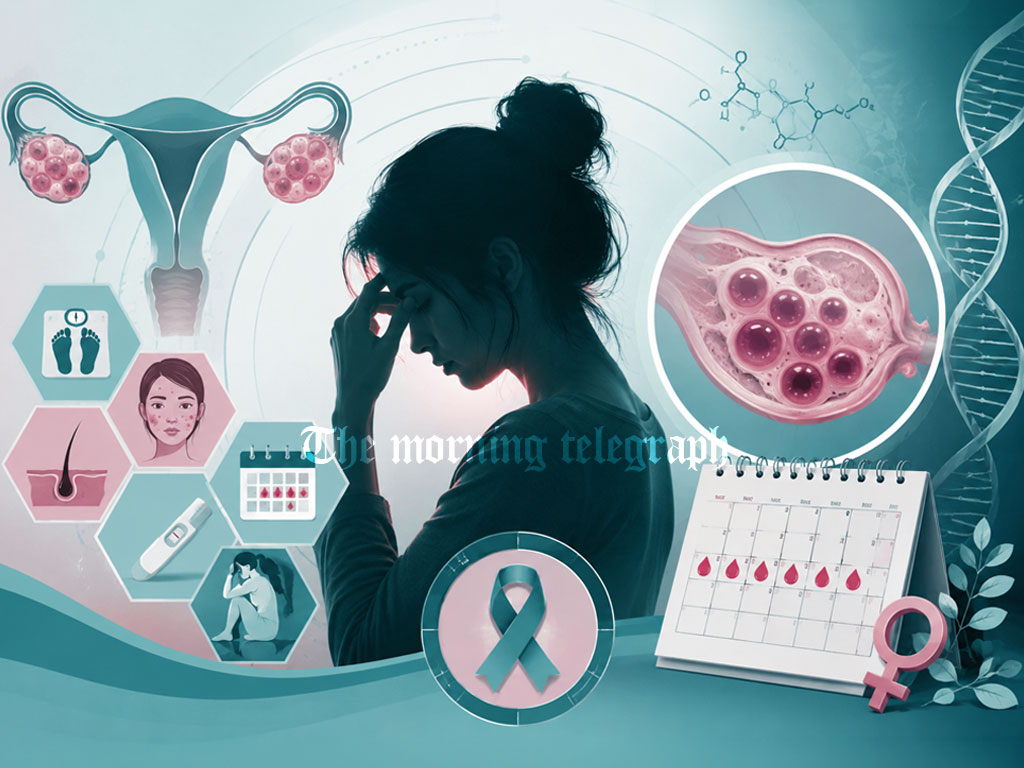
PCOS name change to PMOS aims to better explain a common hormonal and metabolic condition affecting 170 million women worldwide.
PCOS name change to PMOS has sparked fresh attention on a common but incurable hormonal condition affecting millions of women worldwide.
For many women, the condition begins with symptoms that are confusing, embarrassing, and often ignored until they become harder to manage.
“My hair started falling out abnormally. I also gained a lot of weight, about ten kilos more than my ideal weight for my height. I’m not someone who eats a lot. My periods also stopped for four months,” said a woman who asked to be identified as Venu, speaking to BBC Sinhala Service about her experience.
“After conducting the relevant tests, the doctors diagnosed me with Polycystic Ovary Syndrome. I had never heard of such a thing before. But I later learned that this is an extremely common condition among women that requires advice and treatment.”

What is Polycystic Ovary Syndrome?
Polycystic Ovary Syndrome, commonly known as PCOS, is a hormonal imbalance condition that occurs in women.
It is difficult to know the exact number of women who have PCOS. However, healthcare data suggests it is very common, with the condition seen in around seven out of every 100 women worldwide.
Although no proper calculation has been carried out in Sri Lanka, Consultant Obstetrician and Gynaecologist Dr. S. Sivasumithran said the condition can be seen in about one out of every five women.
PCOS can occur at any time from a girl’s first menstrual period to menopause.
However, more than half of women with the condition show no symptoms.
In this condition, the ovaries contain a large number of harmless small follicles, usually up to around 8mm or 0.3 inches in size.
Because of this, eggs do not mature properly, and ovulation does not take place correctly.
This condition is commonly described as cyst formation or swelling of the ovaries.
“The medical condition referred to in Western medicine as Polycystic Ovary Syndrome/Disease, or PCOS/PCOD, is a condition of non-maturation of eggs, and a specific name is not mentioned in Ayurvedic medical texts,” said Intern Ayurvedic Physician Keshanie Randima.
“Since this is a condition related to a woman’s menstrual cycle, the symptoms related to this condition are described under ‘Arthava Vyapath’ and ‘Arthava Kshaya’ in Ayurvedic medicine.”
“In Ayurveda, the word ‘Arthava’ represents the female seed, female humours, and the blood released during menstruation. Since changes occur in all three, female seed, female humours, and menstrual blood, in this condition, it is described under ‘Arthava Vyapath’,” the Ayurvedic physician further explained.
The three main features of PCOS
The first major feature is irregular periods or no periods at all.
This means eggs are not maturing properly and ovulation is not taking place correctly.
The second feature is increased androgens.
This means the body has high levels of “male” hormones, which may cause physical signs such as excessive hair growth on the face or body.
The third feature is polycystic ovaries.
This means the ovaries become enlarged and contain many fluid-filled follicles. However, this should not simply be described as cysts forming on the ovaries.
If a woman has at least two of these three main features, doctors may diagnose her with PCOS.
Other symptoms women may experience
Polycystic Ovary Syndrome can cause several symptoms in women.
These include thinning and loss of hair, weight gain, excessive hair growth on the face or body, acne, enlargement and darkening of the neck, emotional problems, anxiety, depression, difficulty getting pregnant, miscarriage, and a higher risk of developing Type 2 diabetes.
However, symptoms vary from person to person.
They can also change over time.
Dr. Sivasumithran said there are also PCOS patients who do not show any of these symptoms.
“I had to struggle a lot to have a child. The doctors told me I have Polycystic Ovary Syndrome. They explained that it’s not exactly infertility, but a condition where conceiving a child is a bit difficult,” said a 37-year-old woman from the Negombo area.
“I now have two children. My symptom is that I get a lot of pimples all over my body and face. I only passed a drop of blood during my periods. But the condition worsened a bit because I didn’t see a doctor until I was ready to have children,” she added.
What causes PCOS?
The exact cause of PCOS remains unknown.
However, it is often believed to be linked to hereditary genes. Many women with the condition are likely to have a mother, sister, or female relative with PCOS.
Abnormal hormone levels and high insulin levels are also connected to the condition.
Insulin is the hormone that controls blood sugar levels.
In many women with PCOS, the body becomes resistant to insulin. To overcome this, the body produces higher amounts of insulin.
This can increase the production and activity of hormones such as testosterone.
Being overweight or obese also increases the amount of insulin the body produces.
“In an obese person, fat is deposited in parts of the body, especially the abdomen. Then the body requires more insulin. When that insulin requirement increases, resistance to its action develops. Then the body starts producing even more insulin. This makes the body even larger,” Dr. Sivasumithran explained.
How can you know if you have PCOS?
A doctor will examine your body, medical history, and symptoms.
Blood tests and ultrasound scans may also be carried out.
“An ultrasound scan is a test with no complications. This test can be used to see the presence of immature, unruptured egg follicles in the ovaries. Sometimes the ovaries may be enlarged or appear as water-filled lumps.”
“We can mostly diagnose this condition using an ultrasound scan, but it’s difficult to reach a decision based solely on that. We have to look for other symptoms as well. A hormone test can also be done. Similarly, the disease can also be detected by conducting an insulin test due to the effect of the body’s insulin status,” Dr. Sivasumithran said.
Having a certain number of bubble-like lumps is not necessarily a problem.
However, having a higher number than expected for your age may create suspicion of the condition.
Can PCOS be cured?
PCOS cannot be cured.
However, it can be managed.
If you have the symptoms mentioned above, it is very important to seek medical advice.
Following a doctor’s advice can help manage the condition in several ways.
If you are overweight for your height, losing weight can reduce symptoms. Proper exercise and diet control are essential.
Irregular periods can be managed through hormonal birth control pills and other medications. But these should only be taken on a doctor’s prescription.
Excessive body hair can be managed through methods such as waxing, laser treatment, or other hair removal techniques. Medication may also help.
Severe acne can also be controlled with medication.
A healthy lifestyle and a balanced diet eaten at proper times are also important.
“I was diagnosed with Polycystic Ovary Syndrome when I was 18. I didn’t take any of the medication given at that time. Nor did I follow any health advice. Now I am 35. The disease has increased considerably, and I now have to face many health problems. I request everyone to be aware of this and maintain their health properly,” a Sri Lankan woman currently living abroad told BBC Sinhala Service.
Is PCOS the same as infertility?
Women with PCOS can have the same number of children as women without the condition.
However, doctors say they may need additional medical advice and treatment when trying to become pregnant.
This makes early diagnosis and proper treatment very important.
Explaining further, Intern Ayurvedic Physician Keshanie Randima said: “If this disease is neglected or not properly treated, one may face subfertility or infertility, gestational diabetes, abortions or premature childbirths, as well as many other diseases such as hypertension and heart diseases.”
What does Ayurveda recommend?
Ayurvedic Physician Keshanie Randima explained several recommendations to help prevent the non-maturation of eggs.
These include eating a balanced diet daily, adding more vegetables, leafy greens, and fruits to meals, maintaining a healthy weight through daily exercise, and drinking kola kenda, or herbal porridge, at least once a week.
She also recommended avoiding hot, sour, and “vidahi,” or inflammatory, foods as much as possible.
Examples include prawns, cuttlefish, oily fish, pineapple, and pickles.
She also advised consuming foods and drinks that cool the body, maintaining mental peace and wellness as much as possible, and limiting fast food and processed meats.
“In Ayurveda, which has a treatment system specific to each individual, there are successful treatments for this disease. These include gentle purification treatments, ‘Nasya’ treatment, ‘Vasti’ treatment, treatments to enhance digestive fire, medication to correct hormonal imbalances, administering medication internally to promote egg maturation, and external treatments,” the physician said.
Did you have these symptoms as a teenager?
If you had an irregular menstrual cycle or no menstruation, increased facial and body hair growth, weight gain, facial acne, or hair loss during adolescence, you may have had signs of PCOS without knowing it.
The World Health Organization says that although 10% to 13% of women of reproductive age worldwide have this condition, around 70% of affected women are unaware that they have it.
According to WHO, women with PCOS face a higher risk of developing several long-term health problems affecting both physical and emotional well-being compared to women without PCOS.
The term Polycystic Ovary Syndrome refers to the abnormal formation of small, fluid-filled, blister-like cysts in the ovaries.
However, a study published in The Lancet medical journal has proposed that this name is misleading, because this feature is not a primary characteristic of the condition, based on extensive research conducted to date.
The name change was announced on Tuesday, May 12, at the European Congress of Endocrinology in Prague, Czech Republic.
The study was led by experts including Professor Helena Teede of Monash University’s Monash Centre for Health Research and Implementation in Melbourne, Australia.
It was carried out in collaboration with the Global Name Change Consortium and supported by 56 medical and patient groups worldwide.
The proposed new name is Polyendocrine Metabolic Ovarian Syndrome, or PMOS.
Why was the name changed, and what does it mean for women? BBC Sinhala examined the issue.
A condition affecting 170 million women worldwide
According to the study published in The Lancet, PCOS affects more than 170 million women worldwide.
The study indicates that one in every eight women globally has the condition.
Another study published on the Oxford Academic website, used as a source, states that the global percentage of women with at least two internationally recognised PCOS diagnostic features is 12.1%.
It further states that Pakistan, Afghanistan, Middle Eastern countries, and the Eastern Mediterranean region, including Egypt and Libya, report the highest percentage, at 15.1%.
The study, published in January 2026, also states that the Southeast Asian region, including Sri Lanka, India, Nepal, and Thailand, reports the second-highest prevalence of PCOS at 14.3%.
The study also states that no data is available for the African region.
Why has PCOS been proposed to change to PMOS?
As mentioned earlier, the study published in The Lancet says the name Polycystic Ovary Syndrome does not accurately reflect the condition.
The World Health Organization also points out that some women with PCOS may not have the symptom of abnormal small blister-like cysts in their ovaries, but may still have other symptoms.
According to WHO, having at least two of the three main symptoms is enough to diagnose the condition.
The new study says this ambiguity in terminology can create misunderstandings among patients, doctors, policymakers, and the general public.
Researchers point out that PCOS affects the endocrine system, including hormones, metabolism, and many parts of the body, including reproductive health, mental health, and skin.
They believe the unclear nature of the current name leads to delays in diagnosis and makes communication between patients and healthcare professionals more difficult.
Another concern raised by the study is that many people may think the condition only affects fertility or childbearing.
As a result, women with PCOS may be judged unfairly over their ability to conceive.
In certain cultures, including South Asian societies, having children is considered very important for women.
In such contexts, women who are unable to bear children may face shame, pressure, and stigma.
Researchers argue that the ambiguity of the PCOS term may contribute to shame and stigma within communities.
They point out that for years, international medical guidelines, experts, and patient groups have requested a name change.
After worldwide surveys and workshops, a careful and detailed process led to the proposal that the name should be changed.
Agreement has been reached to use the words “polyendocrine,” “metabolic,” and “ovarian” in the new name.
This is intended to better describe how the condition affects multiple body systems, including hormones, metabolism, and the ovaries.
Accordingly, the word “cysts” has been removed from the name.
Why does the new name matter?
PMOS is not just a problem of the ovaries.
In this condition, several issues connected to the body’s endocrine system interact with one another.
The research team hopes the more descriptive name will improve global understanding of the condition.
The World Health Organization says this is a major global public health issue and one of the most common hormonal disorders affecting women.
As mentioned earlier, around 70% of affected women do not seek treatment due to lack of awareness.
According to WHO, women with this condition are at higher risk of developing gestational diabetes or hypertension during pregnancy, weight gain, Type 2 diabetes, hypertension, high cholesterol, cardiovascular diseases, obesity, sleep apnoea, metabolic liver disease, abnormal growths inside the uterus, and endometrial cancer.
Therefore, if you suspect you have symptoms related to PMOS, it is important to consult a qualified doctor immediately or visit the nearest hospital to confirm the condition.
Is there treatment?
The World Health Organization says there is no definitive cure for this condition.
However, available treatments can improve quality of life.
WHO’s official website states that early identification of symptoms and seeking treatment are important to protect women’s reproductive health, as well as their physical and mental well-being during and after their reproductive years.
Eating a healthy diet and adopting a healthy lifestyle are also important.
When will the name change happen?
The condition previously known as PCOS is expected to be renamed PMOS from 2028.
The name change will take place in several stages.
The process involves eight steps, including publishing research, developing resources, and carrying out global communication.
The transition from the old name to the new name is expected to happen gradually over about three years.
The international guidelines currently used by 195 countries are scheduled to be updated in 2028.
At that point, the new name PMOS is expected to replace PCOS.