
By Marlon Dale Ferreira
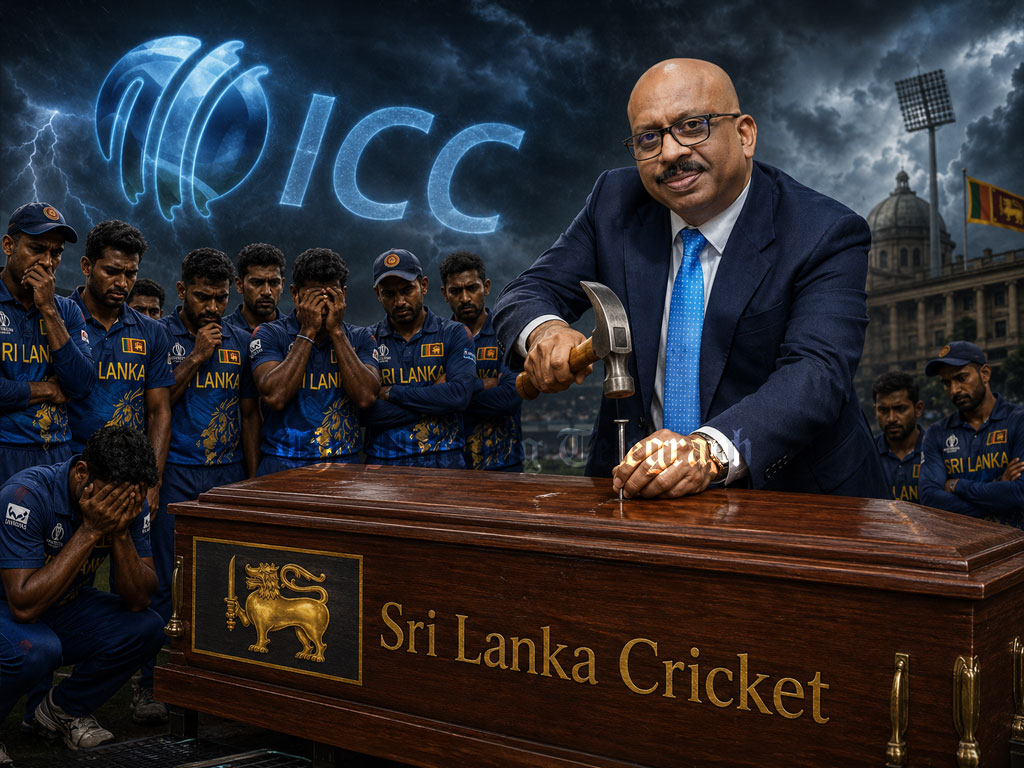
In what critics are calling blatant political interference, Sports Minister Sunil Kumara Gamage may have just driven the final nail into Sri Lanka Cricket’s suspension coffin by issuing a directive to alter SLC’s tournament structure, a matter many argue is not within his authority to impose. The Minister may have the power to amend or modernize the country’s outdated Sports Law governing all national sports associations, but he has no business interfering in the internal structure of one individual association. Any changes to SLC’s tournament framework, constitution, or member-approved governance structure must come through its own membership, not through a political directive from a Minister. That is why this latest move may have lit the ICC fuse once again, placing Sri Lanka Cricket dangerously close to the very political-interference trap that previously brought international shame and suspension.
The controversy surrounding Sri Lanka Cricket’s forced administrative shake-up has now taken a far more explosive turn.
Just as ICC officials were recently in Sri Lanka to discuss concerns surrounding the questionable interim-style setup created after the entire elected SLC Executive Committee resigned citing “personal reasons,” Sports Minister Sunil Kumara Gamage appears to have driven what critics may now call the final nail into Sri Lanka Cricket’s political-interference coffin.
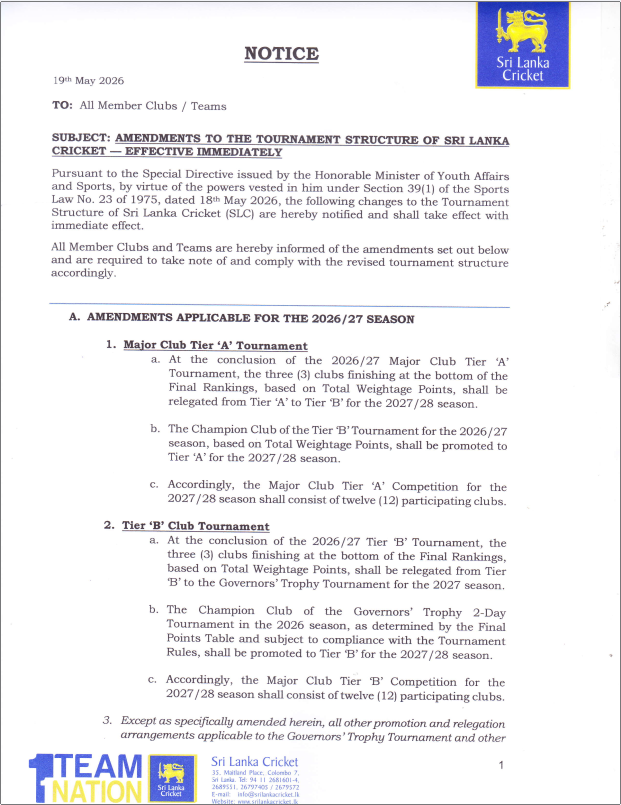
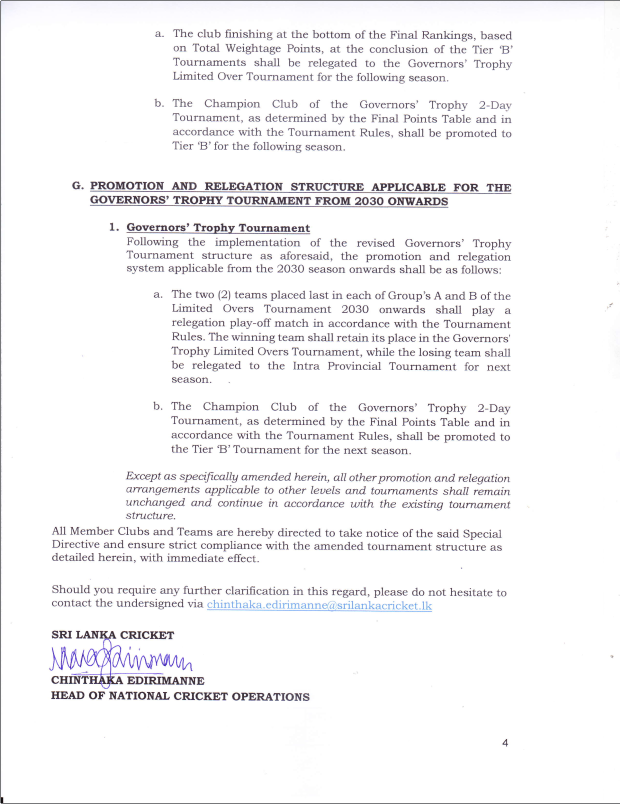
The latest storm erupted after Sri Lanka Cricket’s Head of National Cricket Operations, Chinthaka Edirimanne, sent an email to all SLC members on 19 May 2026 under the subject line “Amendments to the Tournament Structure of Sri Lanka Cricket — Effective Immediately.”
In that email, members were informed that the changes had been made “in accordance with the special directive issued by the Honorable Minister of Youth Affairs and Sports.”
That single line has now opened a dangerous question.
Since when does a Sports Minister decide Sri Lanka Cricket’s tournament structure?

Ministerial Directive or Political Interference?
According to the notice sent to all member clubs and teams, the amendments were issued pursuant to a Special Directive by the Minister, relying on powers said to be vested in him under Section 39(1) of the Sports Law No. 23 of 1975, dated 18 May 2026. The notice further stated that the revised structure would take effect immediately and that all member clubs and teams were required to comply.
That has triggered outrage among critics who argue that the Minister has no business interfering in SLC’s internal tournament structure.
The central argument is simple.
Sri Lanka Cricket is a member-based body. Any major change to its cricketing structure, especially tournament formats, promotion, relegation, and club participation, should be endorsed or approved through its own members and constitutional process.
Not by ministerial command.
Not by political directive.
Not by a government-appointed transformation committee.
The Timing Could Not Be Worse
The timing of the directive is what makes this matter even more explosive.
This comes after SLC President Shammi Silva and his entire Executive Committee resigned collectively on 29 April 2026, citing personal reasons.
However, many members of the public, cricket stakeholders, and political observers have continued to question whether those resignations were truly voluntary or whether they were obtained under pressure from the current government’s higher authorities.
That concern became even more serious when, on the same day as the resignations, the Sports Minister issued a Gazette suspending Sri Lanka Cricket and appointed a Cricket Transformation Committee.
Now, barely weeks later, the same Minister has issued a directive changing SLC’s tournament structure.
To critics, this looks less like reform and more like control.
The Tournament Changes Imposed
The directive sets out sweeping changes affecting the 2026/27 season, the 2027/28 season, and beyond.
For the 2026/27 Major Club Tier A Tournament, the three clubs finishing at the bottom of the final rankings, based on total weightage points, will be relegated from Tier A to Tier B for the 2027/28 season. The champion club of the Tier B Tournament for the 2026/27 season will be promoted to Tier A. As a result, the Major Club Tier A competition for the 2027/28 season will consist of 12 clubs.
For the Tier B Club Tournament, the three bottom clubs in the 2026/27 season will be relegated to the Governor’s Trophy Tournament, while the champion club of the Governor’s Trophy 2-Day Tournament in 2026 will be promoted to Tier B for the 2027/28 season.
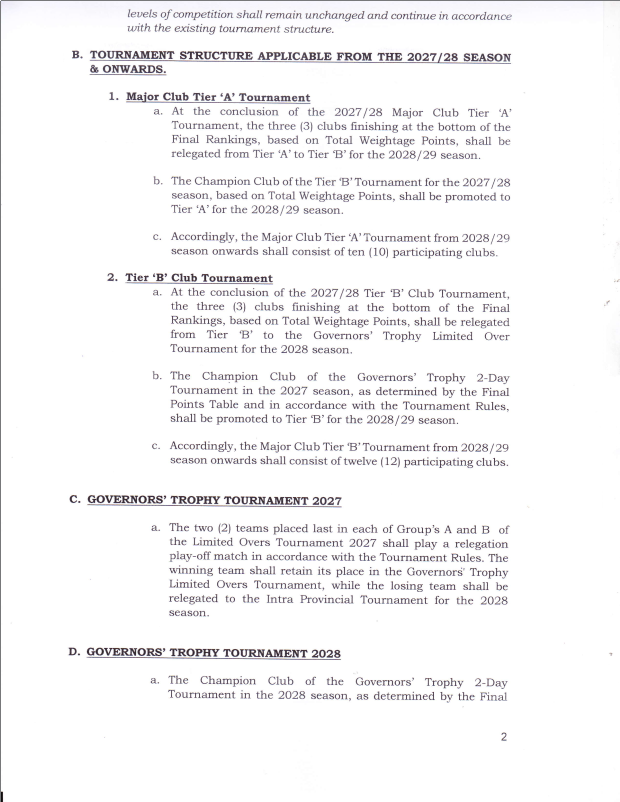
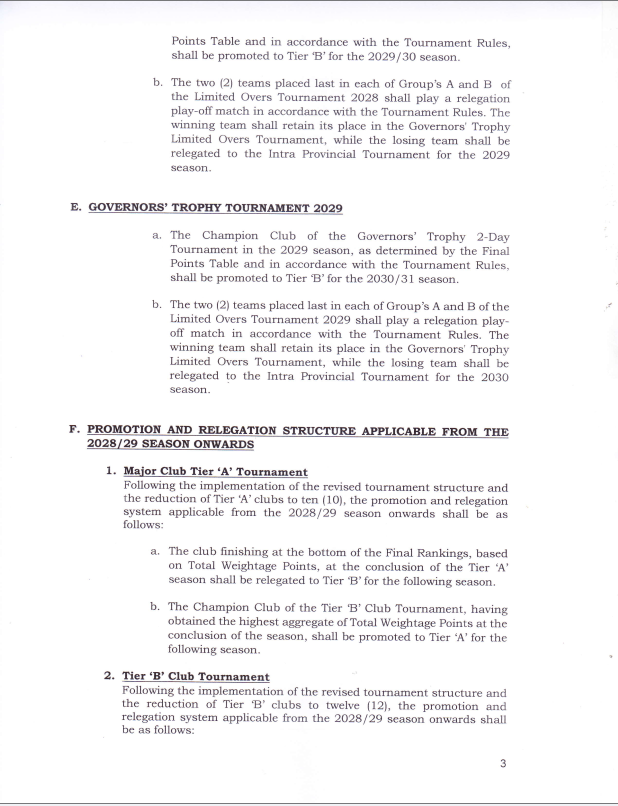
From the 2028/29 season onwards, the Major Club Tier A Tournament is to consist of 10 participating clubs, while Tier B will consist of 12 participating clubs.
The Governor’s Trophy structure is also altered, with relegation play-offs involving the bottom teams of Groups A and B in the Limited Overs Tournament, and movement between the Governor’s Trophy and Intra Provincial Tournament from 2027 onwards.
On paper, these may appear to be cricket-structure reforms.
But the explosive question is not whether the changes are good or bad.
The question is: who had the authority to make them?
Members Overruled?
The strongest criticism now being made is that the Minister has effectively overruled the decision-making rights of SLC’s own members.
If tournament restructuring is part of cricket governance, then SLC’s membership should be central to the process.
The Minister may have authority under the Sports Law to issue general directions across sports bodies. But critics argue that singling out SLC’s tournament structure through a special directive creates a dangerous precedent.
If a Minister can change cricket’s domestic structure today, what stops another Minister from changing team selection, election rules, club voting, or financial policy tomorrow?
That is why many now see this as more than administrative interference.
They see it as a direct assault on cricket autonomy.
The ICC Problem Returns
The International Cricket Council has repeatedly made clear that it will not tolerate political interference in cricket administration.
Sri Lanka already suffered an ICC suspension in November 2023 over governance and interference concerns. That suspension was lifted only after assurances were given to the ICC that sports bodies, including Sri Lanka Cricket, would be allowed to function with autonomy and that interim-style political interference would be discouraged.
Against that background, the latest ministerial directive could not have arrived at a more dangerous moment.
ICC officials had only recently been in Sri Lanka to discuss concerns relating to the current cricket setup.
Now, the Minister has issued a directive changing SLC’s tournament structure with immediate effect.
The question now practically writes itself:
Has the Minister handed the ICC fresh evidence of political interference?
A Bad Precedent for Every Sport
Critics are not arguing that Sri Lanka’s domestic cricket structure is perfect.
The issue is not whether reforms are needed.
The issue is whether a Minister can force those reforms on one national sports body while bypassing the body’s own members and internal constitutional mechanisms.
If the Sports Law is outdated, the Minister can seek to reform the law.
If governance needs improvement, the Minister can bring a fair, transparent, and uniform framework for all sports.
But using ministerial power to impose structural changes on SLC alone creates a bad precedent.
Cricket is not the only sport in Sri Lanka.
If this method is accepted today, it could be used tomorrow against any national association that falls out of political favour.
Sidath and Dinal Questions Resurface
The controversy also brings renewed attention to Sidath Wettimuny and lawyer Dinal Philips, both of whom are linked to ongoing discussions on cricket governance reform.
They have previously been quoted as supporting constitutional-style reforms similar to models used in countries such as Ireland and South Africa.
However, critics now point out that both men are also said to be connected to an existing legal case involving SLC and the Ministry of Sports.
That creates another uncomfortable question.
How were individuals linked to litigation involving SLC and the Ministry first brought into the National Sports Council, and now into the Minister’s Cricket Transformation Committee, while the case is still pending?
To critics, that is not merely bad optics.
It raises concerns over vested interests, conflict of interest, and whether reforms are being driven by independent governance principles or by individuals already positioned against the existing SLC structure.
From the Frying Pan Into the Fire
The appointment of figures connected to pending litigation was already controversial.
Now, with the Minister’s tournament directive being pushed through SLC’s own communication channels, the situation has moved from the frying pan into the fire.
Member clubs have now been told to comply with a structure that appears to have originated not from the membership, but from a ministerial directive.
That is the heart of the problem.
SLC’s members are the constitutional stakeholders of the institution.
They cannot be reduced to passive recipients of government orders.
The Question ICC Must Ask
If ICC officials are serious about protecting cricket autonomy, they may now have to ask a simple question:
Who made these tournament changes?
Was it Sri Lanka Cricket’s membership?
Was it an elected cricket administration?
Was it a properly constituted cricket committee operating under SLC’s constitution?
Or was it the Minister of Sports acting through a special directive?
The answer to that question may determine whether Sri Lanka has once again crossed the ICC’s red line.
Minister’s Directive Pushes SLC Into ICC Danger Zone
Minister Sunil Kumara Gamage’s directive may have been presented as tournament reform.
But to many in cricket circles, it looks like something far more dangerous.
It looks like a Minister changing the internal cricket structure of Sri Lanka Cricket after the elected Executive Committee resigned under a cloud of suspicion, after a politician-led transformation setup was installed, and after ICC officials had already shown concern over the direction of the game.
This is why critics say the Minister may have driven the final nail into the SLC coffin.
The issue is no longer only about Tier A, Tier B, Governor’s Trophy, promotion, or relegation.
It is about who controls cricket in Sri Lanka.
Is it the members of Sri Lanka Cricket?
Is it the ICC-recognized cricket body?
Or is it the Minister of Sports?
Until that question is answered, Sri Lanka Cricket remains trapped in the same dangerous territory that once triggered ICC punishment.
And this time, the evidence may have been delivered not in whispers, but in writing.

Where is the didirective minister has sent?