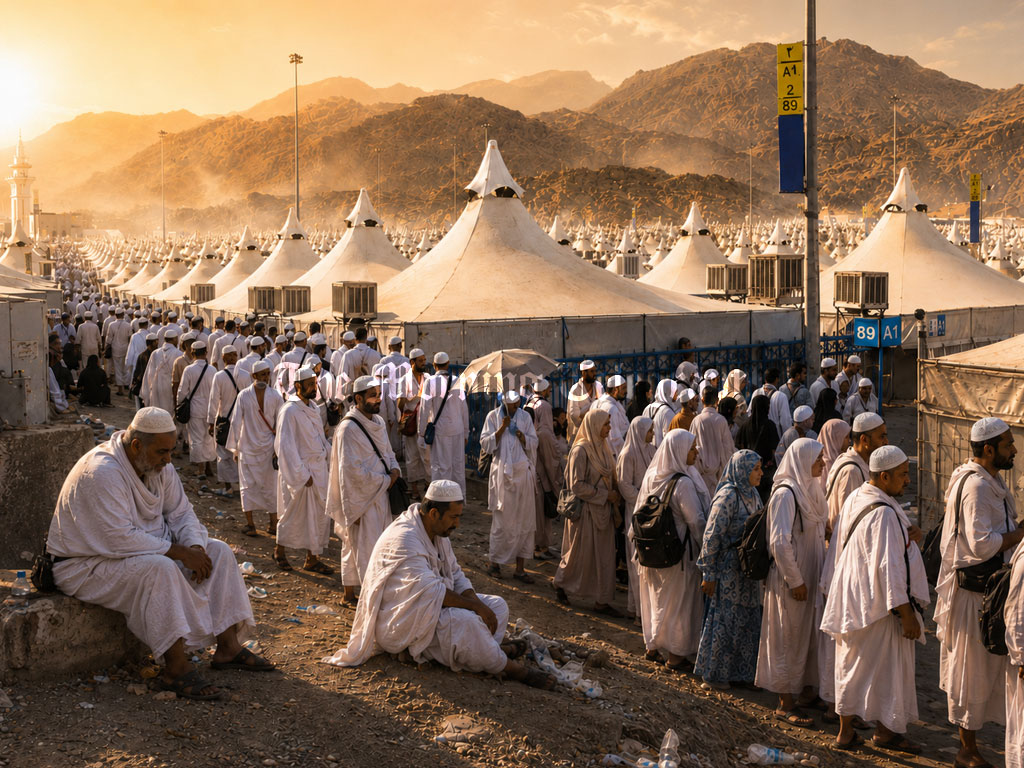
Mina Hajj crisis leaves 3,500 Sri Lankan pilgrims facing poor tents, limited toilets, weak food service, and calls for resignations.
The Mina Hajj crisis has left 3,500 Sri Lankan Muslim devotees facing severe hardship during what they expected to be one of the most sacred experiences of their lives.
Reports reveal that the pilgrims, who had hoped to spend four spiritually meaningful days in tents in the sacred land of Mina, instead faced a deeply disappointing and unpleasant ordeal this year.
Deprived of even basic human necessities and left helpless under extremely difficult conditions, the devotees are said to be suffering greatly.
The situation has exposed what critics describe as serious shortcomings and moral failures in the management systems of the responsible authorities.

At the centre of the crisis is the Sri Lanka Hajj Committee’s unilateral decision to assign responsibility for the arrangements to a travel company named Rehlat Wa Manafe, reportedly without consultation with experienced local travel agents.
Each pilgrim taking part in the journey had paid a substantial sum of Rs. 562,000, expecting top-tier “Category A” services and facilities.
However, according to the reports, the pilgrims were instead provided with lower-quality “Category C” tent facilities, worth less than half the amount they had paid.
This has led to accusations that the organizers seriously misled the pilgrims by delivering services far below the promised standard.
One of the most distressing aspects of the ordeal has been the sanitation crisis.
For the entire group of 3,500 pilgrims, only 32 toilets had reportedly been allocated, and those same units also had to be used for bathing.
This means there was only one toilet for every 100 pilgrims.
Even if one person used a toilet for just five minutes, an individual would get the opportunity to use a toilet only about twice a day.
As a result, elderly pilgrims and those suffering from medical conditions were forced to wait in long queues for hours under the scorching sun.
The food supply system is also reported to have failed badly.
For the entire exhausted group, only two buffet lines had been allocated, one for men and one for women.
Pilgrims returning from religious observances in the harsh desert climate were forced to stand in long queues for food, only to eventually receive meals that were reportedly of such poor quality that they were almost inedible.
What has caused deeper anger among the distressed pilgrims is the alleged arbitrary and hypocritical conduct of the authorities.
While ordinary pilgrims were reportedly fainting from extreme heat and hunger, members of the Hajj Committee are said to have refused even to visit the common tents to check on their well-being.
Instead, reports claim they remained in fully air-conditioned private VIP quarters, enjoying luxury services.
Critics argue that misusing funds meant for pilgrims’ welfare and subjecting them to such hardship on foreign soil could amount to both financial fraud and a violation of human rights.
As a result, strong public opinion has now emerged that all five members of the Sri Lanka Hajj Committee must take full responsibility for this failure and resign from their positions immediately.