Drug crisis trial reveals court testimony on MSD procedures, WR certificates, missing training, and alleged institutional failures.
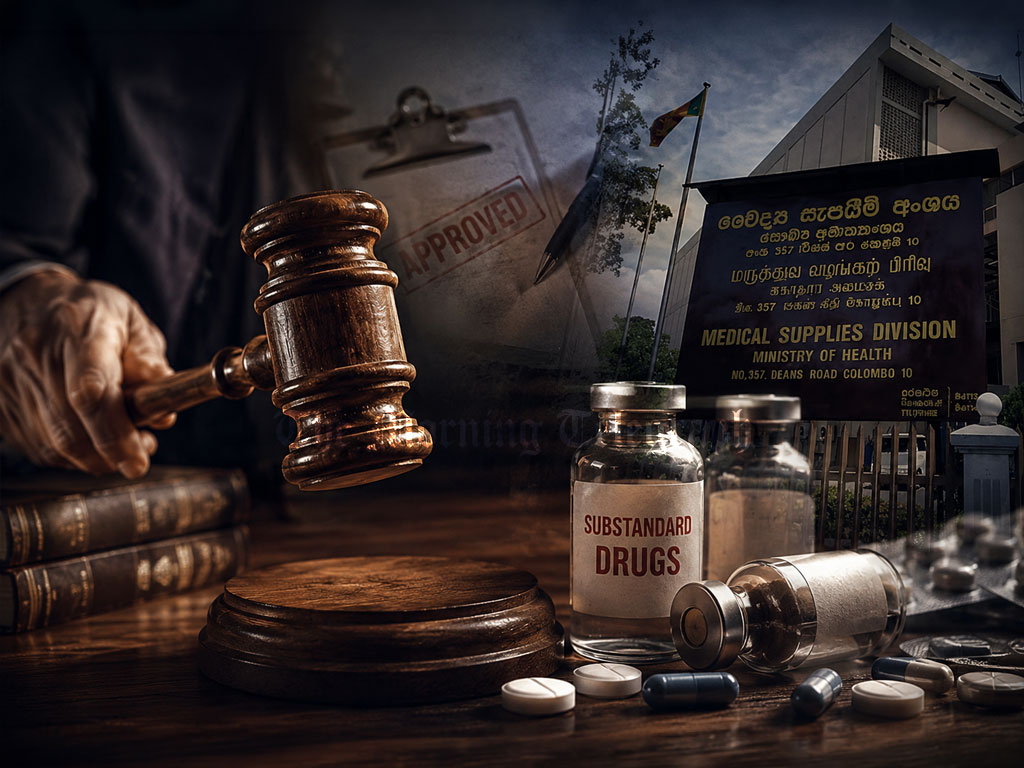
The drug crisis trial over the alleged importation of substandard medicines has exposed a deeper institutional tragedy inside Sri Lanka’s health system, with court testimony pointing to confusion, weak procedures, poor training, and serious gaps in accountability.
The case, which has triggered major controversy across the country’s health sector, is now being heard before a permanent three-judge High Court. However, the proceedings so far have shown that judgments delivered on social media and public platforms over sensitive incidents can look very different when tested inside an actual courtroom.
The testimony of H. M. D. N. Bandara, Chief Stores Controller of the Medical Supplies Division (MSD) of the Ministry of Health, who was called as a prosecution witness, and the cross-examination he faced, revealed that institutional weakness, irresponsibility, and inefficiency may have contributed heavily to the crisis.
The proceedings also suggested that if the institutional system had functioned actively, transparently, and systematically, and if the legal framework had been stronger, no external party would have been able to act outside established procedures.

Prosecution Questions Procedures And Missing Records
Under questioning by Deputy Solicitor General Lakmini Girihagama, the court examined how drugs were imported under a separate category within the Medical Supplies Division, bypassing the procedures of the State Pharmaceuticals Corporation.
Questions were also raised over whether officials properly checked the accuracy and validity period of Waiver of Registration certificates.
Deputy Solicitor General: “Where is the validity period of a WR certificate checked?”
Witness: “A date is mentioned as WR. We act accordingly.”
Deputy Solicitor General: “It states it is valid for twelve weeks from the date of issue of the relevant letter. What happens if it is delayed?”
Witness: “We can refuse to accept it.”
The questioning also exposed weaknesses in communication between the Stores Control Division and senior management.
Deputy Solicitor General: “Was everything that was put in SPC category also put in MSD category?”
Witness: “No.”
Deputy Solicitor General: “The 7th accused instructed to select according to SPC category or EO1.”
Witness: “Not everything was put in MSD category parallel to SPC category… I am still confused, Your Honour.”
Bench Steps In Over Witness Confusion
As the witness became distressed over contradictions between written instructions and what had been practically implemented, the judge intervened directly.
Judge: “Did you work according to letter 305?”
Witness: “I got confused, Your Honour, I acted according to the letter.”
Judge: “You are a Stores Control Officer, where did you get confused?”
Through this exchange, the court appeared to focus on the confusion surrounding responsibility, procedure, and accountability among officers holding critical positions in a state institution.
Defence Raises System Breakdown Argument
During cross-examination, defence lawyer Ashoka Serasinghe highlighted how mechanical and inefficient the entire process had become.
The court heard evidence regarding the limited ability of lower-level officers to change system data, as well as the role of officers who may have avoided responsibility.
Lawyer: “There is something called an order list. How is it prepared?”
Witness: “Based on information in the system.”
Lawyer: “Can you change them?”
Witness: “No. The file cannot be changed. We only have limited access.”
The defence also raised questions about the officer directly responsible for accepting the drug stock.
Lawyer: “As the Chief Stores Control Officer, who is the officer responsible for accepting this drug stock?”
Witness: “Kasturisinghe is responsible for this.”
Lawyer: “Where is he?”
Witness: “I don’t know his whereabouts… he did not report for duty.”
The court also heard troubling evidence about the lack of specific training given to officers.
Lawyer: “Is separate training given to new recruits regarding duties?”
Witness: “No, the relevant process is explained to them.”
Lawyer: “Does someone transferred from a hospital have experience regarding supply and distribution in your division?”
Witness: “Technically, no. It’s a different duty. They need to adapt. There is no specific training.”
No Written Policy On Buffer Stocks
Questions raised by lawyer Rahul Jayatilake, appearing for the ninth accused, further revealed that there were no written guidelines within the Ministry of Health on maintaining buffer stocks when importing medicines.
Lawyer: “Do you think it is not possible to maintain buffer stocks through emergency procurement due to various legal documents?”
Witness: “Emergency procurements are not to fill gaps. Regular orders and supplementary orders cannot be placed.”
Lawyer: “There is no written procedure for going into buffer stock methods, is there?”
Witness: “That is a decision that higher administration must take.”
Lawyer: “It is something carried forward as a custom, not something done by maintaining documents.”
Witness: “A method maintained without any problem in the health service.”
Lawyer: “Is it not in writing?”
Witness: “No.”
These exchanges indicate that decisions inside Sri Lanka’s health system have, over the years, often depended not on a formal written policy framework but on individual discretion, internal practice, and “custom.”
The most serious message emerging from this trial is that the doors of the state mechanism were left so open that external parties could enter. What is now being tested before the law is whether a stronger, more transparent, and accountable institutional system could have prevented such a tragedy, even during the pressures of a sudden economic crisis.
Court Record
2026/06/10
The Chief Stores Controller of the Medical Supplies Division of the Ministry of Health, H. M. D. N. Bandara, who was called by the prosecution to give evidence in the case concerning the importation of substandard drugs, was summoned for the fifth day yesterday (10). Testifying under the direction of Deputy Solicitor General Lakmini Girihagama on behalf of the prosecution, the Chief Stores Controller stated the following before the permanent three-judge High Court.
Deputy Solicitor General: As the Chief Stores Controller, do you accept drug stocks?
Witness: No, Your Honour.
Deputy Solicitor General: Who accepts the stocks?
Witness: The Stores Control Officer. Once he refers the recommendation to the Assistant Director, the Assistant Director accepts based on instructions. Alternatively, after the Assistant Director signs, it is forwarded to the relevant sections for further action.
Deputy Solicitor General: Why do you not go to accept the goods?
Witness: It is not assigned to me as a duty. That is why I do not participate.
Deputy Solicitor General: Is an order with no one assigned an active order?
Witness: The status of that order can be inquired and known from the State Pharmaceuticals Corporation.
Deputy Solicitor General: An order in Category ‘V’ on page 188 of P 291 has been placed for item 00 603 205 on September 24, 2022. Once such an order is released into the Pronto system, can it be removed?
Witness: No.
Deputy Solicitor General: Is it determined whether that order is active or not by asking and finding out from the State Pharmaceuticals Corporation?
Witness: Yes, Your Honour.
Deputy Solicitor General: Through which stages do they confirm that?
Witness: It can be confirmed through steps such as whether it has been procured, technical, whether letters of credit have been opened, etc.
Deputy Solicitor General: If not in such a stage, is it inactive?
Witness: Yes, Your Honour.
Deputy Solicitor General: For this confirmation, is it necessary to place the item under pending along with the relevant stock?
Witness: Yes, that can be obtained from the State Pharmaceuticals Corporation.
Deputy Solicitor General: You previously said that when you see a gap between the annual order and the supplementary order, you carry out emergency procurements to complete it. Please say whether the purchase order in P 310 was issued according to the order you identified.
Witness: Yes.
Deputy Solicitor General: It was issued on January 13, 2023.
Witness: Yes, Your Honour.
Deputy Solicitor General: You said that 2,500 should be supplied by January 23, 2023. It should have been completed by January 23.
Witness: Yes.
Deputy Solicitor General: According to P 309, when was the note entered that the supply of this item was received by the division?
Witness: On May 16.
Deputy Solicitor General: There is another note under the note in 309-1. To whom is ‘Reference above, priority, availability one month’ written?
Witness: By Dr. Kapila Wickramanayake.
Deputy Solicitor General: Is there an official seal on it?
Witness: Yes. There was confirmation that SPC ‘V’ orders are not received with the official seal of the Director’s office. Therefore, we were told to enter them under MSD Category ‘V’. It was the Assistant Director who came to the Stores Control Division and verbally stated this.
Deputy Solicitor General: How many drugs were entered under Category ‘V’?
Witness: 182.
Deputy Solicitor General: How many are in MSD Category ‘V’?
Witness: 158, Your Honour.
Deputy Solicitor General: Were all those entered under SPC Category ‘V’ also entered under MSD Category ‘V’?
Witness: No.
Deputy Solicitor General: Written instructions were given to place orders within three days. The ones instructed to be entered were entered.
Witness: The others were not instructed, Your Honour.
Deputy Solicitor General: You told the court that under letters 305 to 307, orders can be placed for suppliers selected under the E06 method.
Witness: When instructed to always enter SPC ‘V’, the 7th accused instructed to enter under MSD ‘V’. The 182 entered under SPC ‘V’ were not in MSD. When asked how MSD ‘V’ was entered for the new ones entered under SPC ‘V’, it was said that instructions were received. Orders were submitted parallel to SPC ‘V’ orders and in relation to the EO1 letter.
Judge: Did you work according to letter 305?
Witness: Yes.
Deputy Solicitor General: If so, where is it stated that ‘SPC V equals MSD V’?
Witness: I got confused, Your Honour.
Deputy Solicitor General: It is not notified in writing by letters 305 to 307.
Witness: I got confused. I acted according to the letter.
Deputy Solicitor General: The 7th accused instructed to select according to either SPC Category ‘V’ or EO1.
Witness: Not everything was entered under MSD ‘V’ parallel to SPC ‘V’. I am still confused, Your Honour.
Judge: You are a Stores Control Officer, aren’t you? Where did you get confused?
Deputy Solicitor General: The 7th accused instructed to enter parallel to SPC ‘V’. Or to enter parallel to EO1. That is why you said you entered EO1.
Witness: Yes, Your Honour.
Deputy Solicitor General: Page number 190 in document 134… What is this document?
Witness: A Waiver of Registration (WR).
Deputy Solicitor General: You said you receive photocopies. Did you accept them while under EO1 procurement?
Witness: Yes.
Deputy Solicitor General: Do you check whether the stock was supplied within the registration period?
Witness: We confirm whether the stock was imported within the registration period.
Deputy Solicitor General: Where is the validity period of a WR certificate checked?
Witness: A date is mentioned on the WR. We act accordingly.
Deputy Solicitor General: Where on that document 134?
Witness: At the bottom where it says MB.
Deputy Solicitor General: It states it is valid for twelve weeks from the date of issue of the relevant letter. What happens if it is delayed?
Witness: We can refuse to accept it.
Deputy Solicitor General: There is a document marked ‘229 E’ that you prepared. It was prepared on 2022/09/24. Did you include items with less than one month of stock in the priority list on that day?
Witness: Those are priority 1 and 2 items on the priority list on those respective days.
Deputy Solicitor General: Is the list prepared on September 22, 2022, similar to the 182 items in P 260?
Witness: There are three items under priorities and categories in the stock lists as well.
Deputy Solicitor General: Can you identify pages 20–28 in document E 61?
Witness: Yes. These documents are reported weekly to the Presidential Secretariat and the Ministry of Health via telephone calls. Emails are also sent.
Deputy Solicitor General: Does the Pronto system also do this?
Witness: The report is downloaded, copied and pasted into Excel, and the estimate details are obtained. They are added to the stock list of 387.
Deputy Solicitor General: That is a list prepared for three months.
Witness: Yes, Your Honour. Those are MSD items with less than three months.
Deputy Solicitor General: I am asking whether attention was paid to whether procurement has taken place for the items in the list of less than three months, from 301 to 317, by October 24.
Witness: The items were considered, but not in that manner.
Deputy Solicitor General: Was such a list prepared on an unconfirmed basis as well?
Witness: Yes.
Deputy Solicitor General: Every drug on the priority list has an SR number. Can you see 317 drugs?
Witness: Yes.
The examination-in-chief was concluded, and Lawyer Ashoka Serasinghe, appearing for the 5th accused, began cross-examination.
Lawyer: Have duty lists been given to Stores Control Officers as pharmacists?
Witness: Yes, Your Honour.
Lawyer: (Shows a duty list) You identified the 5th accused. Is this list relevant to him?
Witness: Yes, Your Honour.
Lawyer: Did he handle procurement matters?
Witness: Yes, Your Honour.
Lawyer: Does the SPC handle procurement matters?
Witness: Yes, Your Honour.
Lawyer: As a Stores Controller, can you make decisions alone when issues arise regarding the receipt of goods?
Witness: In such situations, the problem is referred to senior officers.
Lawyer: In duty list 5 V 1, is attention paid to analyzing WR documents?
Witness: No.
Lawyer: In document 5 V 2, does it mention the WR documents given to Stores Control Officers through another circular?
Witness: It says that it should be mentioned when activating an item.
Lawyer: Is there a responsibility for Stores Control Officers to check the WR certificate?
Witness: Those instructions were not given before.
Lawyer: Why were such instructions not given specifically?
Witness: It says to check.
Lawyer: Do you check the accuracy when accepting goods?
Witness: There is nothing to check the accuracy.
Lawyer: You know about this case, don’t you?
Witness: Yes, two drugs: Human Immunoglobulin and Rituximab.
Lawyer: Are most of the accused in the case officers and employees who worked with you?
Witness: Yes, Your Honour.
Lawyer: Was a workshop held for Stores Control Officers regarding NMRA technical documents?
Witness: Yes, it was held in 2023.
Lawyer: Why was it held?
Witness: To teach us how to examine a WR.
Lawyer: The workshop was held in 2023. Do you not remember the date?
Witness: A letter came instructing me to attend that workshop.
Lawyer: There is an attendance record. You attended as well, and your name is listed under number 22.
Witness: Yes, Your Honour.
Lawyer: Is the 5th accused’s name also among the attendees of the workshop listed in document 5 V 3?
Witness: Yes.
Lawyer: Has he signed indicating he attended?
Witness: He has signed under number 29.
Lawyer: Now, do you have an understanding about WR?
Witness: We were given that understanding.
Lawyer: Is document 134 a WR document?
Witness: Yes, a WR document.
Lawyer: From NMRA, to whom is it addressed?
Witness: It is addressed from NMRA to the Controller of Imports and Exports.
Lawyer: Document 134 is issued to a private institution. To whom is this issued?
Witness: Isolese Bio Pharma.
Lawyer: To whom is the original given?
Witness: To the relevant supplier.
Lawyer: Does the supplier give it to the Controller of Imports and Exports?
Witness: Yes.
Lawyer: After the goods are cleared by Customs, what is given to the permit?
Witness: After clearance, the permit is given to the institution by the company.
Lawyer: When did the MSD Category ‘V’ come in place of SPC Category ‘V’?
Witness: It came during a special occasion.
Lawyer: When was that?
Witness: Around the end of September 2022.
Lawyer: Why did it come?
Witness: It came as a decision taken at meetings held during that period.
Lawyer: Was there a special situation in the country at that time?
Witness: There was an economic problem when the Indian Credit Line Scheme arrived. Accordingly, MSD Category ‘V’ came. Here, that process was done under the ICL. Initially, for ICL, there was something called ‘X’. Later, MSD ‘V’ was introduced as a specific method.
Lawyer: Who is the authority for procurement?
Witness: We were informed that it was the State Ministry.
Lawyer: That was abolished, wasn’t it? Were goods still imported through Category ‘V’?
Witness: I think through the Ministry of Health.
Lawyer: As the Chief Stores Controller, are you saying you don’t know?
Witness: Yes, I don’t know.
Lawyer: Are you not stakeholders here, bringing goods from suppliers through the MSD? From where are they procured?
Witness: We place the order for the required items. Other than that, we do not intervene.
Lawyer: Once the procured goods arrive, which officer handles the duties?
Witness: The Stores Control Officer.
Lawyer: Before a procurement is made, a list of goods is prepared after consulting you. The information for that is obtained from the Stores Control Officer, isn’t it?
Witness: Yes, Your Honour.
Lawyer: (Shows document P 308) This is the basic information about the item given by the Stores Control Officer.
Witness: Yes, Your Honour.
Lawyer: There is a document called P 299. There is a letter that caused the release of the relevant goods.
Witness: Yes.
Lawyer: Under P 360, all information has been informed to senior officers by the Stores Control Officer. How does he do that?
Witness: Through the computer system.
Lawyer: There is something called an order list. How is it prepared?
Witness: Based on information in the system.
Lawyer: Can you change them?
Witness: No. The file cannot be changed. We only have limited access.
Lawyer: An order list is submitted through P 291. What are they?
Witness: Human Immunoglobulin.
Lawyer: Look at P 309. Is this a document given after you receive the goods stock?
Witness: It is the document submitted after the goods are received.
Lawyer: The file comes first. The pharmacist examines the file and makes a decision. Is this that document?
Witness: Yes, Your Honour. If found satisfactory during examination, it can be forwarded upwards.
Lawyer: Can the Stores Control Officer not accept it without that?
Witness: Only after the Assistant Director signs does it become a suitable stock.
Lawyer: The information in note 309 has been counted. In one place it says ‘delivery date has been expired’.
Witness: Delays in the order date are mentioned. If an expiry date occurs, it is informed to higher authorities. Thereafter, action is taken based on the decisions from senior officers.
Lawyer: Do senior officers give orders? When data held on the computer screen is being recorded, couldn’t this be a human error?
Witness: Only that person would know that.
Lawyer: Is there some error in this procedure?
Witness: The procedure has not been disrupted. Only the number has changed.
Lawyer: When this wrong number went to senior officers, senior officers can also log into the computer system and check.
Witness: This is Rituximab.
Lawyer: As the Chief Stores Control Officer, who is the officer responsible for accepting this drug stock?
Witness: Kasturisinghe is responsible for this.
Lawyer: Who are the officers responsible for accepting this stock as Stores Control Officers? Is the 5th accused involved in this?
Witness: Kasturisinghe is responsible for this.
Lawyer: Where is he?
Witness: I don’t know his whereabouts.
Lawyer: Did he resign?
Witness: He did not report for duty.
Lawyer: How many years have you worked in the Medical Supplies Division?
Witness: Three or four.
Lawyer: The CID questioned several people from the Medical Supplies Unit. Was Kasturisinghe also questioned?
Witness: He might not even be in Sri Lanka.
Lawyer: Rituximab is one of the two drugs in question. Do you know the loss caused by it?
Witness: I don’t remember.
Lawyer: There has been an irregularity in your division. Can you roughly say how much the loss is?
Witness: I do not know numerically.
Lawyer: Which of these two drugs is more expensive?
Witness: Rituximab is cheaper.
Lawyer: How many vials of Human Immunoglobulin related to this case have been delivered?
Witness: 3,000.
Lawyer: How much Rituximab was delivered?
Witness: Around 2,000.
Lawyer: Are you not aware of the loss that occurred?
Witness: I cannot enter the information.
Lawyer: Who enters the information?
Witness: The store clerk.
Lawyer: Is the data uploaded not through your knowledge?
Witness: No, Your Honour. Stock statuses are uploaded through the GRN, not through me. However, I can view it.
Lawyer: You believe Pronto is correct. A compact disc has also been prepared instead of laboratory data.
Witness: A document has been prepared by combining past data. I am not involved in that.
Lawyer: As answers to questions, you will say that data does not exist.
Witness: No, Your Honour. I looked at that data and did an analysis.
Lawyer: You trust Pronto. P 20 7 is a report prepared by the Government Analyst.
Witness: That is something he submitted to court. It has been prepared based on computer data.
Lawyer: What you did was analyze what you saw. The national stock system is the MSD. Is it maintained continuously in numerical terms? I suggest that it is a combination of hospital data and MSD data.
Witness: The computer system should be observed.
Lawyer: Do you have confirmation regarding the MSD stock status?
Witness: Yes, Your Honour.
Lawyer: You have no personal confirmation about external places.
Witness: It is one that exists within the computer system.
Lawyer: Earlier you said it was a report prepared by the Government Analyst’s Department.
Witness: I submitted it to court. I do not know its correctness.
Lawyer: You answered questions regarding that data.
Witness: Yes, Your Honour.
Lawyer: When the expiry of a stock is raised as a suspicion, it is not visible within this target.
Witness: Yes, it does not show that numerically.
Lawyer: Did you only see the remaining numbers?
Witness: Yes, Your Honour.
Lawyer: Even if stock exists, the usable ones for the drug should be examined separately, shouldn’t they?
Witness: They were not separated like that.
Lawyer: Pharmacists from various places come to your position.
Witness: Yes, Your Honour.
Lawyer: Is separate training given to new recruits regarding duties?
Witness: No, the relevant process is explained.
Lawyer: Is there no such thing as a training period?
Witness: Not specifically.
Lawyer: Does someone transferred from a hospital have experience regarding supply and distribution in your division?
Witness: Technically, no, Your Honour. It is a different duty. They need to adapt. There is no specific training.
Lawyer: NMRA documents are technical documents. A workshop was held to train on that. However, do new Stores Control Officers who join get knowledge about NMRA documents?
Witness: They learn from others according to existing knowledge.
Lawyer: Is the relevant Stores Controller or Assistant Director present to refer for Rituximab?
Witness: Mr. Wanniarachchi.
Lawyer: Stores Control Officers cannot make a decision about the supplier, can they?
Witness: Yes, Your Honour.
Lawyer Rahul Jayatilake, appearing for the 9th accused, begins questioning.
Lawyer: (Shows document P 229 E III from file P 143)
Witness: I prepared this priority list.
Lawyer: Was it emailed to the 10th accused?
Witness: Yes, Your Honour.
Lawyer: Was it by order of a senior officer?
Witness: Yes, Your Honour.
Lawyer: Do you think it is not possible to maintain buffer stocks through emergency procurement due to various legal documents?
Witness: Emergency procurements are not to fill gaps. Regular orders and supplementary orders cannot be placed.
Lawyer: Is this something that is in the guidelines?
Witness: It is not written like that.
Lawyer: There is no written procedure for going into buffer stock methods, is there?
Witness: That is a decision that higher administration must take.
Lawyer: It is something carried forward as a custom, not something done by maintaining documents?
Witness: A method maintained without any problem in the health service.
Lawyer: Is it not in writing?
Witness: No.
Lawyer: Do you have the authority to create such a method?
Witness: Yes, I can explain that.