
By Marlon Dale Ferreira
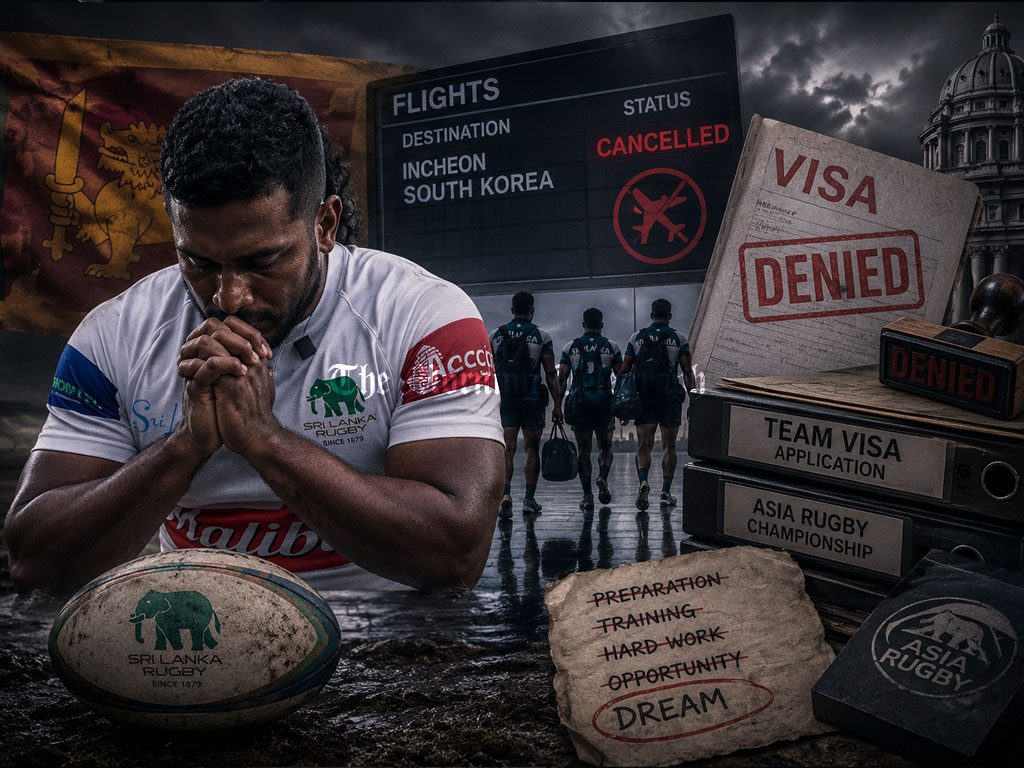
Sri Lanka Rugby captain Lasindu Karunathilka did not need to shout to expose the scale of the disaster. His words carried enough pain.
After Sri Lanka’s final Asia Rugby Championship fixture against South Korea was cancelled because the national team failed to secure travel visas in time, Lasindu posted an emotional message that cut deeper than any official statement. It was not the language of politics. It was not the language of excuses. It was the voice of a captain forced to watch a historic opportunity die before his team even reached the airport.
For Sri Lanka’s Tuskers, this was not just another match lost on paper. This was a chance to beat South Korea, claim second place in Asia, and prove that the one-point defeat to Hong Kong China in Colombo was not a lucky performance, but a sign of a team rising again.
Instead, the country was handed a 20-0 defeat without a ball being kicked.

A Captain Left Carrying the Pain
Lasindu wrote with a “heavy heart and profound sadness,” saying he felt a deep personal weight as captain.
That single sentence should shame every official who had anything to do with this fiasco.
The players had trained, sacrificed, endured pain, fought through work commitments, education demands, club politics, and the uncertainty that surrounds Sri Lankan rugby. Many of them were not salaried XVs professionals. They were men giving their bodies for the jersey while administrators sat in offices supposedly handling the basics.
A visa is not a tactical puzzle. It is not a line-out strategy. It is not an injury crisis. It is basic administration.
Yet that basic duty was bungled so badly that a national team was denied the right to compete.
Dreams Shattered Before Kick-Off
The cruelest part of this disgrace is that the damage was not limited to rankings, points, or tournament tables.
For some players, this may have been their first opportunity to represent Sri Lanka in a major international fixture. For others, it may have been one of the last chances to pull on the national jersey in a meaningful Asian contest. Those moments cannot be replayed. Those dreams cannot be rescheduled like a committee meeting.
Lasindu’s message captured that heartbreak clearly.
He said the squad had shown its potential by pushing defending champions Hong Kong China to the absolute limit, losing 15-14 in Colombo. He described the team as young, united, and free of politics, agendas, or divisions.
That is what makes this scandal even more painful.
The players had done their part.
The coaches had done their part.
The fans had believed.
The administrators failed.
SLR’s Statement Cannot Wash Away the Shame
Sri Lanka Rugby later attempted to explain the disaster by referring to operational and administrative issues during the final stages of squad preparations.
According to the official explanation, the separation of the Men’s Sevens and Men’s Fifteens programmes led to additional player selections and a revised squad list, which then caused delays in approvals and visa processing.
That explanation may describe what happened.
It does not excuse it.
In fact, it makes the matter worse.
If squad changes, internal approvals, and visa processing cannot be managed for a scheduled international fixture, then what exactly is the point of having a national rugby administration?
This was not a surprise birthday party. This was an Asia Rugby Championship match. The date, venue, country, travel requirement, and competition calendar were known well in advance.
South Korea Won Without Playing
Asia Rugby confirmed that the match scheduled for the Namdong Asiad Rugby Stadium in Incheon could not proceed because Sri Lanka was unable to obtain the necessary travel visas in time.
South Korea was awarded four competition points, with the result recorded as a 20-0 victory.
That scoreline will sit in the official record books, but it will never tell the full story.
It will not show the sweat poured into training.
It will not show the young players who dreamed of making history.
It will not show the captain’s grief.
It will not show the fans who had waited to see whether Sri Lanka could finally turn promise into a major Asian statement.
It will simply say: South Korea 20, Sri Lanka 0.
That is the brutal administrative tombstone left behind by this failure.
Asia Rugby’s Role Also Deserves Scrutiny
Asia Rugby may have acted within competition regulations, but its public handling of the aftermath raises uncomfortable questions.
At a moment when Sri Lankan players were grieving a lost opportunity, Asia Rugby President Qais Al Dhalai posted praise for Sri Lanka Rugby President Pavithra Fernando and his team, highlighting their work across governance, development, competitions, women’s rugby, and regional engagement.
The timing was extraordinary.
While Lasindu was speaking from heartbreak, the regional rugby leadership appeared to be exchanging compliments with the very administration under whose watch Sri Lanka had just suffered one of its most embarrassing international rugby moments.
That is not leadership.
That is tone-deaf diplomacy.
Asia Rugby should be asking hard questions about how one of its member unions failed to get a national team to a championship fixture. It should be demanding an independent explanation, not offering warm public praise while the players are left to carry the humiliation.
Pavithra and Hassan Cannot Pretend Nothing Happened
Sri Lanka Rugby President Pavithra Fernando and CEO Hassan Sinhawansa cannot hide behind soft statements, technical excuses, or ceremonial language.
This happened under their watch.
Critics are right to ask whether heads should roll.
In serious sporting nations, a national team forfeiting an international fixture because of visa failures would trigger resignations, inquiries, suspensions, or at the very least a transparent public accountability process.
In Sri Lanka, officials too often survive by issuing statements, blaming process failures, and waiting for public anger to fade.
That cannot happen this time.
This was not a small clerical mistake.
This was a national disgrace.
The Players Deserved Better
Lasindu’s tribute to his teammates and coaches revealed what Sri Lanka Rugby should have protected.
He spoke of coaches who poured their hearts and endless hours into the team. He spoke of players who turned up despite massive personal challenges. He spoke of a squad united across clubs and backgrounds, without politics or divisions.
That is the Sri Lanka Rugby the public wants to see.
Not committees fighting for control.
Not officials posing for photographs.
Not administrators celebrating governance while players are denied visas.
Not regional bosses praising office-bearers while a national captain apologises to fans for something that was outside the team’s control.
The Jersey Was Betrayed Off the Field
This disaster should hurt every rugby supporter because it tells a familiar story.
Sri Lankan players are expected to sacrifice like professionals while being supported by systems that operate like amateurs.
They are asked to train, bleed, and compete against better-funded nations while their own officials cannot complete the basic administrative work needed to put them on a plane.
Lasindu and his team were not beaten by South Korea.
They were beaten by incompetence.
They were beaten by delay.
They were beaten by administrative failure.
They were beaten by a rugby system that continues to wound the very players it claims to serve.
A National Apology Is Not Enough
Sri Lanka Rugby owes the players, coaches, families, fans, and the country more than an apology.
It owes them the full truth.
Who was responsible for the visa process?
When were the applications submitted?
Were deadlines missed?
Were squad changes handled properly?
Did the Ministry of Sports delay approvals?
Who signed off on the final travel plan?
Why was the crisis not escalated earlier?
And most importantly, who will take responsibility?
Until those answers are given, every statement from Sri Lanka Rugby will sound like another attempt to manage the embarrassment rather than confront the failure.
Lasindu’s Words Must Not Be Buried
Lasindu Karunathilka ended his message by saying his pride in the team remains unshaken.
That pride is justified.
The shame belongs elsewhere.
It belongs to the officials who failed to protect the players’ opportunity. It belongs to those who allowed a national team to be reduced to a walkover result. It belongs to those who continue to cling to office while the players carry the emotional cost of their incompetence.
Sri Lanka did not lose 20-0 in Incheon.
Sri Lanka lost in boardrooms, approval chains, email threads, and visa desks long before kick-off.
And if Sri Lanka Rugby and Asia Rugby think this can be buried under statements, social media praise, and administrative language, they have badly misread the moment.
Lasindu’s post has already said what the official statements refused to say.
The players gave everything.
The system failed them.

Very well summed up Marlon. The buck stops with the incompetent administration.
As you rightly pointed out, they had plenty of notice to finalise travel plans. No matter what they claim was section issues between two programs.
It is heartbreaking for the team who poured their all into the preparation.
Sri Lanka Rugby stand guilty of incompetence and negligence to the young men who trained hard to bring their country pride.
Hope the people responsible have the balls to admit they were wrong and not hide behind laughable excuses.