by Roy Denish
A routine U.S. Air Force test mission ended in tragedy when a B-52 Stratofortress crashed moments after takeoff, killing all eight people on board. The devastating disaster has triggered a major military investigation into one of the deadliest bomber accidents in recent years.
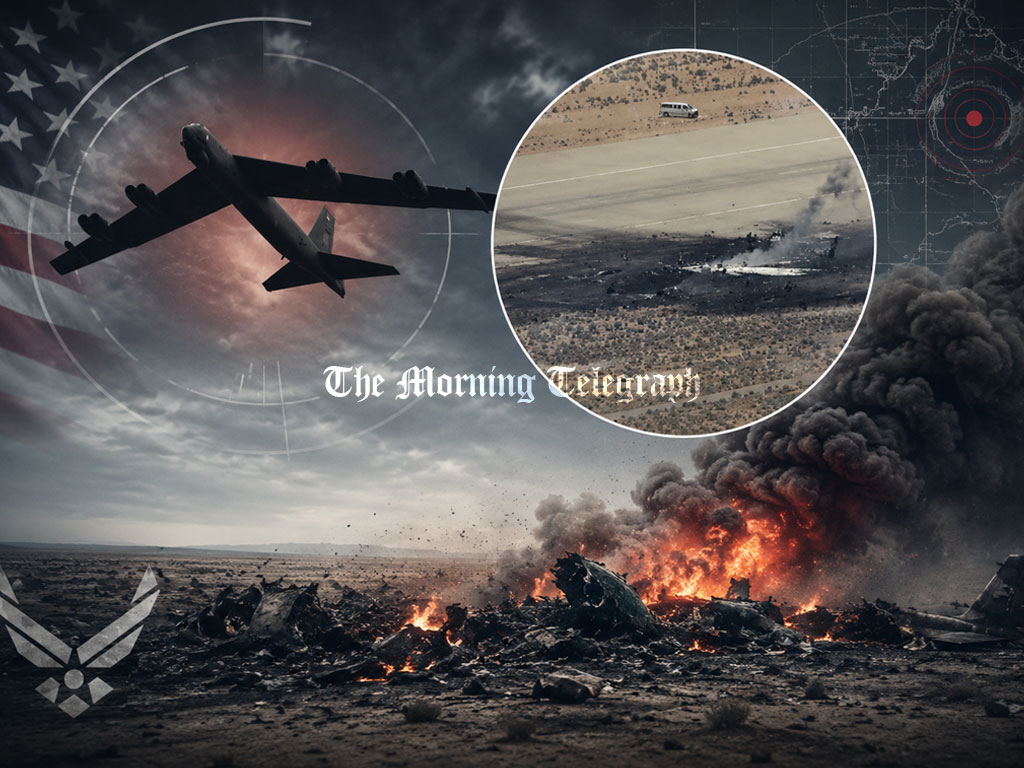
(Reuters) – A U.S. Air Force B-52 Stratofortress strategic bomber crashed shortly after takeoff at a sprawling military base in the Southern California desert on Monday, killing all eight people on board, military officials said.
The heavy, eight-engine aircraft went down at 11:20 a.m. local time (1820 GMT) during a routine test mission at Edwards Air Force Base in the Mojave Desert, approximately 100 miles (161 km) north of Los Angeles.
Colonel James Hayes, deputy commander for the 412th Test Wing at Edwards, told a news conference that review of the crash footage confirmed the high-impact impact was “unsurvivable.”

“We lost eight great Americans,” Hayes said, adding that the victims included a combination of uniformed military personnel, government civilians, and defense contractors. Aerospace giant Boeing later confirmed that two of its employees were among the dead. Names are being withheld pending full notification of next of kin.
Aerial video footage of the crash site showed a localized, heavily charred patch of the desert floor near the runway. The impact appeared to have completely destroyed the aircraft, leaving no major structural debris visible through the thick black smoke.
Military officials said the long-range bomber was conducting a local test sortie in support of an ongoing radar modernization program. The program, which utilizes an Active Electronically Scanned Array (AESA) system to upgrade the aging bomber’s analog radar, is designed to extend the operational lifespan of the decades-old fleet.
An aviation safety expert and former investigator for the Federal Aviation Administration (FAA), Jeff Guzzetti, said the rapid nature of the crash immediately after takeoff strongly pointed to a flight control or structural “controllability issue.”
“A flight test is always riskier than normal operations,” Guzzetti said, noting that while the B-52 platform has been in service for 70 years, integrating new digital testing devices can introduce unforeseen technical challenges.
Air Force officials established an emergency operations center at the base to coordinate recovery efforts. The airfield was closed to inbound traffic for most of Monday, and non-commercial visitor passes to the installation were suspended while emergency crews contained the site.
The Air Force has launched an official accident investigation board to determine the exact mechanical or operational cause of the disaster. Hayes noted that a complete military safety investigation of this scale typically takes up to six months to conclude.
Monday’s incident represents the first major crash of a B-52 bomber since May 2016, when an aircraft went down during takeoff on the U.S. island territory of Guam. All seven crew members survived that accident.
First introduced in the 1950s, the Boeing-built B-52 Stratofortress remains a primary pillar of the U.S. strategic bomber force, capable of carrying both precision-guided conventional munitions and nuclear weapons.