By Roy Denish
The discovery of 10 more bodies at the Chemmani mass grave has pushed the total recovered remains to 351, deepening one of Sri Lanka’s most haunting wartime investigations. The presence of bound victims, infants, and personal belongings is intensifying calls for truth, accountability, and justice decades after the disappearances.
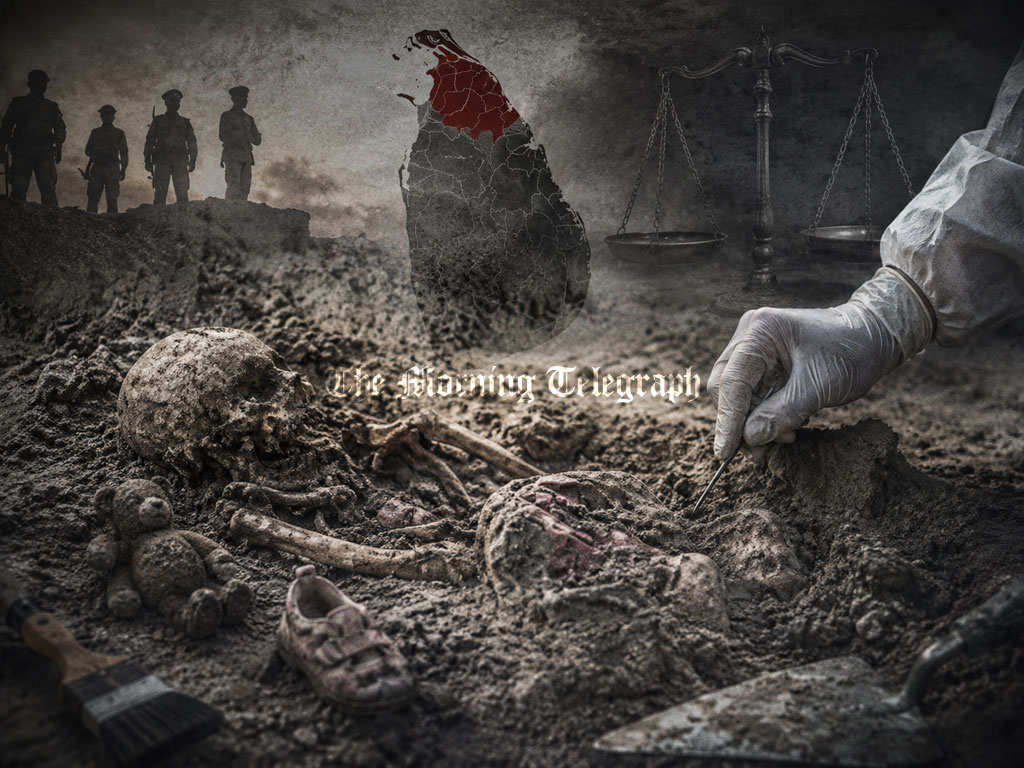
The unearthing of ten more bodies at the Chemmani mass grave site has brought renewed scrutiny to one of the most grim chapters of the Sri Lankan civil war, exposing stark evidence of systematic executions and child casualties that successive administrations have long been accused of covering up. Forensic investigators operating under tight security at the northern excavation site reported that the newly discovered remains bore the clear hallmarks of extrajudicial killings, matching the grim patterns established when the site was first partially exposed decades ago.
Forensic examinations of the remains indicate that the victims were subjected to severe physical trauma before death. According to investigators close to the judicial probe, several of the skeletal remains were found with their hands bound tightly behind their backs, while others showed signs of blindfolding, pointing directly to execution-style killings. The chaotic, highly compressed positioning of the bodies in shallow trenches, mostly stripped of clothing, heavily contradicts any claims of standard wartime burials and indicates a deliberate effort to conceal a mass slaughter.

Among the dead, the recovery of infant and toddler remains has added a profoundly tragic layer to the investigation. While forensic teams continue the meticulous process of aging the skeletons, officials confirmed that multiple infants, some estimated to be under one year old, have been exhumed from the site. The presence of children was further verified by the discovery of everyday items buried alongside the bones, including infant feeding bottles, small shoes, plastic toys, and a weathered school bag, underscoring that entire families were targeted in the sweeps.
The historical context of the site identifies the perpetrators as members of the Sri Lankan security forces and military intelligence units operating in the Jaffna peninsula. The grave site first came to light in 1998 during a murder trial, when a convicted army lance corporal confessed that the Chemmani area was used as a mass dumping ground for hundreds of Tamil civilians who had been detained. The vast majority of the victims are believed to be part of the wave of young Tamil men and women who disappeared after being taken into military custody at checkpoints and during security sweeps in late 1995 and 1996, immediately after the military retook the region.
Despite the gravity of the ongoing discoveries, potential internal whistleblowers and local witnesses have overwhelmingly refused to come forward due to an entrenched atmosphere of fear and institutional intimidation. Human rights advocates note that families of the disappeared and local activists face persistent surveillance by state intelligence services, making the personal cost of speaking out immense. Furthermore, a deep-seated culture of impunity means that previous insider confessions never led to the prosecution of high-ranking military commanders, convincing potential whistleblowers that exposing the truth carries severe personal danger without any guarantee of institutional justice.
The history of the site also confirms that successive state administrations were fully aware of the mass grave but actively chose to stifle comprehensive investigations. Following the initial military confessions in the late 1990s, the administration at the time faced intense international pressure and permitted a highly restricted exhumation that proved the allegations by unearthing fifteen bodies. However, after that initial phase, consecutive governments defunded the investigations, blocked further exploration, and routinely downplayed the scale of the disappearances to shield the military command structure. The fact that the true, massive scale of the grave is only being fully exposed now, decades later, highlights what independent observers describe as a deliberate, generation-long policy of administrative avoidance and systemic cover-up.