By Roy Denish
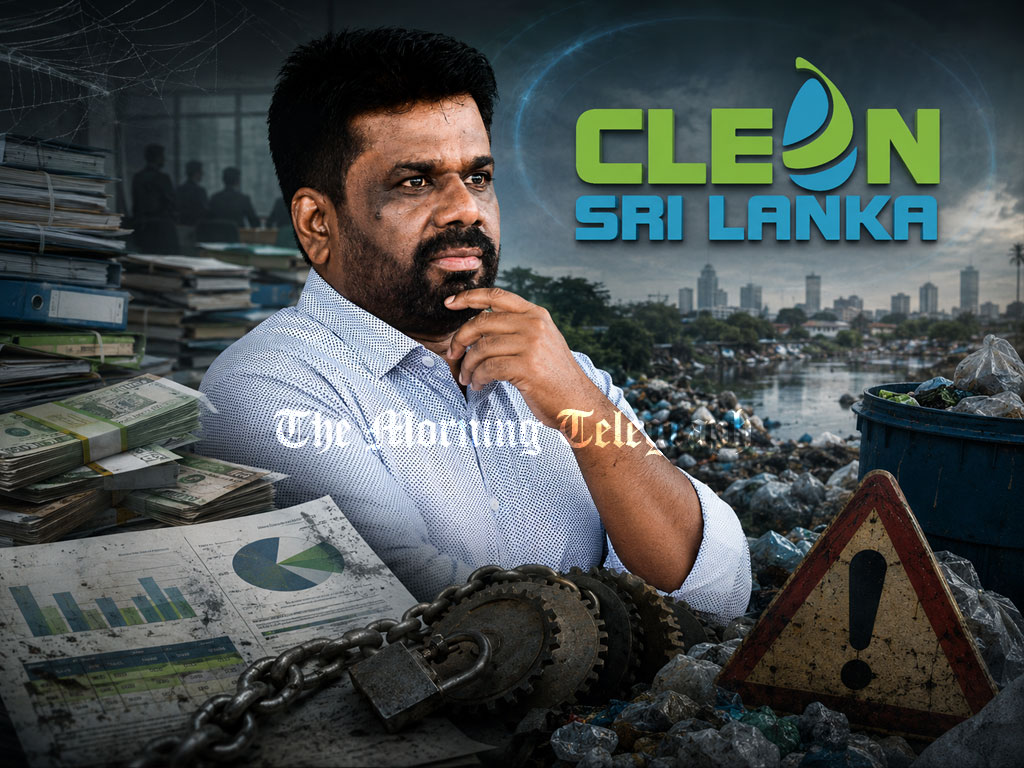
President Anura Kumara Dissanayake’s flagship Clean Sri Lanka campaign was meant to clean up the country’s environment and governance, but government records now suggest the program itself is stuck in a dirty mess of unspent billions, unfinished projects, corruption allegations, and bureaucratic gridlock.
A flagship nationwide campaign launched by Sri Lankan President Anura Kumara Dissanayake to transform the country’s environment and governance has stalled amid mounting allegations of corruption and severe bureaucratic paralysis, according to government records and officials.
The “Clean Sri Lanka” initiative, introduced on New Year’s Day 2025 as a sweeping social, environmental, and ethical revival program, is facing fierce political pushback and an administrative bottleneck that has left billions of rupees in public funds unspent.
Opposition figures and critics have recently leveled accusations against the program’s managers, alleging opaque financial handling, political favoritism in staffing, and the unauthorized use of state vehicles.

The Clean Sri Lanka Secretariat, operating under the Presidential Secretariat, strongly denied the claims. In a formal statement, the secretariat called the allegations “distorted and misleading information” intended to sabotage the state’s flagship initiative. It added that the program’s top oversight body, an 18-member Presidential Task Force comprising military commanders, police officials, and experts, operates entirely on a voluntary basis without receiving salaries or state allowances.
However, newly disclosed government data obtained under the Right to Information (RTI) Act reveals that the program’s biggest obstacle may be internal gridlock rather than external political warfare.
Out of a massive 11.5 billion Sri Lankan rupees ($38.3 million USD) combined budget allocated for 2025 and 2026, the state had managed to spend just 2.93 billion rupees ($9.7 million USD) by the end of March 2026. The vast majority of the funds remains untouched in Treasury accounts while cities continue to struggle with waste management, plastic pollution, and contaminated waterways.
The structural breakdown is also visible in project delivery. According to the RTI disclosures, the initiative aimed to execute 62 distinct public works projects in its first year, but completed only 28. The remaining 34 unfinished projects have been rolled over into the 2026 agenda, clogging an administrative system that has drawn sharp criticism from within the government itself.
Senior ministers have expressed growing frustration, publicly pointing the finger at what they describe as a complacent, deeply entrenched public sector bureaucracy intentionally slowing down implementation.
The standoff highlights the immense challenge facing President Dissanayake, who won election on a platform of anti-corruption, public efficiency, and institutional departure from past governance failures. While the administration continues to run mandatory anti-corruption workshops and strict civil discipline drives, critics say the government must act aggressively to overhaul its stagnant implementation units if its premiere domestic policy is to survive.