An alleged Euro 2,800 payment accepted by a senior Olympic official has ignited fresh controversy within the National Olympic Committee of Sri Lanka, raising serious questions about transparency, election integrity, accountability, and the credibility of the country’s Olympic movement.
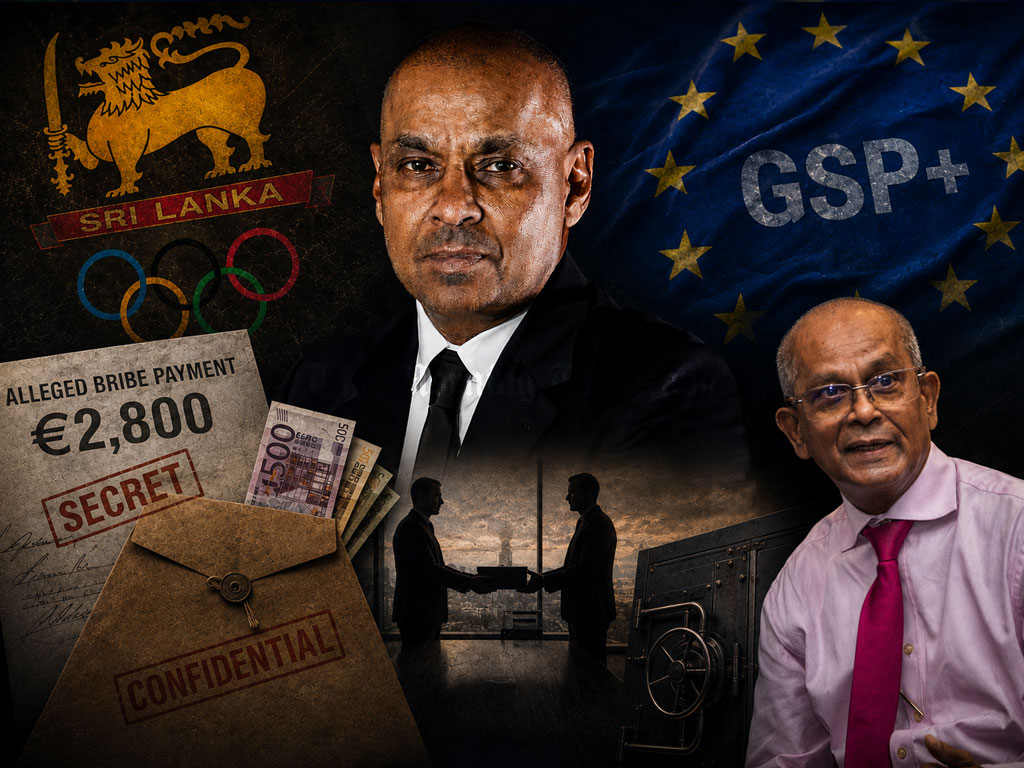
A startling document trail submitted by former National Olympic Committee of Sri Lanka Secretary General Maxwell De Silva has raised explosive questions over an alleged Euro 2,800 payment accepted by current NOCSL President Asanga Seneviratne when he was serving as Vice President on or around the 10th of January 2021.
The revelation now demands an immediate independent investigation by be it the International Olympic Committee, the Olympic Council of Asia, Sri Lanka’s Bribery Commission, and local law enforcement authorities.
At the heart of the matter is one disturbing question: if a senior Olympic official admitted receiving money from a visiting delegation, why was the matter not immediately reported to the correct anti-corruption authorities and parent body?

The Euro 2,800 Question
According to documents reportedly submitted by Maxwell De Silva, Seneviratne had allegedly accepted a payment of Euro 2,800, from a foreign delegate which he later handed over to the NOCSL.
The money was subsequently placed in the NOCSL vault.
If the money was accepted as a gift, why was it accepted?
If it was suspected to be improper, why was it not reported?
If it was linked to vote canvassing, why were the Bribery Commission, IOC, or OCA not immediately notified?
Alleged Meeting at Shangri-La Colombo
Unconfirmed reports surrounding the incident claim that sometime before January 10, 2021, four officials attached to the NOCSL were invited to a meeting at the Shangri-La Hotel in Colombo by a visiting Middle Eastern delegation related to sports that had reportedly arrived by private jet.
The purpose of the meeting, according to these allegations, was to present a proposal and canvass votes at an election.
It is alleged that, at the end of the meeting, gift boxes were handed over to them by the visiting delegates.
Further unconfirmed allegations suggest that large sums of money and luxury wrist watches were supposedly were handed over to them by the delegates. Were they intended as gifts or inducements to influence votes are questions that arise.
However, what makes the issue more serious is that Seneviratne is alleged to have admitted receiving a gift, which comparatively was a small sum of Euro 2,800 according to him.
A Paltry Sum or Evidence of a Bigger Culture?
The amount itself may appear small when compared with the alleged scale of vote-buying normally associated with international sports politics.
But that does not make the matter minor.
A bribe does not become acceptable because the amount is smaller than expected.
If an Olympic official accepts money from a delegation seeking influence, the issue is not only the amount. The issue is the ethical breach, the failure to disclose, the possible conflict of interest, and the credibility of the entire Olympic movement in Sri Lanka.
This is why the Euro 2,800 allegation cannot be brushed aside as a clerical matter or an internal misunderstanding.
It goes directly to the integrity of NOCSL governance.
Why Was This Not Reported?
The most damaging aspect of this episode is not merely the alleged acceptance of money.
It is the apparent failure to report the matter to the relevant authorities.
If the NOCSL leadership was aware that a senior official had accepted money from a foreign delegation in suspicious circumstances, the issue should have been formally reported to the Commission to Investigate Allegations of Bribery or Corruption.
It should also have been reported to the International Olympic Committee and the Olympic Council of Asia.
The fact that the money was allegedly placed in the NOCSL vault does not resolve the matter.
In fact, it raises more questions.
Who authorized the money to be kept there?
Was an official entry made?
Was it recorded in the books?
Was the source documented?
Was the money ever returned?
Maxwell De Silva’s Dossier Opens a New Front
The document was reportedly submitted by Maxwell De Silva along with several other documents connected to accusations he had made against former NOCSL President Suresh Subramaniam regarding a separate case.
However, the material now appears to have opened an entirely different front.
Instead of only raising questions about past leadership, the dossier has now placed the current NOCSL President Asanga Seneviratne under direct ethical scrutiny.
That is why this matter must not be buried inside internal politics, factional rivalries, or election disputes.
If the allegation is false, Seneviratne deserves the opportunity to clear his name through a transparent inquiry.
If the allegation is true, then the consequences must be immediate and severe.
CIABOC, IOC and OCA Cannot Stay Silent
This matter cannot be handled internally by the NOCSL.
The allegation involves a now serving Olympic official, a foreign delegation, a possible payment, an alleged vote-canvassing context, and a failure to report the matter to anti-corruption authorities.
That requires external scrutiny.
The Bribery Commission must examine whether the alleged acceptance of Euro 2,800 constitutes an offence under Sri Lankan law.
The IOC must examine whether the conduct violates Olympic ethics rules.
The OCA must determine whether the alleged meeting and payments were connected to regional Olympic politics.
The NOCSL must disclose whether the money was recorded, banked, returned, retained, or used.
Anything less would be a betrayal of public trust.
The Vault Cannot Become a Graveyard for Evidence
The claim that the money was placed in the NOCSL vault is not an answer.
It is the beginning of the investigation.
A vault cannot become a hiding place for uncomfortable evidence.
If the money was improper, it should have triggered an immediate written report, board disclosure, legal advice, and formal notification to the relevant authorities.
If none of that happened, then those who knew of the incident and failed to act must also be questioned.
This is no longer just about the person who allegedly accepted the money.
It is about everyone who knew, stayed silent, and allowed the matter to disappear into an institutional safe.
A Test of Olympic Integrity in Sri Lanka
The Olympic movement speaks loudly about ethics, transparency, fair play, and clean governance.
Those values mean nothing if allegations of bribery inside a National Olympic Committee are allowed to vanish without consequence.
The NOCSL cannot demand discipline from athletes while ignoring unanswered questions inside its own boardroom.
It cannot speak of Olympic values while failing to explain why alleged bribe money was kept in a vault instead of being reported.
It cannot hold elections under a cloud and then expect the public to trust the outcome.
Immediate Investigation Is Now Unavoidable
The path forward is clear.
The IOC, OCA, CIABOC, and Sri Lankan authorities must launch an immediate investigation into the alleged Euro 2,800 payment.
Asanga Seneviratne must be required to step aside from sensitive NOCSL duties or be placed under appropriate provisional safeguards until the inquiry is completed.
All documents submitted by Maxwell De Silva must be examined.
The NOCSL vault records must be audited.
Banking records must be checked.
Meeting participants must be questioned.
The visiting delegation must be identified.
The contents alleged gift boxes received must be investigated.
The public must be told whether this was an isolated incident, an internal cover-up, or part of a wider culture of vote-buying and influence trading in Olympic sport.
Until that happens, the Euro 2,800 allegation will hang over the NOCSL presidency like a stain that cannot be washed away.
Sri Lanka’s Olympic movement now faces a defining test.
Will it protect the truth, or protect power?