By Roy Denish
A sharp comparison of how India used criminal leverage after the MSC Elsa 3 disaster while Sri Lanka’s X-Press Pearl strategy risks becoming a $1 billion paper victory.
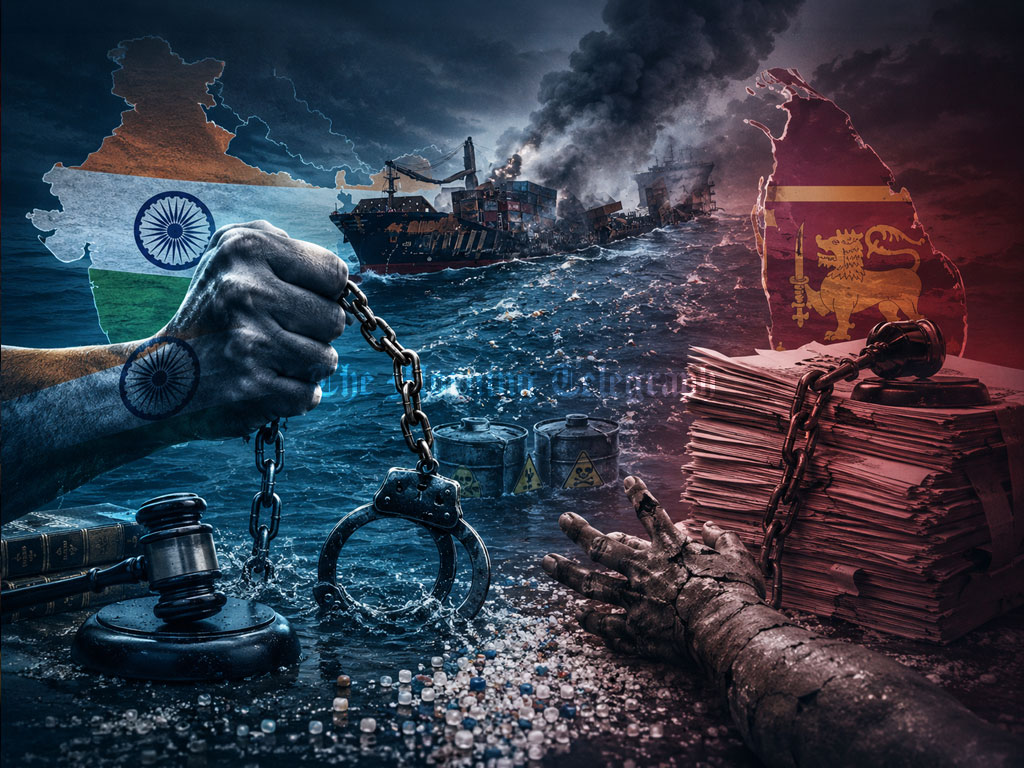
The maritime disasters involving the MV X-Press Pearl in 2021 and the MV MSC Elsa 3 in 2025 stand as two of the most devastating environmental crises in the history of the Indian Ocean. While both incidents shared eerie similarities—toxic chemical payloads, structural failures resulting in catastrophic fires or sinking, and the release of billions of plastic nurdles—the subsequent legal battles revealed a stark divide in tactical execution. India systematically out-maneuvered the global shipping industry and the international maritime legal framework, while Sri Lanka’s legal apparatus, culminating in a flawed strategy by its Supreme Court, ultimately bungled its case from a perspective of international enforceability.
When the Singapore-flagged X-Press Pearl developed a severe nitric acid leak in 2021, it first sought refuge at India’s Hazira port. In a calculated move of risk assessment, Indian port authorities denied the vessel entry, effectively protecting their own coastline and passing the volatile situation to Sri Lanka. Sri Lanka allowed the vessel into its outer anchorage near Colombo, where it caught fire and sank, initiating a monumental environmental disaster. Years later, Sri Lanka’s Supreme Court issued a landmark 361-page judgment ordering a historic $1 billion initial compensation package against the ship’s owners (X-Press Feeders) and their UK-based insurer (The London P&I Club).

From a strict maritime and private international law perspective, however, the Supreme Court of Sri Lanka fundamentally crippled its own case. The court chose to award this massive compensation package by invoking its domestic Fundamental Rights (FR) public law jurisdiction to vindicate citizens’ constitutional rights to a clean environment. While this was a victory for domestic environmental jurisprudence, it created a practically toothless “paper judgment” on the global stage. Under international private law and statutory frameworks like Singapore’s Reciprocal Enforcement of Foreign Judgments Act, foreign courts will look past a judgment’s label to its substance. Because Sri Lanka’s $1 billion award stems from a public constitutional petition aimed at punishing corporate negligence, foreign courts are highly likely to classify it as an unenforceable foreign public or penal law. Private international law universally dictates that sovereign states will not enforce the penal or public laws of another nation, legally isolating Sri Lanka’s judgment within its own borders.
Furthermore, this constitutional approach created an irreconcilable procedural conflict with parallel civil litigation tracks. While the Supreme Court was finalizing its ruling, the Sri Lankan Attorney General’s department had already filed a parallel civil damages claim in Singapore—a move the Supreme Court openly criticized as “irrational.” By letting these legal tracks fracture, the Sri Lankan legal system handed the shipowners a powerful defense. In international courts, the owners can now convincingly argue that the domestic constitutional proceeding in Sri Lanka lacked the rigorous adversarial protections of a standard civil trial, such as the cross-examination of scientific experts and formal discovery of evidence, thereby violating principles of natural justice and procedural fairness.
The Supreme Court also failed to legally neutralize international maritime liability caps, such as the Limitation of Liability for Maritime Claims (LLMC). While the court attempted to bypass these caps by declaring a doctrine of “absolute liability” for hazardous activities, a domestic constitutional decree does not dissolve international treaty obligations or the maritime laws of the state where the physical assets actually sit. Because the court prioritized a retrospective constitutional declaration over aggressive civil maritime liens or the immediate arrest of commercial assets, the $1 billion order relies entirely on the voluntary compliance of foreign corporations who have successfully resisted payment by labeling Sri Lanka’s damage methodologies as “theoretical” and “arbitrary.”
When the Liberian-flagged MSC Elsa 3 developed a severe list and sank off the coast of Kerala, India, in May 2025, spilling hazardous calcium carbide and millions of plastic pellets, New Delhi and local state authorities actively learned from Sri Lanka’s gridlock. India bypassed abstract constitutional debates entirely and immediately weaponized its domestic criminal legal framework alongside standard maritime claims. The Kerala state government declared a state-specific disaster, while the local coastal police filed criminal negligence charges against the ship’s master and senior officers, instantly seizing their passports.
While multi-billion-dollar international shipping lines and P&I clubs can easily afford to let a civil lawsuit or a foreign constitutional dispute drag out in courts for a decade, they cannot afford to have their senior captains and engineers held indefinitely under criminal indictment in a foreign nation. This calculated move gave India immediate, physical leverage, bypassing the standard jurisdictional loopholes used by insurers and forcing the Swiss-based operator (MSC) to negotiate on India’s terms to secure the release of its crew. Simultaneously, India deployed a tightly coordinated multi-agency response team to scientifically catalog the debris and link the chemical pollution to immediate local fishing bans, creating an airtight, rules-based evidentiary tie before insurers could mount a defense.
In a final twist of transboundary irony, the southwest monsoon currents eventually swept the plastic nurdles from India’s MSC Elsa 3 disaster hundreds of miles away onto the northern beaches of Sri Lanka. This left Sri Lanka to bear the ecological brunt of both maritime disasters simultaneously—struggling to collect its hard-fought $1 billion from its own 2021 wreck due to a flawed Supreme Court strategy, while witnessing how India’s aggressive, localized criminal framework successfully out-smarted the global maritime legal system to extract immediate corporate accountability.