
By Marlon Dale Ferreira.
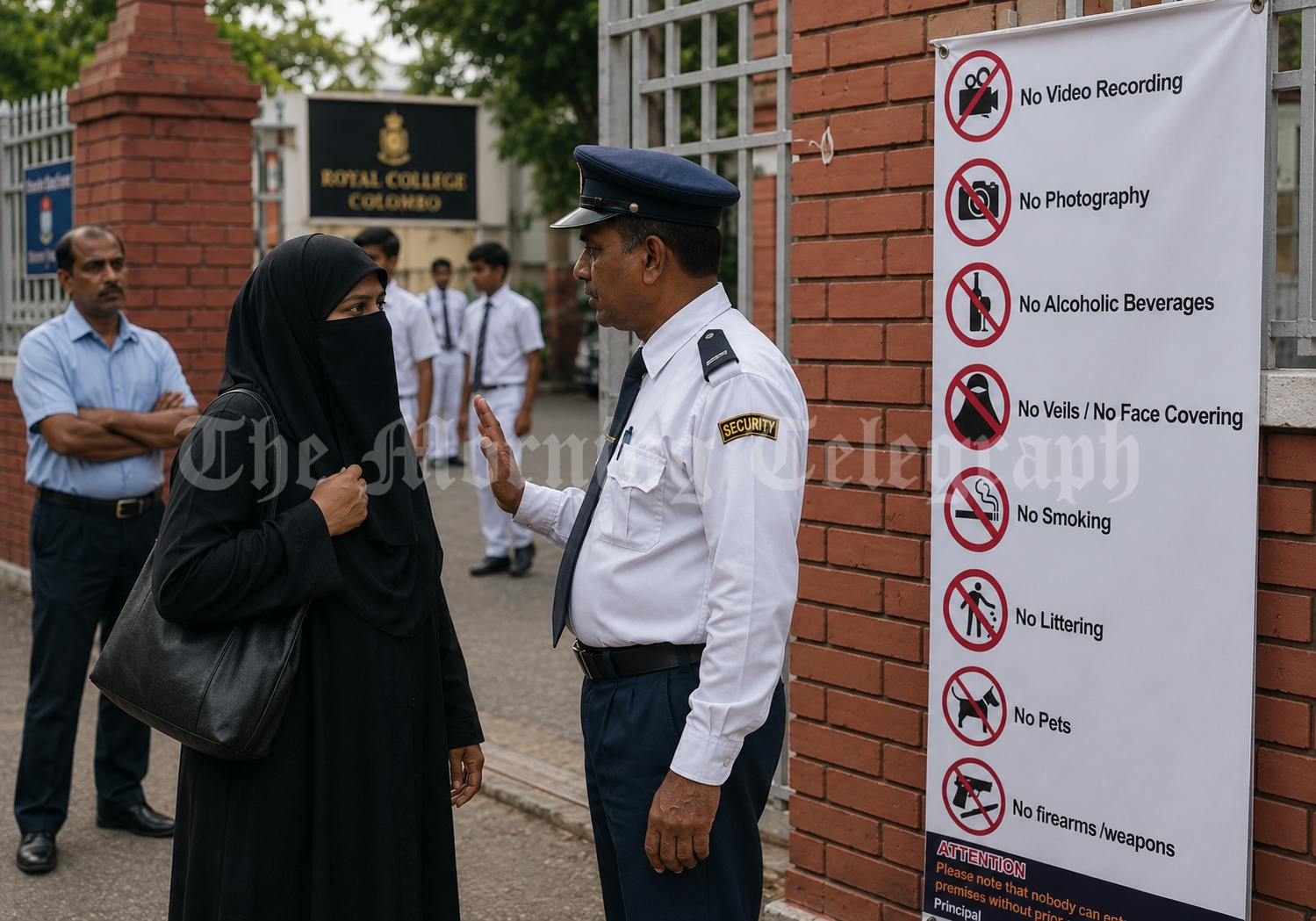
For the first time in the school’s 180-year history, a banner prohibiting veils and face coverings has reportedly been displayed at Royal College, Colombo, prompting complaints from Muslim parents who allege humiliation, discriminatory treatment and exclusion from their children’s education.
Unprecedented Banner Displayed at School Entrances
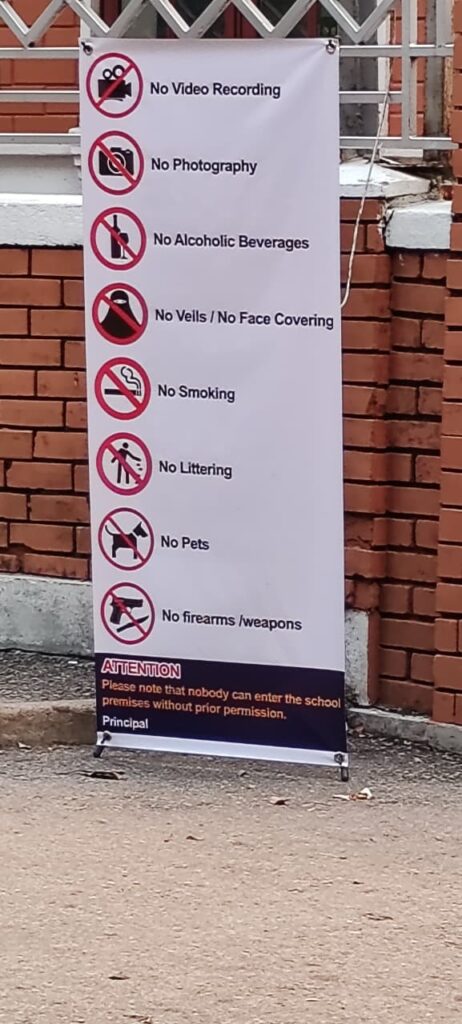
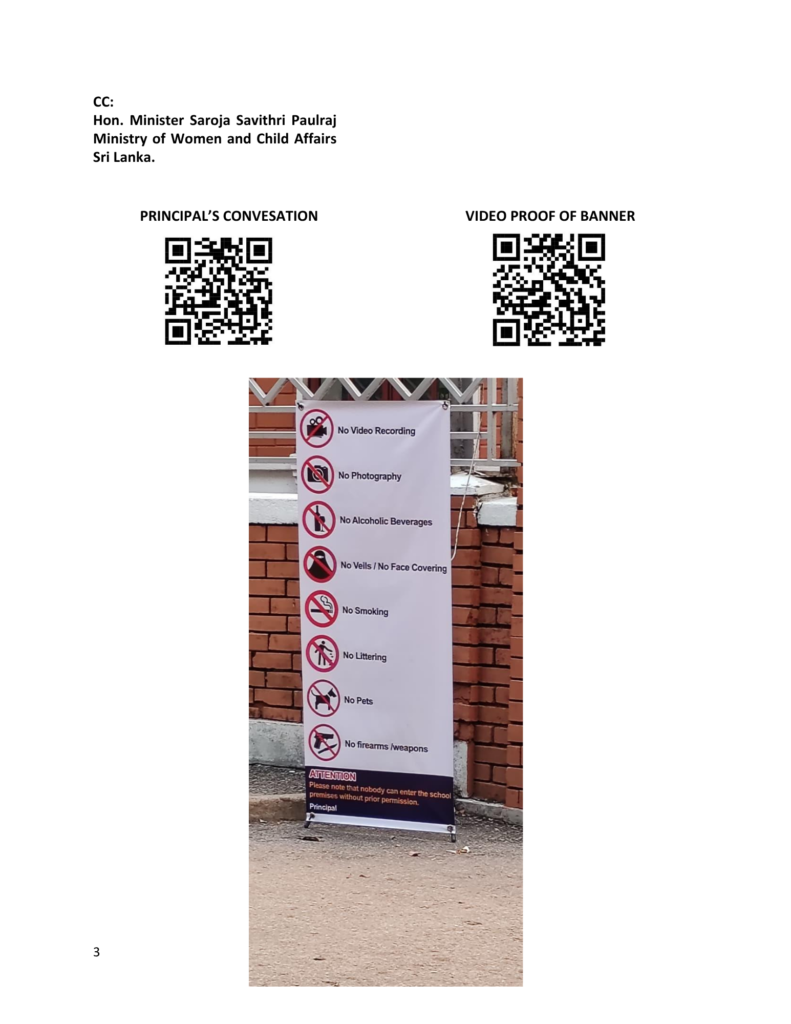
Royal College, Colombo, one of Sri Lanka’s oldest and most prestigious national schools, has become the centre of a growing human rights controversy after displaying banners stating “No Veils / No Face Covering” at its main entrance and primary section entrance.
The restriction, which affected parents say has never previously been displayed in this manner during the institution’s 180-year history, was reportedly introduced under the administration of Principal Athula Wijewardana, who assumed office in April 2025.
The banner was reported to be in place by June 3, 2026.
Affected parents argue that the prohibition effectively prevents Muslim mothers who wear the niqab from entering the school and participating in meetings, functions and other matters connected to their children’s education.
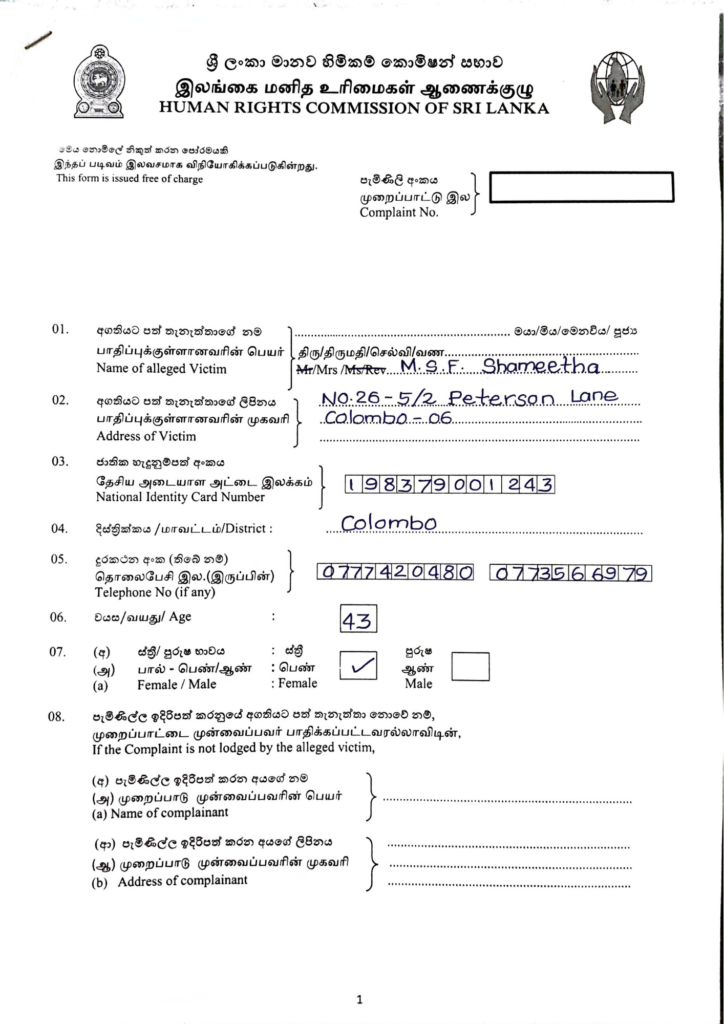
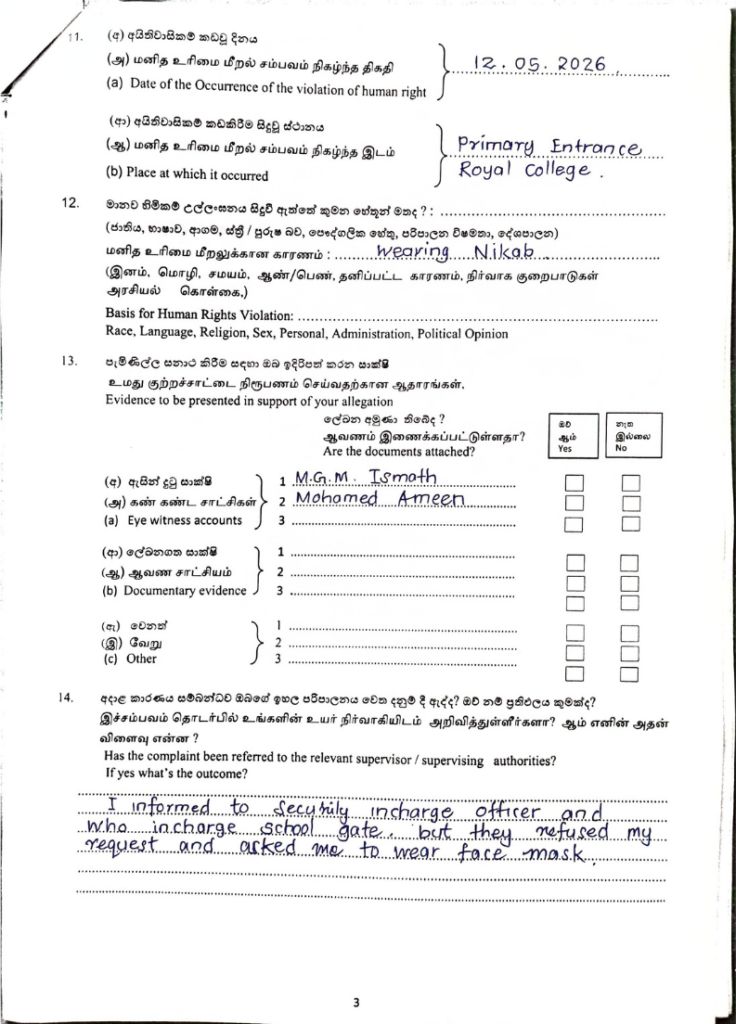
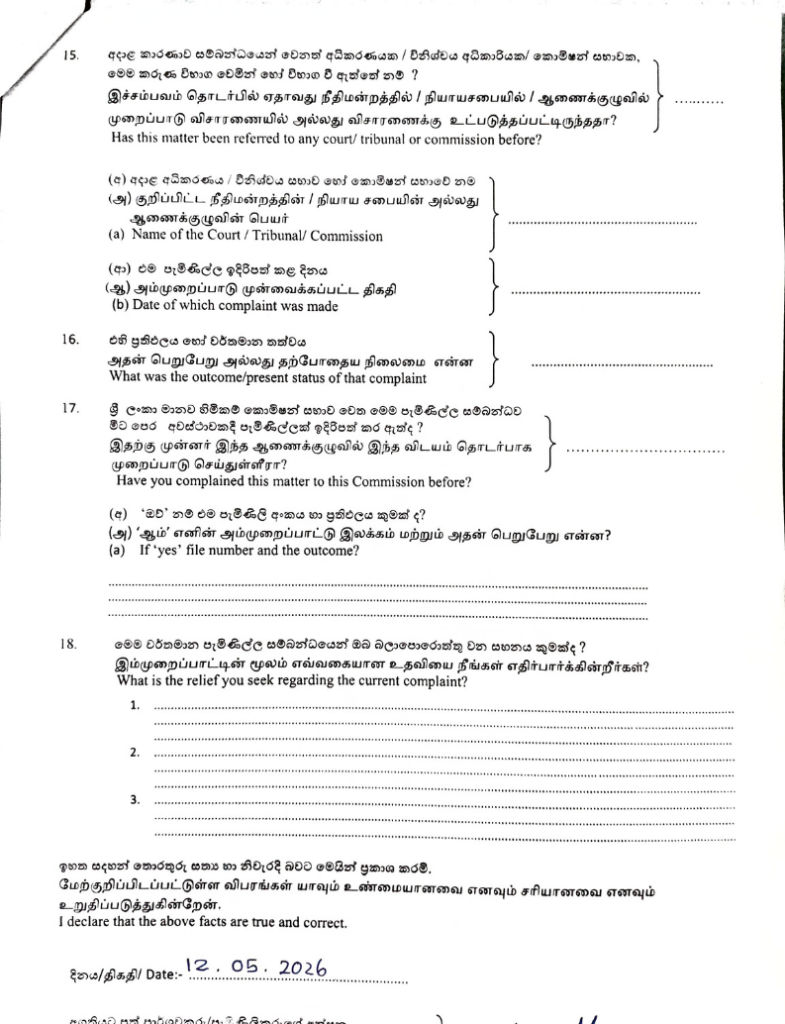
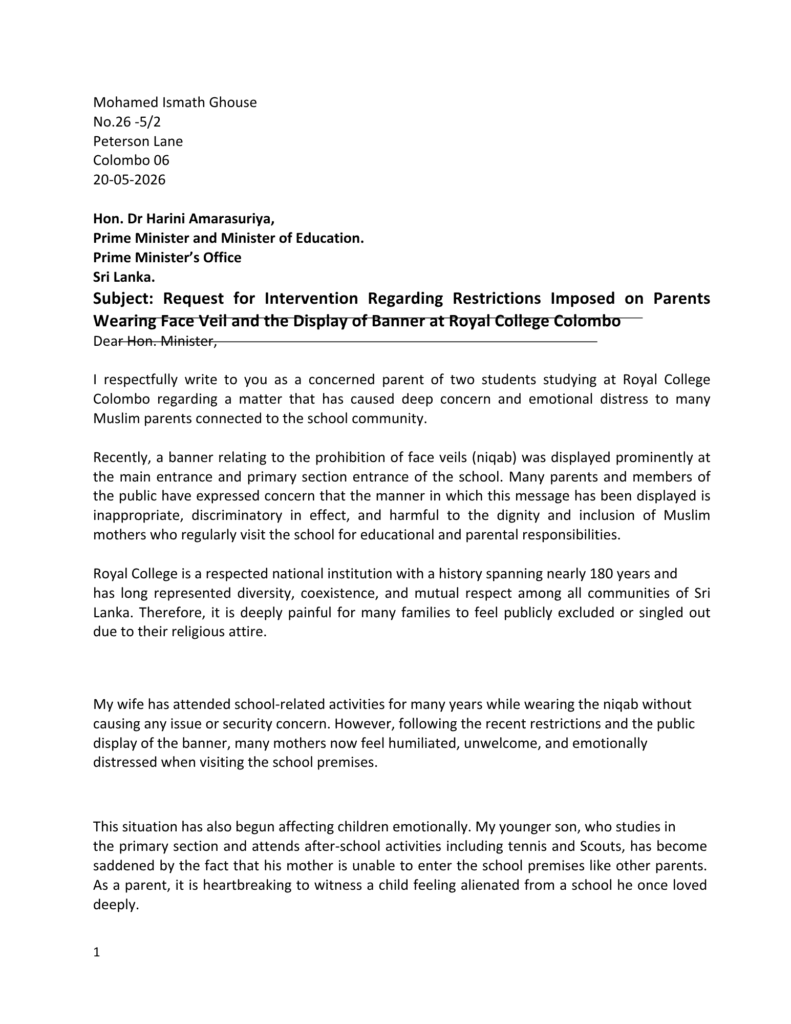
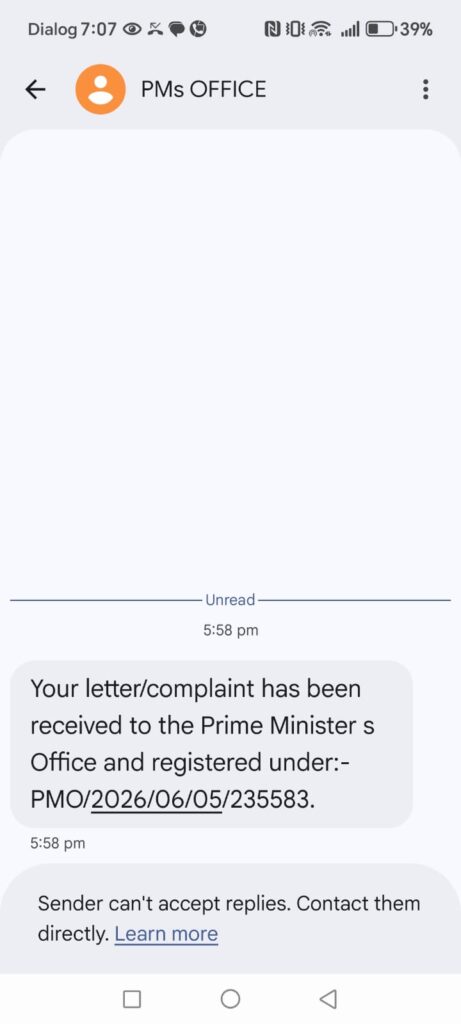
The move has prompted formal complaints to the Human Rights Commission of Sri Lanka and representations to the Ministry of Education and Deputy Minister Muneer Mulaffar through his secretary, Mohamed Sajahan.
Mother of Two Says She Was Denied Entry
One complaint was submitted by Mrs. Sheeraaz, a mother of two Royal College students studying in Grade 5D and Grade 12 COM T.
She said that because her husband is employed overseas, she personally attends school meetings and handles matters concerning her children’s education.
According to her written complaint, she visited Royal College on April 2, 2026, to attend a parents’ meeting for her elder son.
Upon arriving at the main gate, she was allegedly denied entry by a security officer identified as Mr. Rathnayaka.
She alleged that the officer also spoke to her in a disrespectful and insulting manner in front of other parents, making comments about her face covering and her presence at the school.
The mother said the incident caused her considerable embarrassment and emotional distress.
Further Comments Allegedly Made Inside School
After eventually reaching the relevant classroom, the parent said she encountered further objections to her attire.
She alleged that Mr. Mayuran, the Tamil Medium Section Head, repeatedly told her that her face covering was unsuitable for Royal College and that she should wear such clothing only at home.
According to the complaint, the discussion continued for an extended period in front of other parents, causing further humiliation and disrupting the purpose of the meeting.
The parent maintained that she had attended the school solely to fulfil her responsibilities regarding her children’s education.
She argued that all parents should be treated with dignity and respect regardless of religious belief or manner of dress, provided that they comply with the law and legitimate school regulations.
Complaint Sent to Deputy Minister
In a letter dated June 3, 2026, addressed to Deputy Minister Muneer Mulaffar through his secretary, Mohamed Sajahan, the parent requested an investigation into the treatment she allegedly experienced and the basis for the newly displayed prohibition.
She asked the Ministry to examine whether the restriction was necessary, proportionate and consistent with the rights of parents to participate in their children’s education while observing their religious practices.
She also requested clarification on any official policy governing parental access to school premises and dress requirements for parents attending school meetings and functions.
The complainant asked that her identity and personal details be treated with strict confidentiality during any inquiry because she feared that her children could experience discomfort or repercussions.
Parents Say Niqab Was Previously Permitted
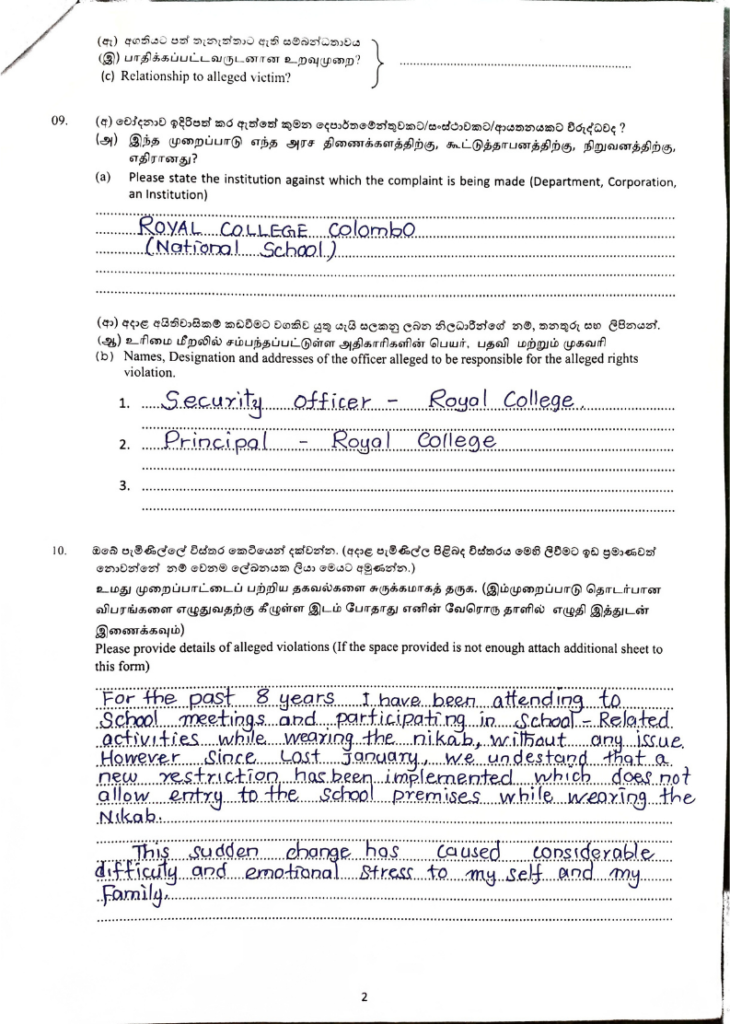
Another parent of two Royal College students has separately complained to the Human Rights Commission of Sri Lanka.
According to that complaint, his wife had attended school meetings and participated in activities while wearing the niqab for more than eight years without any reported security issue.
He claimed that the restriction was introduced only in January 2026.
“This sudden change has caused considerable difficulty and emotional stress to myself and my family,” the parent stated in his complaint.
Affected families argue that the absence of previous incidents raises questions about why a complete prohibition became necessary instead of a more balanced identification process.
Principal Accused of Making Humiliating Remarks
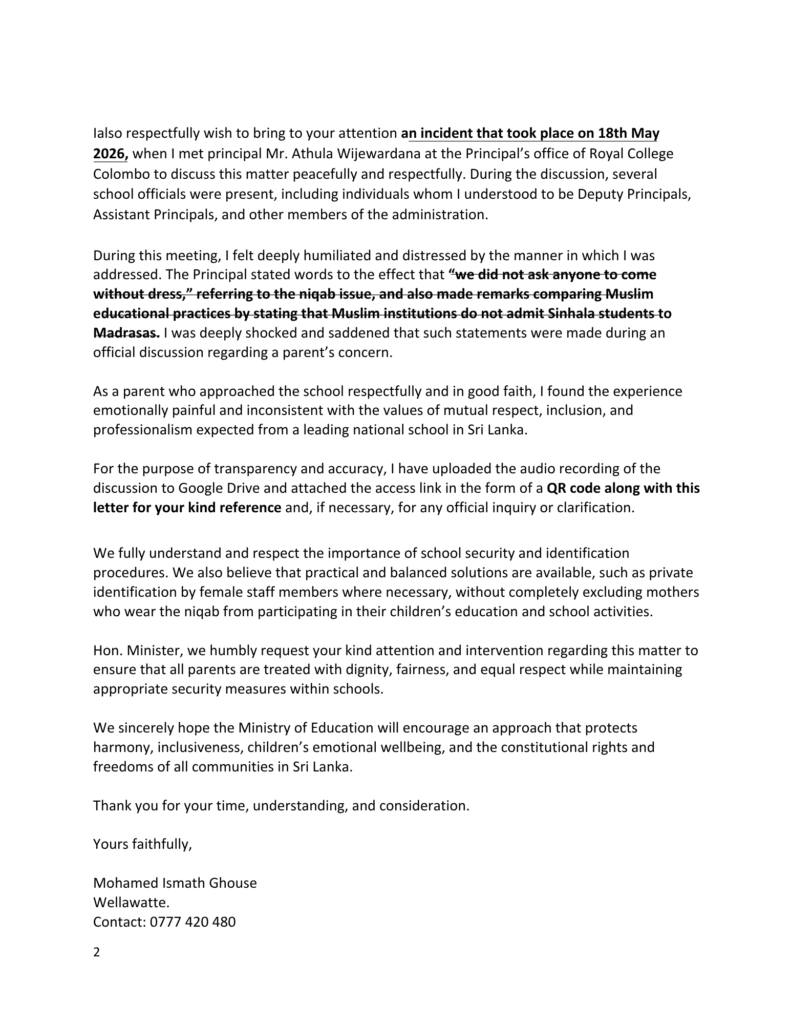
One parent also described a meeting held with Principal Wijewardana in an attempt to resolve the issue through discussion.
The meeting was reportedly attended by deputy principals, assistant principals and other members of the school administration.
According to the complaint, the principal made remarks that the parent considered deeply humiliating and distressing.
The principal allegedly stated words to the effect that “we did not ask anyone to come without dress” while discussing the niqab.
He was also accused of comparing Muslim education practices and stating that Muslim institutions did not admit Sinhala students to madrasas.
“As a parent who approached the school respectfully and in good faith, I found the experience emotionally painful and inconsistent with the values of mutual respect, inclusion and professionalism expected from a leading national school in Sri Lanka,” the parent said.
The complainant stated that an audio recording of the meeting had been uploaded to Google Drive and provided to the Human Rights Commission for verification.
The allegations concerning the meeting remain subject to examination, and no formal response from the principal or school administration was included in the material supplied for this report.
Child Reportedly Distressed by Mother’s Exclusion
Parents say the controversy is no longer affecting only the adults involved.
One father reported that his younger son, who studies in the primary section and participates in tennis and Scouts, had become saddened because his mother could not enter the school like other parents.
“As a parent, it is heartbreaking to witness a child feeling alienated from a school he once loved deeply,” he said.
The complaints argue that excluding a parent from school functions may affect the emotional welfare of the child and weaken parental participation in education.
Female Verification Officer Proposed
The complainants have acknowledged the importance of school security and the need to verify the identities of visitors.
However, they argue that a complete ban on face coverings is unnecessary when practical and respectful alternatives are available.
They propose appointing a female security officer or designated female staff member who could privately verify the identity of a woman wearing a niqab.
Under this system, the parent could briefly uncover her face in a secure and private setting before being permitted to enter.
The parents say such an arrangement would address legitimate security concerns without excluding Muslim mothers or violating their religious beliefs and personal dignity.
Constitutional Rights Cited
The complaints allege that the restriction and the manner in which it has been enforced may violate several fundamental rights guaranteed by Sri Lanka’s Constitution.
Articles 10 and 14(1)(e) protect freedom of thought, conscience and religion, including the freedom to manifest a religion through observance and practice.
The complainants argue that wearing religious clothing forms part of that protected expression.
Articles 12(1) and 12(2) guarantee equality before the law, equal protection of the law and protection against discrimination on religious grounds.
The parents have also cited Article 11, which protects individuals from torture and cruel, inhuman or degrading treatment.
They argue that the alleged public humiliation, insulting remarks and exclusion from the school could amount to degrading treatment requiring investigation.
Previous Human Rights Ruling Referenced
The complaints refer to the case of F.F. Rameez and others v. Principal, Tri/Tri Sri Shanmugam Hindu Ladies College, Trincomalee and others.
In that matter, identified as HRC/TCO/27/18, the Human Rights Commission reportedly held that denying a person the right to wear traditional clothing on religious grounds amounted to a violation of the equality protections contained in Article 12.
The parents maintain that the principles recognised in that case should also apply to Muslim mothers seeking access to Royal College while wearing religious attire.
Children’s Rights Obligations Raised
The complainants also refer to Sri Lanka’s obligations under the Convention on the Rights of the Child.
They argue that the best interests of the child should be treated as a primary consideration in decisions affecting access to education and parental participation in school life.
According to the parents, a policy that prevents a mother from attending meetings, activities and important educational events may adversely affect both the parent and the child.
Relief Requested From Human Rights Commission
The affected parents have asked the Human Rights Commission to investigate whether their fundamental rights were violated.
They have also requested interim directions requiring the removal of the “No Veils / No Face Covering” banners while the complaints are under consideration.
The complainants want the school to permit parents wearing the niqab to enter the premises subject to reasonable and respectful identification procedures.
They have further requested that the Ministry of Education issue clear national guidelines to schools on religious attire, parental access and security verification.
The complaints also seek appropriate action against anyone found responsible for implementing a discriminatory policy or humiliating parents.
Royal College’s Secular Legacy
Royal College was established in 1835 as the Colombo Academy during British colonial rule.
It received royal recognition from Queen Victoria and was renamed Royal College in 1881.
The institution has frequently been described as the “Eton of Sri Lanka” and has long been regarded as a symbol of academic excellence, national leadership and unity.
Despite several of its earliest principals being Anglican clergymen, the school historically maintained a secular public identity.
Royal College educated students from different religious, ethnic and social backgrounds at a time when many schools were founded along denominational lines.
Supporters of its secular tradition say this allowed generations of students to form friendships and develop mutual understanding across Sri Lanka’s communal divisions.
Concerns Over Changing Religious Character
The latest controversy has also revived an earlier debate over whether Royal College has gradually moved away from its secular traditions.
Critics argue that the school has increasingly adopted an overtly Buddhist institutional character over the past three decades.
Among the concerns previously raised was the conversion of the school’s Little Theatre into a Buddhist shrine room.
Critics have also pointed to the installation of a golden canopy, reportedly costing more than Rs.2.5 million, as well as the increased presence of Buddhist statues and religious symbols around the school.
An annual Pirith ceremony, reportedly costing nearly Rs.1 million, has also been questioned by those who believe the school should maintain religious neutrality.
These critics do not object to Buddhist teaching or observance itself but argue that a national public school should avoid creating the impression that one religious community enjoys greater institutional recognition than others.
Former Principal Cited as Example of Secular Leadership
Those calling for Royal College to return to its secular foundations have highlighted the example of the late Bogoda Premaratne.
Premaratne, a distinguished former student of Ananda College and a recognised Buddhist scholar, served as Royal College Vice Principal from 1959 to 1966 and Principal from 1966 to 1971.
He was the school’s first Buddhist principal and the first non-Old Royalist Ceylonese to hold the position.
Critics of the school’s present direction note that Premaratne maintained the established traditions of Royal College without introducing a shrine room, placing Buddhist statues in his office or initiating an annual Pirith ceremony.
They argue that his administration demonstrated how a deeply religious individual could lead a secular national institution without giving institutional preference to one faith.
Questions Over Offerings to Bhikku Teachers
Earlier commentary also raised concerns over a practice under which classes reportedly take turns providing breakfast and lunch to five Bhikku teachers on school days.
It was also alleged that financial offerings of at least Rs.1,000 were made alongside the meals.
School-related sources reportedly maintained that contributions were voluntary and that the Bhikku teachers did not insist on a particular menu.
Nevertheless, critics questioned whether State-paid teachers should accept regular additional financial offerings from parents.
They also contrasted the practice with the financial difficulties faced by students at the Royal College hostel, including children from rural areas who reportedly struggle to pay monthly fees of approximately Rs.6,000.
Walpola Rahula Thero’s Teachings Invoked
Critics have cited the writings of the late Venerable Walpola Rahula Thero to argue that religious observance should prioritise compassion and support for those in need.
His work “Sathyodaya,” translated into English as “Truth Awakening” by Royalist Niranjan Selvadurai, emphasised feeding the hungry, clothing those without sufficient clothing, sheltering the homeless and caring for the sick as meaningful offerings to the Buddha.
His criticism of excessive ritual and unquestioned tradition has also been invoked in calls for Royal College to focus on Buddhist ethical values rather than costly religious displays.
Parents Say They Feel Unheard
Affected parents say they have attempted to resolve the niqab issue through meetings, letters and appeals to public authorities.
However, they claim that no meaningful solution has yet been offered.
“Day by day, we are losing hope. We have brought this matter to the attention of various authorities and officials through meetings, letters and appeals. Despite our sincere efforts, we have not seen any meaningful response or resolution,” the parents said in a statement.
“As law-abiding citizens and concerned parents, we continue to seek a fair, compassionate and reasonable solution through the proper channels. However, the lack of progress has left many affected families feeling disappointed, unheard and increasingly discouraged.”
They said they nevertheless remained hopeful that justice, understanding and goodwill would prevail.
Ministry Urged to Intervene
The Ministry of Education has been urged to examine the legal basis, necessity and implementation of the face-covering restriction.
Parents want the Ministry to determine whether the policy is consistent with constitutional equality, religious freedom and the right of parents to participate in their children’s education.
They have also called for a national policy to prevent individual schools from imposing inconsistent or discriminatory dress restrictions without clear legal authority.
Human Rights Inquiry Expected
The Human Rights Commission of Sri Lanka, established under Act No.21 of 1996, has the authority to investigate complaints concerning alleged infringements of fundamental rights.
The Commission is expected to consider the Royal College complaints in due course.
Until a formal inquiry is completed, the claims made by the parents, including allegations concerning individual members of the school administration, remain allegations requiring independent verification.
The controversy nevertheless presents a broader question for one of Sri Lanka’s most celebrated national institutions: whether security concerns can be addressed without undermining religious freedom, parental dignity and the secular tradition that Royal College has represented for generations.
#RoyalCollegeColombo #SriLankaNews #HumanRights #ReligiousFreedom #FaceCoveringBan #Niqab #MuslimParents #ParentalRights #EducationNews #SchoolPolicy #EqualRights #FundamentalRights #InclusiveEducation #HRCSL #MinistryOfEducation


When the muds come to Royal, you cannot expect the Class. The current principal and Mr Mayuran are perfect examples for the unfits to a place like RC. For both, please get out of of my school and find your place at another institution.
– M F Zubair, Royal College Past Student
When I was hearing the authoritative tone of the Principal, I feel that he was under influence of some sort of subtance.
It’s a great decision to ban those eight things from the school premises I feel bad for the poor pets who is going to fight for them.
The school has Male security guards and are they ( Niqab wearing ladies) ok to check them by this security guards then I will support them.
yes pls don’t ban the pets
As an old Royalist, I am deeply concerned by the recent developments surrounding Royal College Colombo. Royal College has a proud history of more than 180 years, built on values of unity, respect, diversity, and excellence. Any action or policy that may be perceived as discriminatory risks damaging the reputation that generations of Royalists have worked hard to uphold.
I respectfully urge the Principal and the College administration to engage openly with all affected communities, listen to their concerns, and ensure that every student and parent feels respected and treated equally regardless of their religion or background. The strength of Royal College has always been its ability to bring together Sri Lankans from all communities under one banner. Let us protect that legacy for future generations.
Ty and well said and appreciated by an old royalist
As an old boy, I am deeply disappointed by the Principal’s attempt to compare a national school with madrasas. A madrasa is essentially a religious educational institution, much like a Daham Pasala. Having served as the Principal of Royal, one would expect a clear understanding of these distinctions. Such a comparison raises concerns about the judgment expected from someone entrusted with leading one of the country’s premier schools.
Royal College has always stood as a school that respects people of all races, religions, and backgrounds. Throughout its history, the school has never promoted disrespect toward any faith or community. Instead, Royal has been a shining example of inclusivity, mutual respect, and coexistence.
I would also point out that if non-Muslims wish to visit a madrasa to learn, share knowledge, or better understand the faith, they are generally welcomed warmly and encouraged to engage in constructive dialogue and learning.
As the person responsible for more than 8,500 students, the Principal should be focusing on more pressing issues affecting the school. There are ongoing concerns regarding the maintenance of student toilets, classrooms, and common areas that deserve immediate attention.
In addition, the government’s policy of transferring teachers every five years has had a negative impact on the school’s standards. While students remain at the school for 11 to 13 years, experienced teachers are moved on after only five years, disrupting continuity and affecting the quality of education.
Royal deserves leadership that prioritizes the welfare, education, and development of its students while upholding the values of respect, unity, and excellence that have long defined the school.
I’m surprised the complaint doesn’t request the removal of this principal, it’s a shame such a person with such attitude is the head of one of our prestigious institutions.
As an old Royalist, I am deeply saddened and concerned by the reports surrounding this incident. Royal College has always been a place that stood for excellence, unity, discipline, and respect for all Sri Lankans regardless of their background.
It is disturbing to see the school becoming the center of a controversy involving allegations of religious discrimination and human rights concerns. Whatever the facts may ultimately prove to be, the situation requires immediate and transparent attention from the relevant authorities.
The reputation and values of Royal College are far too important to be compromised by actions that create division or exclusion. The matter should be investigated thoroughly, responsibilities established where necessary, and appropriate steps taken to ensure that the school remains a place where every student is treated with dignity and respect.
As old Royalists, we have a duty to safeguard the traditions and values that made the school one of the nation’s most respected institutions. We should expect nothing less.
100% agreed with your comments Suranjith Wimalaratna 👍
All this anti Hijab racism was created by the campaign team of GR for political gain. Derana at the forefront. Let’s not allow these politicians to decide our communities again. Anyone engaging in such racial practices must be severely dealt with
The principal of Royal college is a government official. The government / ministry must take action on findings of an inquiry.
Well said sir
As an Old Royalist, I clearly remember from my school days that some mothers attended school meetings wearing niqab. It was never seen as a problem and did not affect the harmony, discipline, or excellence of Royal College. The strength of Royal College has always been its ability to respect people from different backgrounds while remaining united as one community.
As an Old Royalist, I urge the Principal to uphold the dignity, fairness, and multicultural spirit that have always defined Royal College.
1.It is the responsibility of the guardians of each religion to ensure that their customs and practices are not abused or misused by some of their followers to cause harm to others or people of other religions.
2.In some countries the guardians of Islam have failed very badly to ensure this.
3.Sri Lanka is a country that has suffered very tragically. Do I need to give instances?
4.If the guardians of Islam or their religious leaders are unable to guarantee the other people that their customs and practices will not be so misused, then it becomes their fundamental right and human right to implement measures to protect themselves.
5.This is what Royal College has done.
6.They have an even heavier responsibility. These are the children of other people in their charge during school time.
7.Tell this lady to take her complaint to her religious leaders and lead a protest against them for failing to take action to protect their religion from their recalcitrant abusers.
8.Some Moslem countries have banned this dress: Tajikistan, Tunisia, Kazakhstan, Azerbaijan, Kyrgystan.
9.Sri Lanka has been kinder. We all know what we got in return.
10.And now we are told, virtually, not to even defend ourselves by taking protective measures.
11.I hope Royal College will not withdraw that order.
12.I am not a Royalist. This is a matter of principle.
13.Please publish my name and email address.
100% agree
When a leader uses authority to alienate families and cultivate division, he isn’t protecting the school, he is tearing down the very values the school anthem teaches our boys to live by.
Our children go to school to learn unity. It is time the leadership practiced the exact same respect they are supposed to teach. We must stand together, protect our mothers, and bring fairness back to our gates.
Face covering must be banned in every country. This has nothing to do with religion.
These are introduced by extremists to subjugate females.
The Principal is absolutely correct.
I agree fully my fellow good sir, very smart guy u are. thank u for insights
I do not consider this to be a religious or multicultural issue, but rather a security issue. School authorities have a responsibility to identify every person entering the premises to help protect approximately 8,000 people, the vast majority of whom are children.
An untrained security officer or school staff member may have addressed the parent impolitely, and if so, that is a separate matter and should be addressed separately. If this event caused embarrassment to the child, even that should be explained, as the decision was to protect the children. Even the banner, which combines visitor access rules with student disciplinary matters, may unnecessarily complicate the message intended for the public. These are all separate issues and should ideally be addressed separately.
If the school’s policy is that no one may enter the premises without prior permission, then parents visiting during school hours should have their identity verified by security staff upon arrival. If a visitor’s identity cannot be confirmed, even if they claim to have permission, the security officer should be empowered to refuse entry until their identity has been verified. If that was the situation in this case, then the officer was carrying out a legitimate security responsibility.
Too often, we solve problems by blaming the person on the front line rather than examining whether the policies, training, and procedures are clear and consistently applied. I hope the school and the Ministry do not unfairly penalize the security officer or other staff for preventing entry to a person whose identity they were unable to verify while carrying out their assigned duties.
This is standard security protocol in schools and other secure facilities. The objective is not to single out any individual or community, but to ensure that everyone entering the school can be properly identified, thereby safeguarding students, staff, and visitors alike.