By Roshan Jayasinghe
Looking Up
How Should We Understand Our Place in the Universe?
There are questions that remain with us throughout our lives. They do not ask to be answered immediately, nor do they disappear because life becomes occupied with work, family and responsibility. They quietly accompany us, returning at unexpected moments and inviting us to see ourselves and the world a little differently than we did before. I have come to believe that these are among the most important questions we will ever ask because they are not searching for certainty. They are inviting us toward understanding.
For many years one question has quietly accompanied me.

How should we understand our place in the universe?
I have never thought of this as a question belonging only to science, philosophy or religion. It belongs to every human being because before we became scientists, philosophers or theologians, we were simply people trying to understand the world in which we found ourselves. Everything humanity has ever discovered, imagined, believed or created has grown from that same desire to understand a little more than we understood yesterday.
These reflections are not written to explain the universe. They are written in the hope that by thinking more deeply about the universe, we may also come to understand ourselves a little more honestly.
There are evenings when I return home after an ordinary day and, before walking inside, I find myself looking toward the night sky. I have done this for so many years that it has become almost instinctive. I never stand there trying to identify a particular constellation or wondering whether I am looking at a distant planet. Instead, I simply allow myself a few quiet moments to look upward in awe.
What has always captivated me is not only the beauty of the night sky, but the realization that this same sky has accompanied every generation of humanity. The people who first walked this Earth stood beneath these same heavens. Ancient civilizations looked upward with wonder. Sailors crossed unknown oceans beneath them. Farmers watched the changing seasons through them. Poets found inspiration beneath them. Scientists continue to study them with instruments capable of revealing distances almost beyond imagination. Children still point toward them with the same curiosity that has accompanied humanity since the beginning.
Our understanding has changed.
The sky has not.
The universe has never changed itself to suit humanity’s understanding. Humanity has simply continued to grow in its understanding of the same universe. Every generation has inherited the observations of those who came before, questioned them, expanded them, corrected them and entrusted that growing understanding to those who followed. What we often call progress is humanity continuing one conversation across thousands of years.
Whenever I stand beneath the night sky, I know that what I can see represents only the smallest glimpse of reality. Beyond those visible stars lies a universe whose complexity stretches far beyond anything my mind will ever fully comprehend. Yet that realization has never left me feeling insignificant. It has always done exactly the opposite. It fills me with gratitude. Out of everything that exists within this immense universe, I have been given the privilege of experiencing a small part of it, wondering about it and sharing those questions with other people making the same journey.
As I have grown older, I have gradually come to appreciate that humanity’s greatest achievement may not simply be intelligence. It may be wonder. Long before we developed mathematics, astronomy, philosophy or science, we wondered. Long before we understood gravity, galaxies or the movement of planets, we observed. We listened. We paid attention. Somewhere in humanity’s distant past someone looked toward the heavens and asked a question that no one could answer.
Why?
Everything humanity has ever come to know began with that question.
When I look back across our history, I no longer see a succession of isolated discoveries. I see one continuing human conversation. Every language we have spoken, every story we have told, every scientific discovery, every philosophical thought, every work of art, every invention and every technology has become another contribution to humanity’s growing understanding of itself and the universe it inhabits. Everything humanity communicates is, in one way or another, an expression of what humanity has come to know at that particular moment in its journey.
Our individual lives are brief, yet the conversation continues. Each generation inherits the understanding of those who came before, contributes something of its own and quietly passes it forward. None of us begins the conversation, and none of us finishes it. We simply become one voice among countless others trying to understand a little more clearly than the generation before us.
There is one development during our own lifetime that has caused me to reflect upon this journey more than almost any other, and that is the emergence of artificial intelligence. Like many people, I have watched its rapid development with genuine curiosity. It is undoubtedly one of the most remarkable achievements of our age. Yet whenever I hear conversations about what artificial intelligence may eventually become, I find that my thoughts travel in a different direction. Before wondering what AI will become, I find myself appreciating what humanity has already become in order to make such a creation possible.
Artificial intelligence did not arrive independently within the universe. It emerged from humanity’s accumulated understanding. Every language it processes was first spoken by people. Every scientific principle it explains was first discovered through careful observation. Every historical event it recalls was first lived by human beings. Every work of literature, every philosophical idea, every mathematical equation and every artistic expression upon which it has been trained exists because someone, somewhere, devoted part of their life to understanding something a little more clearly than those who came before them. AI is remarkable not only because of what it can do. It is remarkable because it quietly reflects the extraordinary depth of humanity’s shared inheritance.
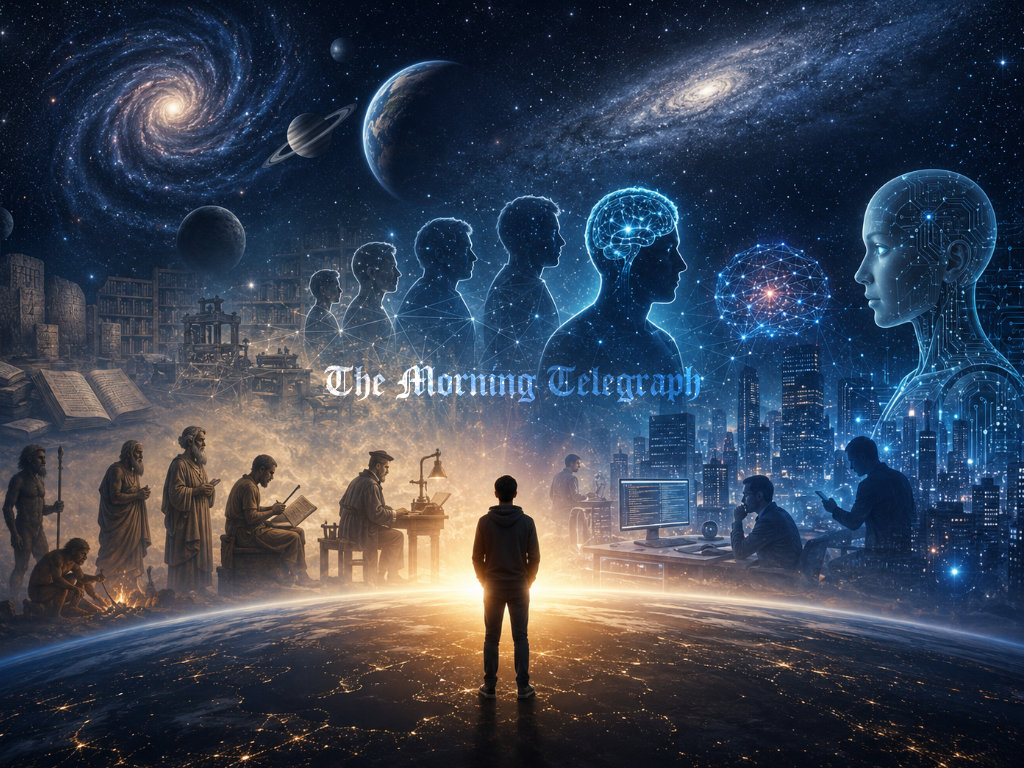
When viewed from this perspective, artificial intelligence becomes less a story about machines and more another chapter in the story of humanity itself. Our ancestors preserved understanding through spoken stories before committing it to writing. We carved knowledge into stone, wrote it upon parchment, filled libraries with books, established schools and universities, developed printing presses, telegraphs, telephones, radio, television, computers and the internet. Each generation found new ways to preserve what it had come to know so that the next generation could begin its journey a little farther along than the one before it. Artificial intelligence now joins that long continuum. It has not replaced humanity’s conversation. It has become one more way in which that conversation continues.
The distinction between knowledge and wisdom has therefore become increasingly important to me. Knowledge helps us understand how the world works. Wisdom asks us how we should live within it. Knowledge enables us to build extraordinary things. Wisdom reminds us why we are building them in the first place. Knowledge expands our capabilities. Wisdom quietly shapes our humanity. History repeatedly reminds us that humanity’s greatest challenges have rarely resulted from a lack of intelligence. More often they have arisen when intelligence advanced more quickly than wisdom.
When I reflect upon my own lifetime, I realise how extraordinary humanity’s journey has already been. I have lived through handwritten letters, telex machines, fax machines, personal computers, mobile phones, the internet, smartphones and now artificial intelligence. Each innovation transformed the way we communicate, yet beneath every change something remarkably familiar remained. Human beings were still trying to understand one another. We were still trying to preserve knowledge, solve problems, build relationships and pass understanding from one generation to the next.
The tools changed.
Humanity did not.
That realization has become one of the quiet foundations of my thinking. Every generation inherits a little more knowledge than the generation before it, but every generation also inherits the same responsibility. We must decide what kind of world that knowledge will help create. We must decide whether our discoveries will deepen our compassion as much as they expand our capabilities. We must decide whether our progress will be measured only by what we invent or also by who we become.
As I have reflected upon these questions over many years, I have gradually become less interested in predicting humanity’s future and more interested in understanding humanity itself. New discoveries will continue. New technologies will emerge. Future generations will almost certainly know things that today remain beyond our imagination. I welcome that journey because curiosity has always been one of humanity’s finest qualities. Yet I hope that alongside every expansion of knowledge there is an equally determined expansion of humility, responsibility and compassion. Without those qualities, knowledge risks becoming little more than power. With them, knowledge becomes wisdom in service of humanity.
The remarkable achievement is not simply that we have created systems capable of processing extraordinary amounts of information. The remarkable achievement is that countless generations of ordinary human beings, most of whom history will never remember by name, patiently observed, questioned, discovered, taught, corrected and passed their understanding forward until such a creation became possible. That may be one of the greatest examples of humanity working together across time.
When I think about humanity’s future, I no longer measure our progress only by our discoveries. I find myself thinking more about our character. Every advance in knowledge enlarges our responsibility. Every new capability asks us to become a little wiser than we were before. The universe does not ask this of us. Humanity asks it of itself.
The older I become, the less interested I am in certainty and the more interested I become in understanding. Certainty often brings conversations to an end. Understanding invites them to continue. Humanity has always progressed because people remained willing to question what they thought they already knew, to remain open to new observations and to revise their understanding when evidence or experience invited them to do so.
Our journey has never been simply about discovering the universe.
In trying to understand the universe, humanity has slowly been discovering itself.
That thought has gradually become one of the foundations of my own understanding. We often speak as though the universe is something separate from us that we are attempting to explain. Yet we are part of that same universe. Every observation we make, every question we ask and every discovery we celebrate is also revealing something about ourselves. It reveals our curiosity, our imagination, our perseverance, our capacity to cooperate across generations and our enduring desire to seek understanding rather than remain satisfied with ignorance.
When I now stand beneath the night sky, I no longer feel that I am simply looking into space. I feel connected to every human being who has ever stood beneath these same heavens wondering about life. Across thousands of years our civilizations have changed, our understanding has deepened and our technologies have transformed the way we live. Yet beneath all of those changes something beautifully familiar has remained. We continue to wonder. We continue to seek. We continue to learn. We continue to hope that those who follow us may inherit a clearer understanding than the one we ourselves received.
I have come to believe that this may be humanity’s greatest inheritance. Not our buildings, Not our wealth, Not even our inventions,
Our understanding.
Everything humanity has ever come to know has been entrusted to those who follow. We inherit questions together with answers. We inherit wisdom together with mistakes. We inherit discoveries together with responsibilities. Every generation becomes both a student of the past and a teacher of the future.
The universe has given us no guarantee that we will ever fully understand it. It has simply given us the privilege of wondering. It has given us curiosity, imagination, compassion and the remarkable ability to pass understanding from one generation to another. Perhaps those gifts are not separate from our place in the universe.
Perhaps they are our place within it.
We are not the center of the universe.
We are a part of the universe that has learned to ask where it belongs.
To me, that is where our human orbit begins.
Author’s Note
The reflections within Human Orbit in the Universe are not offered as conclusions but as an invitation to continue one of humanity’s oldest conversations. They are written from the understanding that our knowledge will continue to evolve and that every generation inherits both the wisdom and the unanswered questions of those who came before.
My hope is not to persuade readers toward a particular philosophy or worldview, but to encourage thoughtful reflection on what it means to be human, how we have come to know what we know and how that understanding shapes the way we live with one another and within the universe we all share.
Truth does not depend upon our understanding of it. Our understanding grows as we continue seeking truth with humility, curiosity and compassion.
If, after reading these reflections, you pause for a moment to look upward with renewed wonder, inward with greater honesty or toward another human being with deeper understanding, then they will have fulfilled their purpose.
About the Author
Roshan Jayasinghe is a writer and observer of human systems. His work explores the gap between man made constructs and lived humanity, with a focus on how economics, trade and everyday choices intersect with questions of fairness, responsibility and inner alignment. Through essays for publications in The Morning Telegraph, he aims to remind readers that they are not passengers in a fixed machine, but active custodians of a shared world.